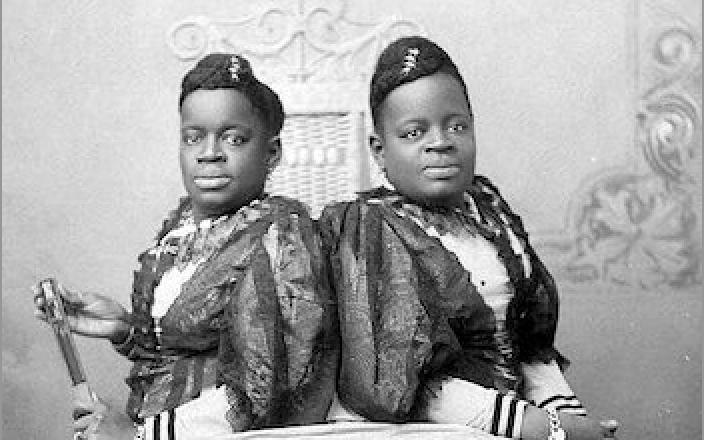
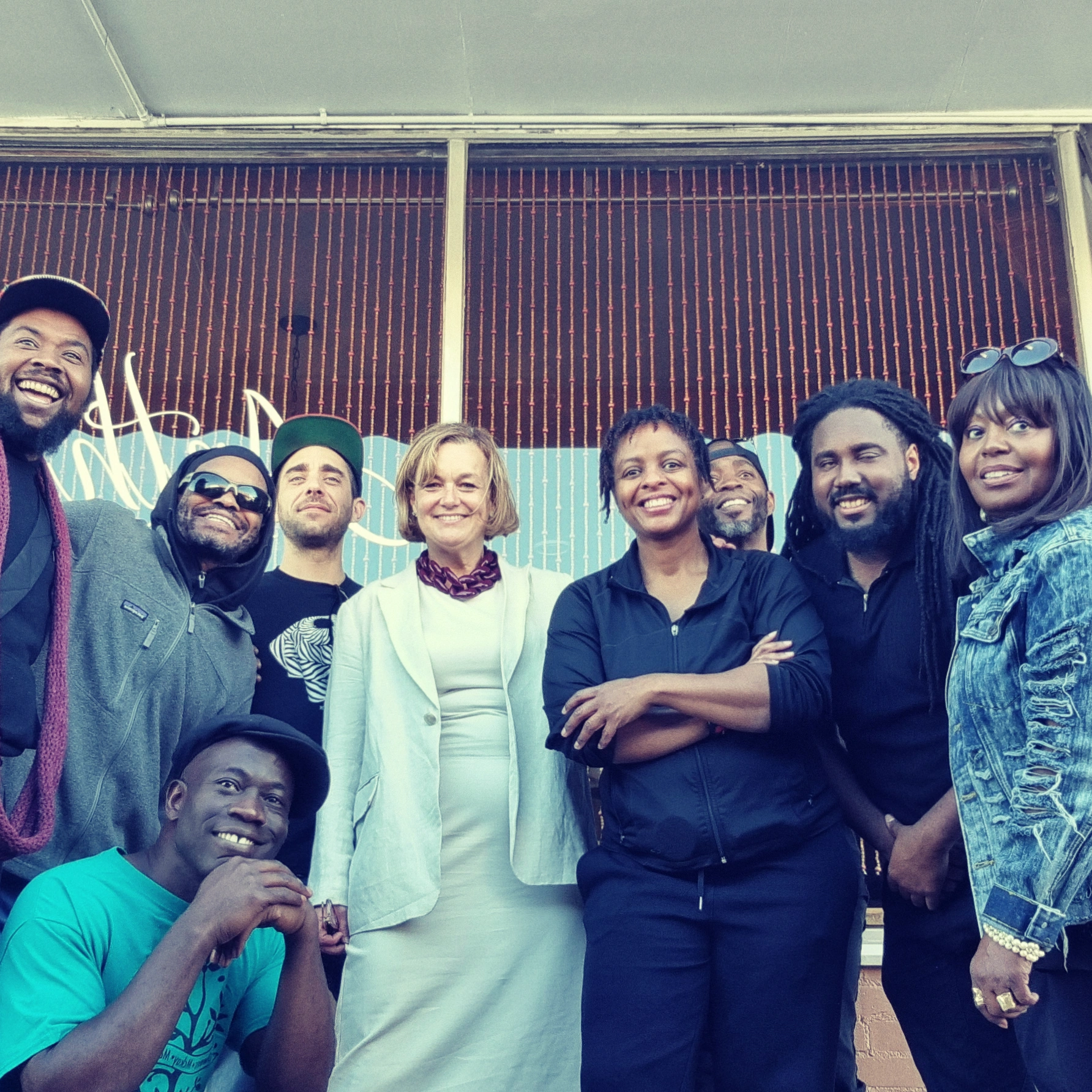
Earlier this fall, I was invited to celebrate Millie-Christine Day in Whiteville NC. It was a quite spectacular occasion. For the first time hiphop artist, musician, poet, and activist Napoleon Maddox brought the full production of Twice the First Time, a performance that celebrates the life of conjoined twins Millie-Christine McKoy and gives form to persisting marginalization, oppression and violence connected to racism and ableism, to the community in which they were born.
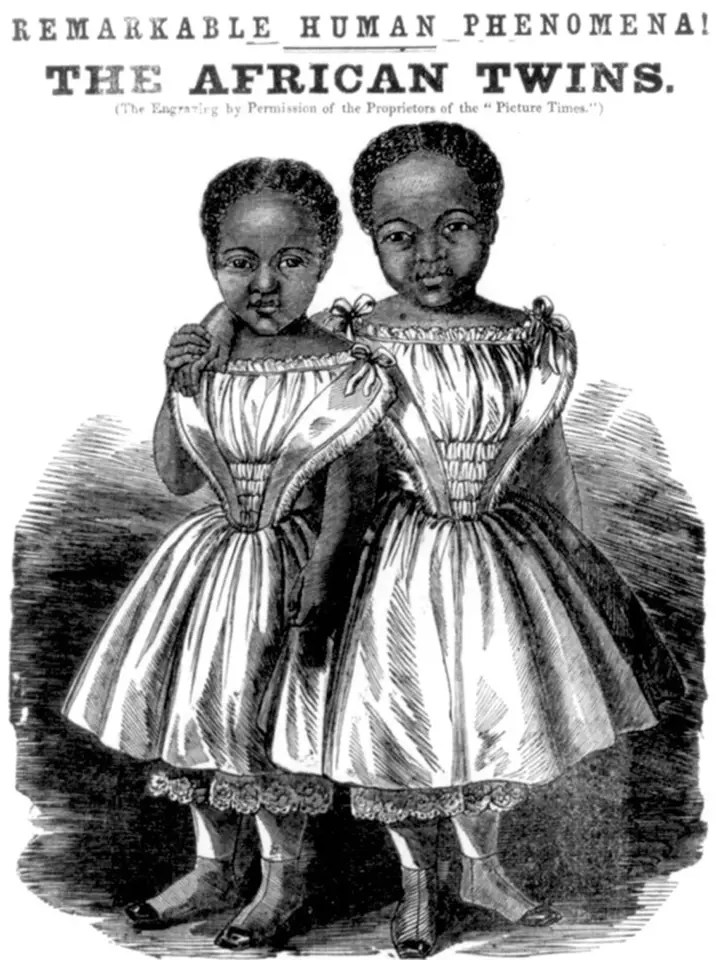
The story of Millie-Christine McCoy is extraordinary. They were born as conjoined twins to their enslaved parents Jacob and Monemia McKoy, near Whiteville, NC in 1851. They were sold for the first time at the age of 10 months, an event that was just the first in a string of sales, trades, trafficking and kidnapping for the purpose of exhibiting the girls in fairs, freak shows, circuses, and museums across the US and Canada. For example, they were exhibited in the P.T. Barnum Museum in downtown Manhattan along with other people with unusual pathologies and disabilities. Eventually they were trafficked to Liverpool by Joseph P. Smith, and that is where their mother finally located them in 1857. Millie Christine would have been between five and six years old at the time. After the emancipation proclamation, Millie-Christine gained more agency and autonomy but remained in the “care” of the Smith family, and continued to appear at similar shows and museums as before, but now with the ability to keep some of their earnings. They were also examined by medical doctors. They learned several languages, toured the world singing, and became known as the “the two-headed Nightinggale” with Millie singing alto, and Christine soprano. In their performances they turned their disability into an asset and the particular gait they had developed to walk, was developed into a dance. The complexity of their lives illustrates the entanglements of agency, subjectivity and autonomy with dependency, objectification and exploitation – and between popular culture and science in a zeitgeist permeated by racism, classism, sexism, and ableism in this Victorian world. Meanwhile, Millie-Christine self identified as “beautifully and wonderfully made” as a testimony to the fact that the deepest form of resistance in an oppressive system, is the conviction of one’s humanity, dignity, and right to self definition.
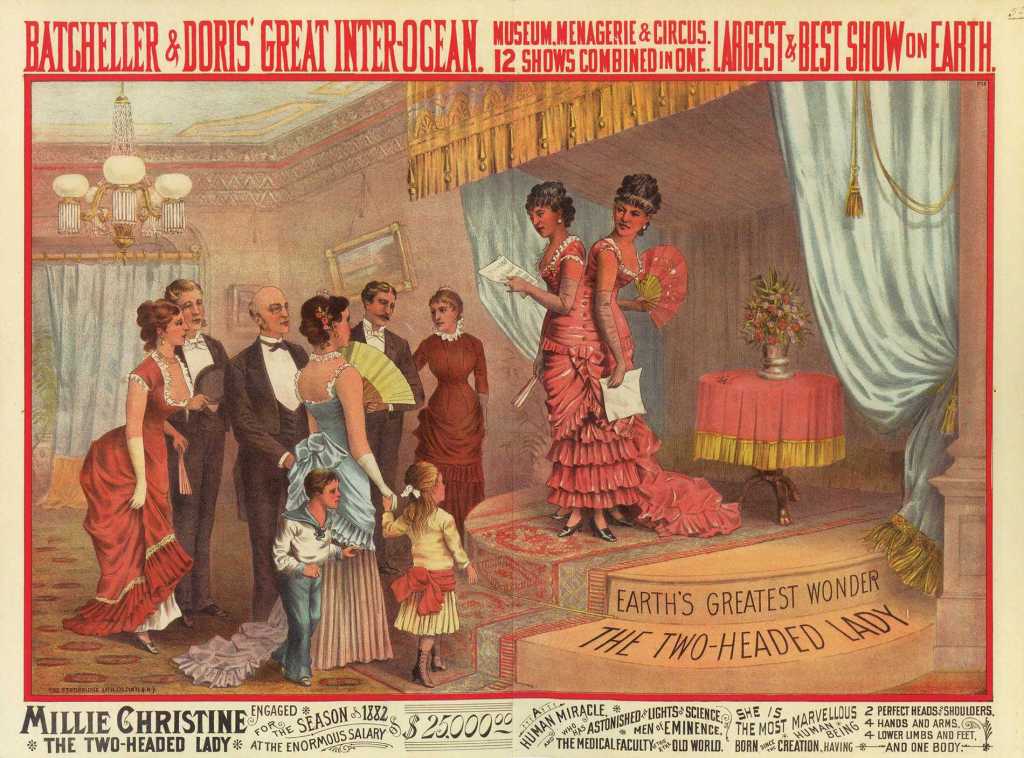
Toward the end of the 19th century, Millie-Christine toured less, returned to Whiteville NC, and settled down in a big 14 room house that they were able to build with their earnings. Millie-Chirstine died in 1912, and since 2012 the city of Whiteville celebrates them every October on Millie-Christine Day, when their many ancestors and family member honor their memory and legacy.
In 2017, one of Millie-Christine’s descendants, award winning composer, vocalist and hip-hop artist Napoleon Maddox was commissioned by the Cincinnati Contemporary Arts Center to create a piece as part of their Black Box series. The result was the extraordinary performance piece Twice the First Time, where Maddox wrote the lyrics to music composed by French musician, composer and music producer SORG . This year Maddox and ISWHAT?! performed Twice the First Time during Millie-Christine Day, along with other community performances, speeches, and commemoration activities.
I was honoured to be invited to participate in the program of Millie-Christine Day this year. My quite open brief was to bring an academic dimension to the event and discuss the international impact of the story of Millie-Christine. I had invited Napoleon Maddox to Linnaeus University in 2019, where he had given lectures and engaged both at the university and in a local high school, and it was my honor to share how impactful that work had been. In addition, I wanted to connect the story of Millie-Christie to the ideas that I have formulated as part of Ethical Entanglements and discuss them with the community in Whiteville, thus bringing Ethical Entanglements into new kinds of conversations. My talk focused on drawing parallells between Millie-Christine McKoy and Christina Larsdotter and discuss how micro-histories in very different parts of the world are pathways to understanding both global history and the human experience, which is always at the center of my own work as an archaeologist and anthropologist. The following community dialogue further explored these connections, both between the two cases, and between the scholarship and Napoleon Maddox’s lyrics.
The parallels of the fates of Millie-Christine and Christina Larsdotter are striking. In life they all performed on 19th century stages that beyond their vocalist performances also showcased their disabilities and “racial” features as curiosities. While Millie-Christine’s body was stolen and trafficked in life, that of Christina Larsdotter met the same fate after death, as her corpse was stolen from her grave, and transported to Karolinska Institutet to become incorporated in the study collection of Anders Retzius (read more about the Retzius legacy at Karolinska Institutet here, and here), cast in a post mortem role not unlike the “freak shows” and exhibitions of curiosities (scientific and otherwise) that used to take advantage of Millie-Christine in their early lives. But in the face of the violence committed against these women by science and popular culture in their lifetime, they possessed both autonomy and independence, and claimed their place as strong individuals in their respective communities (e.g. as home builders, land owners, and active community members). The contrast between this indisputable agency, and the role as objects of curiosity forced upon them, is demonstrated in their histories. In that sense they also illustrate the spectrum model of Ethical Entanglements, and serve as a reminder of our responsibility today to keep recognising the lived life in the human remains we study, and of our “duty to past persons” (to paraphrase the title of Malin Masterton’s thesis) as a fundamental aspect of our professinal ethics. The repatriation and reburial of Christina Larsdotters remains this past spring is also a reminder of what it can mean for all stakeholders to recognise these histories and take responsibility for them and the pain they have caused.

 Ethical Entanglements