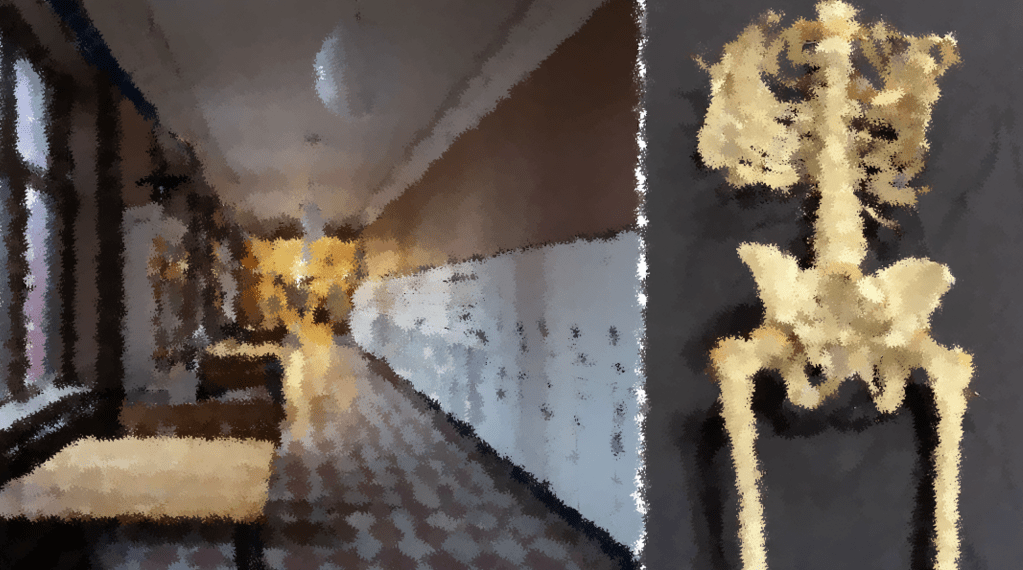
After the discovery, the display was removed, and the school started an investigation that consulted an outside specialist. After examining the remains, the specialist could confirm: these were the remains of a human. But since the consultation was only osteological, its provenance remained unknown. It would require a lot more work to trace who the person whose bones were examined had been in life. This is not unusual. Typically, human remains in schools have a long and complex history that is poorly documented and often forgotten. They were acquired many decades ago, and may have circulated between collections, and changed schools. The Danderyd Highschool now faced the same problem that many Swedish schools have faced before: what should they do with these remains?
Press photos from inside the Danderyd High School and of the skeleton that was used as a Halloween prop. The photos have been intentionally blurred for this blog.
As I have argued in the article Between Objects of Science and Lived Lives. The legal liminality of old human remains, human remains from historic contexts are situated in a legal gray area, and there are no clear laws on how to handle them. For any school that suddenly discovers that they have human remains in their closets, it is difficult to know what the right thing to do might be. They can turn to the police, to museums, to the National Heritage Board, and even to the Swedish Church – and many do, and find that not only do these institutions not feel that this is their business, but also that nobody can really advise them about what to do. This conundrum has been discussed in this blog before, and the case of schools has also been the subject of excellent reporting by Swedish Radio in 2016.
“What is well intentioned may still be ill advised.”
In the case of the Danderyd skeleton, the decision has now been made that it will be cremated and buried in the local cemetery. While this, at first glance seems to be a well intended course of action, it is highly problematic since no provenance research has been carried out on the remains and we therefore have no idea if this would be desired or even acceptable for this individual. What is well intentioned may still be ill advised. To put it bluntly, this act is more about satisfying the needs of the school and the local community than the needs of the person whose remains were used as a prop by that very same community only a few weeks ago. This is not good enough.
In several interviews with Swedish Radio and TV I have argued that given that there is likely to be a large amount of human remains in Swedish schools, this is not a problem that is likely to go away anytime soon. What we need is a proper inventory of what is out there, so that we can get an overview – not unlike the inventory that was carried out in Swedish museums in 2016. Once we have an overview we can develop support and guidelines. Ideally, provenance research should also be carried out so that we know what any appropriate course of action might look like.
This is a big job that will require specialist competence. It is not fair to expect individual schools to take responsibility for this. The situation in Sweden is complicated by the fact that the administrative responsibility of schools has been decentralised from the state to the county level (kommun) in a reform in 1991. Is is safe to say that the large majority of the human remains in Swedish schools were acquired long before then, and the responsibility of this necessary inventory and research must therefore fall upon the Swedish state and in particular on the National Agency for Education (Skolverket). When confronted with this request from me in a TV interview on Nov 15, the National Agency for Education predictably punted the question to the county levels, who in turn decided not to respond to the journalists requests.
What happens next will be interesting to follow, and while the future is unpredictable, one thing is for sure: if we do not take responsibility for this problem now, we will have another story just like this one break in a couple of years, and we will start the debate over. Again.
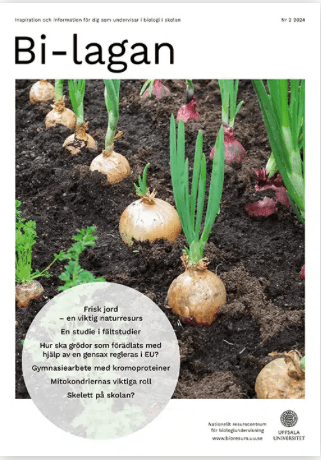
Update: Liv Nilsson Stutz published a short text in Swedish on the topic in Bi-lagan, a resource publication for biology teachers in Swedish schools, published by Uppsala University, in the fall of 2024.
Viewed from the outside, it often seems as if the Nordic countries are very similar in terms of culture and values. But despite their entangled political and cultural histories, and their cultural similarities, a closer look reveals interesting differences, and this is certainly the case for their professional attitudes to the ethics of collections of human remains.
The Nordic Network for Collections of Human Remains is an informal forum that organises different stakeholders in human remains collections, predominantly collection managers, but also researchers and museum professionals across the Nordic countries . The purpose of the forum is to provide a space for reflection and support in professional discussions and development of ethical practices. The Network organised a conference at Arkivcenter Syd, in Lund on October 26-27, 2023 (for full disclosure, Liv Nilsson Stutz has been a member of the steering group during the period 2020-2023, and was part of the organising committee for this conference). The purpose of the conference was to come together for the first time after the end of the pandemic, update one another on the state of the field in the different Nordic Countries, and strengthen both formal and informal ties and relationships throughout the community.
The conference invited speakers from several large collections across the Nordic countries to share their perspectives and experiences. Unfortunately the participant from Norway (Julia Kotthaus from De Schreinerske samlinger, at the Medical Faculty at the University of Oslo) had to cancel last minute, since she needed to prioritise her presence at a repatriation from the collection she manages. These presentations were inspiring in the sharing of protocols and experiences, but also showed the differences in approaches between countries.
Careful storage of human remains in a Swedish museum. Photo by Liv Nilsson Stutz (intentionally blurred).
The Danish model is interesting since it clearly separates ownership from deposition and curation. The former is held by local museums, while the latter is managed by essentially two centralized collections: ABDOU at the University of Southern Denmark (presented by Dorthe Dangvard Pedersen), and The human skeletal collection at the University of Copenhagen(presented by Niels Lynnerup, Marie Louise Jørkov, and Kurt Kjaer). This arrangement has interesting consequences for the management of processes. The facilities are all highly adapted for the preservation and study of human remains, and the research facilities support, track and assist in access to the collection by researchers, students, and even the public. It can be argued that this system that separates the human remains from their otherwise historical and archaeological context in order to prioritise preservation, control, and documentation, implicitly or explicitly categorises the remains almost exclusively as Objects of Science. It appears to be a very clear, but also unproblematising approach. The division has interesting consequences for the most significant case of repatriation of human remains in Denmark, Utimut – the repatriation of human remains and culturally significant objects to Greenland. The ownership of the human remains is now held by Greenland, but Greenland has elected to follow the same system for the management of collections of their human remains as that practiced for remains found on Danish soil, keeping them in Copenhagen. This case is always interesting to bring up in debates about repatriation since it is clear here that the Greenland side appears to share the same concerns for these remains as their Danish counterpart, and also feels that a practice that protects them as Objects of Science is valuable for them. But that does not mean that nothing has changed. There is a significant shift in the attitudes on behalf of the collection managers who do not claim control or ownership, but take the role as mediators and assistants. In this sense then, the Danish system is arguably more inclusive and progressive than in the rest of the Nordic countries, where ownership tends to be associated with the institution that holds the remains.
The Swedish system with decentralised practices and control was illustrated by presentations from two Swedish collections. The Historical Museum at Lund University was represented by Jenny Bergman and Sara Virkelyst who presented a newly established flow chart to systematically support repatriation processes in order to make them transparent and predictable for all stakeholders. The collections at the National Historical Museums were presented by Elin Ahlin Sundman. The issues of ethics appear to be top of mind for the Swedish institutions, but the decentralised practices result in great diversity in protocols and processes – which stands out as quite a contrast to Denmark.
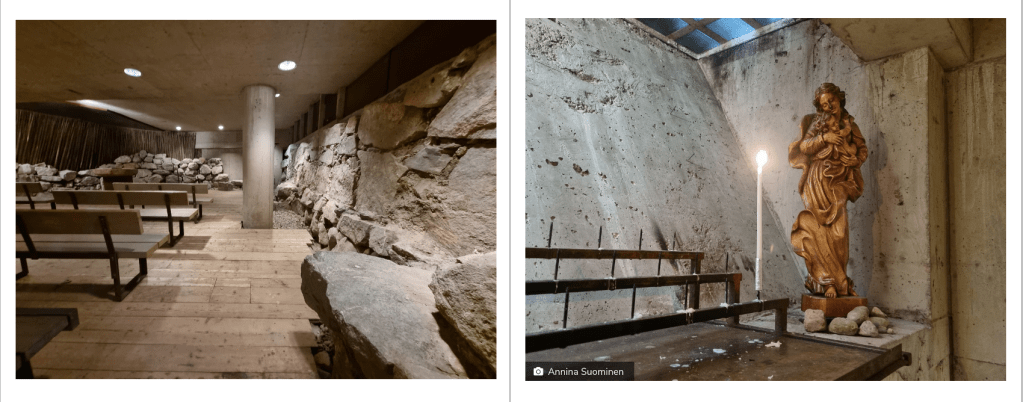
Images from inside the Chapel of the Holy Ghost in the basement of the Casagrande House in Turku, a semi private place of worship that also serves as a resting place for excavated human remains from the later medieval and early modern period. Photos by Annina Souninen, and published by Åbo Underrättelser.
Finland seems to have the least regulation and formalised processes for the care of collections of human remain at the moment. With a law that currently calls for decisions of future reburial to be made before an excavation has even started, human remains, in Finland, appear to be treated more toward the end of “Lived Lives” than in the other countries. They are often reburied immediately – sometimes even before osteological study. It should be added, however, that this position in reality is almost directly dependent on the chronological age of the remains, with prehistoric remains being systematically collected, and historical remains more often reburied. The decision is often made by local parishes who hold a lot of the power in these negotiations. Liisa Seppänen from the University of Turku presented a hybrid solution with the case of the contemporary chapel in the Casagrande House in Turku. The historic building, previously known as Ingmanska huset, was built in the 17th century at the previous location of a Graveyard of the Holy Ghost Church in Turku. After being threatened with demolition in the 1980s, the architect Benito Casagrande purchased and renovated the building under supervision of the Finnish Heritage Agency, and it now includes businesses, shops, and restaurants. The remains of the people buried in the underlying churchyard (from the 14th century and to 1650) were excavated in consecutive projects from the 1960s and through the 1980s, and were collected by a dentist at the university who kept them as a teaching and research collection (predominantly the crania). After extensive lobbying, Benito Casagrande, managed to have the remains transferred from the university to a newly built chapel in the basement of the house, where they can both rest in a sacred space and be accessible for research. The chapel is not open to the public, but can be visited upon request. A small working group, of which Casagrande is a part, oversees the collection and makes decisions with regards to access and curation. The impact of a private citizen is, to say the least, quite extraordinary in this case – but perhaps this is not as difficult to reconcile in a system with a tradition of consultation with the leadership of local parishes. From a more traditional collection manager point of view, Risto Väinölä discussed he human remains collection at the University of Helsinki (LOUMUS) which is a heterogenous collection with a long and diverse history of collection, with potential for research but with limited manifested interest both on behalf of researchers and calls for repatriation.
In addition to the presentations of the state of the field in the respective countries, I also want to highlight two more conceptual papers. Karin Tybjerg from Medicinsk Museion in Copenhagen presented an interesting paper on historical medical collections as a foundation for amemnesis – the clinical medical process of recovering the medical history, usually referring to patient history, to understand medical states in the present, but here expanded to include a broader investigation into the field of medical science, medical history and medical humanities (she has published these ideas in an interesting paper in Centaurus 65(2), in 2023). Equally interesting was Eli Kristine Økland Hausken‘s paper Adressing Bare Bones and Human Remains about her work with exhibitions at the University Museum of Bergen and the underlying ethos of their activities to engage the local community by “lifting the curtain” on the process knowledge production and the history of institutions. I was somewhat surprised at the choice to exhibit a shrunken head, a South American Tsansta (an issue that has also been debated by curator Åshild Sunde Feyling Thorsen from the same intitution), and while I am personally not convinced, I was interested in the arguments in favour of making such an unconventional choice today.
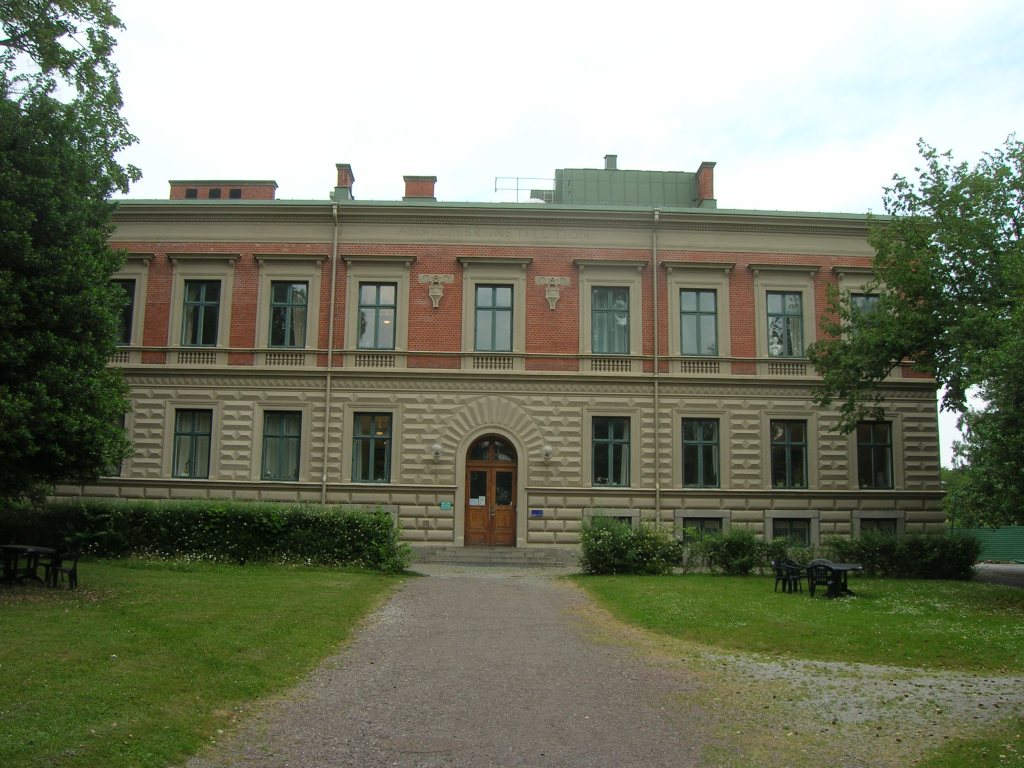
The Old Department of Anatomy at Lund University. Image by Väsk, licensed under CC BY-SA 3.0.
During the course of the conference, three panel talks explored several fundamental issues for the care of collections of human remains. The following topics were explored:
Panel 1: What is the value of collections of human remains? This panel explored the broader topic of the value of these collections for science, pedagogy and history in a time when they are increasingly questioned. Are they valuable? And if so, how?
Panel 2: How to make the collections accessible (including perspectives on digitalization, exhibition, and access for researchers). Should we? And how best to do this?
Panel 3: Accession and deaccession. What are our current challenges? This panel talk will discuss the responsibility (and cost) of accession and deaccession, and discuss the connections to repatriation and (re)burial.
Throughout these conversations it became clear just how entangled these issues really are. The final discussion, on accession and deaccession, also linked up the the local history of anatomy in Lund where a large part of the old and seemingly “worthless” or “problematic” collections from the Department of Anatomy were unceremoniously discarded in 1995 when the department was closed down permanently. Some remains were transferred to the Historical museum (the institution that received most of the skeletal remains) and to other institutions that had previous ownership of remains in the collection, but a shocking amount of wet specimen, ended up in containers to be destroyed or haphazardly collected from the street by private people, potentially to take on another life, now even more in the shadows and even further removed from ethical care. The date, 1995, serves as a reminder that it is not that long ago that these issues were hardly problematised at all.
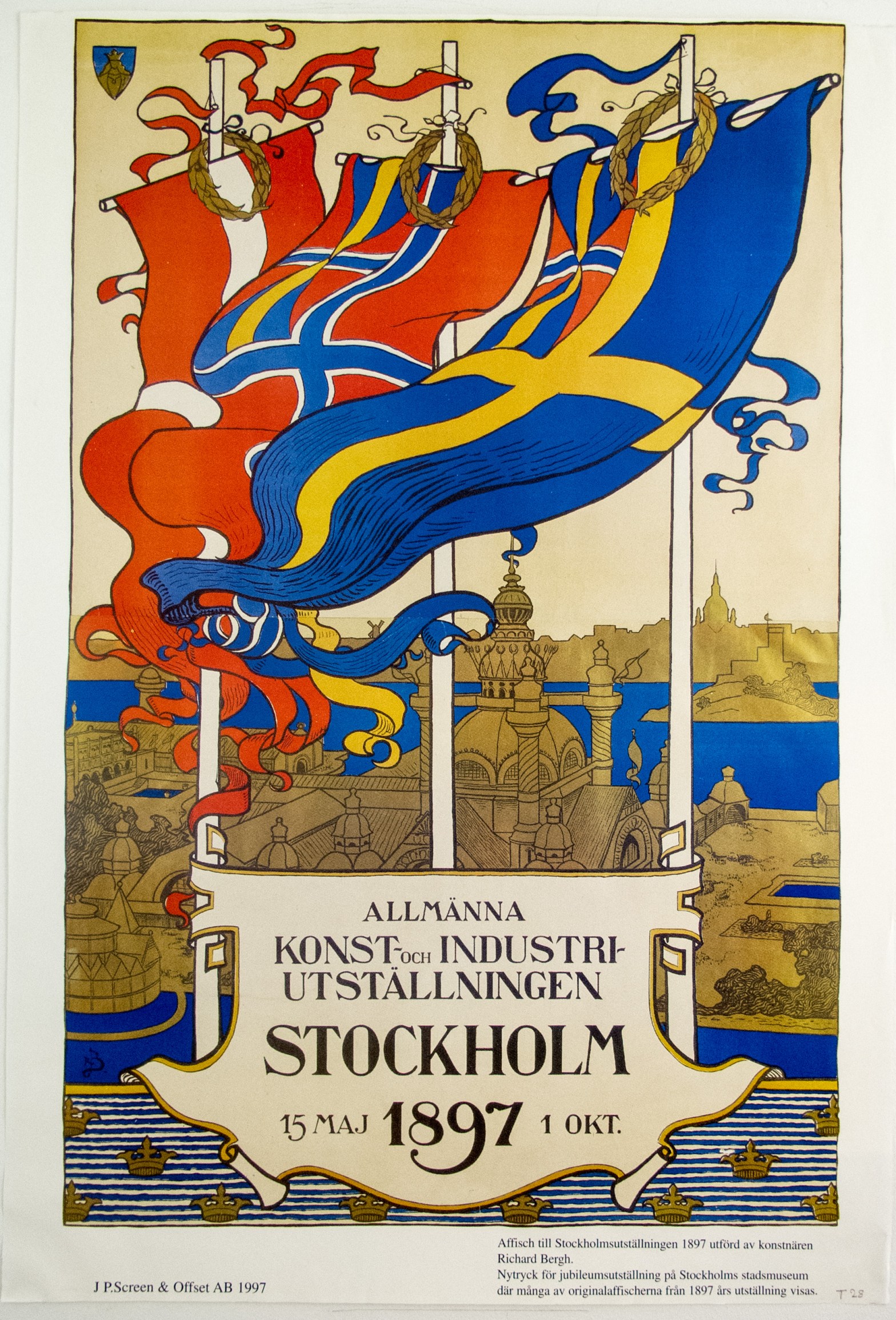
Featured image: Poster for the General Art and Industry Exhibition in Stockholm 1897 (licensed CC BY-SA 4.0). While this poster from the 19th century shows a different political reality, it can be veiwed as a good illustration of the continued entanglement of the Nordic nation states.
When we discuss ethics with regards to human remains in archaeology and history, we tend to focus on the present, its challenges, its needs, and its sensibilities. How to best care for human remains in museums and research is indeed the fundamental question for Ethical Entanglements. But, what about in the past? How did people in the past feel about opening tombs and graves; how did they practice exhumation, what did they think about it, and what debates surrounded this practice? How can the insight into past experiences, values, and practices, be helpful tools as we encounter historic human remains in the present?
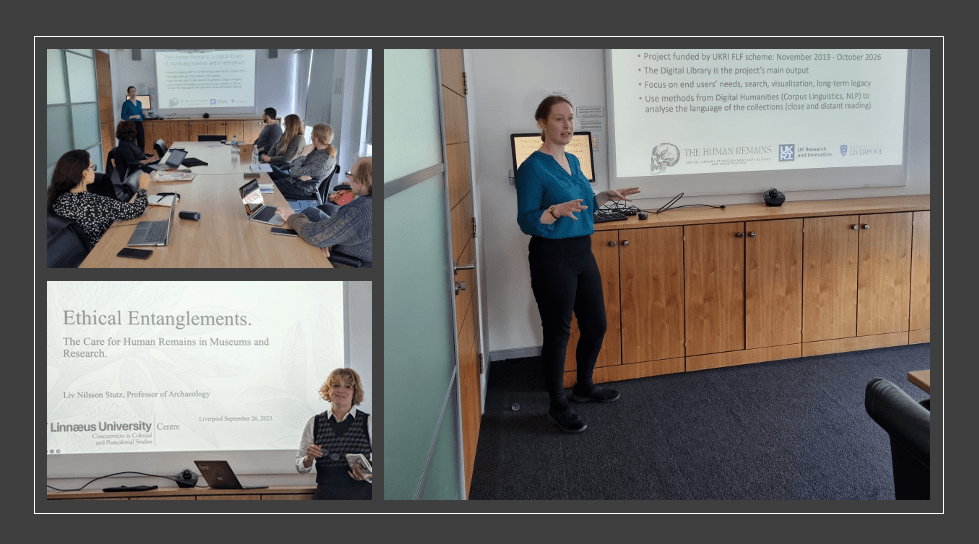
Presentations and discussions with the project teams of The Human Remains and Ethical Entanglements at the University of Liverpool. Photos by Liv Nilsson Stutz and Rita Peyroteo Stjerna.
This impressive research project aims at investigating the history of exhumation, investigation, reburial, and recording of human remains from Christian contexts in Britain from the 7th to the 19th century. The project creates a corpus of knowledge and references that will be of great value, both for interdisciplinary academic scholarship for anybody interested in historical practices and attitudes to death, the body, decay, the afterlife, etc – but also as a support for professionals working in contexts where they encounter historical human remains from Christian contexts, including museum professionals, contract archaeologists, and cathedral managers and workers.
On September 26, the Ethical Entanglements Team had the pleasure to spend an afternoon with The Human Remains Team (Ruth Nugent, James Butler, Glenn Cahilly-Bretzin, Katherine Foster, and Thomas Fitzgerald). After a general introduction of the two projects by the PI:s, we launched into a discussion on a range of topics where we found that the two projects share overlapping research interests, including asking what it means to treat human remains “with respect,” and how our research can best support decision makers today in their encounter with human remains – whether it is people working in contract archaeology, cathedrals, or museums. We also discussed how the context may affect the professional ethics and reflection, and what one context can learn from the other. Our conversations explored how to handle contemporary anxieties around human remains, and the elusive yet central concept of “respect” with regards to historic collections and professional ethics.
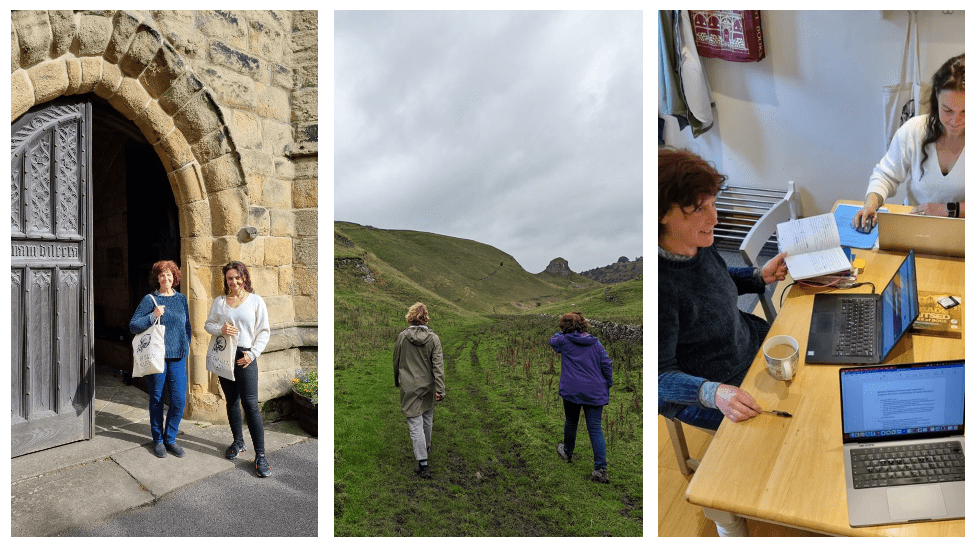
Left to right: Sarah and Rita in front of the church in Tideswell; Liv and Sarah on the path to the gibbet site at Peter’s Stone – a prominent feature in the landscape of Cressbrook Dale in Derbyshire; Sarah and Rita writing at the cottage in Tideswell. Photos by Liv Nilsson Stutz and Rita Peyroteo Stjerna.
After the visit at the University of Liverpool, the Ethical Entanglements team spent a few days on a writing retreat in the Peak District. Between writing sessions at our small cottage in Tideswell, we made visits to local sites that inspired us to think about several dimensions of past practices. At the the beautiful local church in Tideswell we saw a small but dynamic church community that, as indicated by large fundraising signs posted in the church yard, struggled to make ends meet as they cared for both a living community and a rich cultural heritage. If you are dealing with the considerable financial burden of keeping up your historic church buildings, the care for the dead buried in the church yard, under the floors, and potentially elsewhere, is presumably a factor you must always consider, and one that is not always easily solved. A visit to the historic gibbet site Peter’s Stone in Cressbrook Dale inspired us to think about the historic practice of extending criminal punishment beyond death to affect the corpse through violence and humiliation, a topic Sarah has written extensively about in her book (with Emma Battell Lowman) Harnessing the Power of the Criminal Corpse. While local history and folklore seems to offer different accounts in the details, the corpse of a murderer was gibbeted here after being hanged for the crime of murder. A quote form “Worm Hill – the History of a High Peak Village” by Christopher Drewry sums up the economy of death and punishment, the public spectacle of the gibbeting as meaningful (and popular) cultural practice, and the landscape of dread that would have been at least part of the characteristic of places like these (see also The Landscape of the Gibbet by Sarah Tarlow and Zoe Dyndor 2015):
The costs of this horrendous ritual were not insubstantial – £31-5-3 for the investigation leading up to the arrest; £53-18-8 for the gibbeting and £10-10-0 for the gaoler and escort from Derby to Wardlow. Such was the public fascination with the event however that the vicar of Tideswell found none of his congregation in church on the day of the gibbeting but all of them and more at Wardlow where he took the opportunity of delivering a sermon of fire and brimstone under the gallows. Lingard’s skeleton is alleged to have hung on the Wardlow Mires gibbet in chains until it was finally removed 11 years later on 20th April 1826 after complaints about the gruesome chattering of the bones in the wind. The site of this hanging would have been the so-called Gibbet Field at Wardlow Mires where other hangings are reputed to have taken place earlier, including one of a notorious highwayman called Black Harry who was finally apprehended in Stoney Middleton Dale in the 18th century.
Beyond the contextual, there is something here – something about how despite the fact that gibbeting was a sanctioned cultural practice, also teaches us that even across that cultural divide, there was a line that was being crossed. Deliberately.
In addition to providing a beautiful walk, this place provides a concrete experience to think about the passing of time and the changes in culture, and inspires us to reflect if there is such a thing as an ethical fixed point to provide support as we reflect on what it means to be ethical when handling old human remains.
Featured images: Left: Walking toward Peter’s Stone; and Right: the Red Brick Building at the University of Liverpool, photos by Liv Nilsson Stutz and Rita Peyroteo Stjerna
On July 25 (2023), the International Journal of Heritage Studies published (open access) the article “Between Objects of Science and Lived Lives. The legal liminality of old human remains” by Liv Nilsson Stutz, which is the first major article published for Ethical Entanglements. The article serves several purposes: 1) it presents a summary of the results from the survey of Swedish museums practices; 2) it reviews Swedish law with regards to the handling of different categories of human remains; and 3) it frames these analyses within the theoretical model that views human remains as moving along a spectrum between objects of science and lived lives – a theoretical foundation for Ethical Entanglements:
To capture the complexity of the category ‘human remains’, conceptually, legally, and scientifically, our research project ‘Ethical Entanglements’ relies on a model that sees them as moving on a spectrum between being objects of science and lived lives. This model is not intended to lead to any conclusion about how they should be handled, or define how we personally view them, but rather to capture the range of how they historically have been, and still are perceived, categorised, and handled – from the view of the remains as being a relative or an ancestor, to a view represented by the practice of predominantly scientific collection and curation – as objects to be studied. In between lies the range of levels of entangled object- and subjecthood that resonates through all the different aspects of the ethical challenge. Where along the spectrum, between object and subject, any given human remain is perceived to be located depends on several factors including provenance, research history, level of familiarity, level of information, state of preservation, and age, but also current political and cultural debates, cultural concerns, religious and spiritual convictions, and political needs.
The review of the legal instruments clearly demonstrates that there is a distinction made between the recently dead whose remains are covered by laws regulating medical practice, medical research, declaration of death, and burial – and old human remains, which are reduced to cultural heritage, often by proxy to remains resulting from living people’s actions – such as burials practices, commemorative practices, or ritual practices. The recently dead are viewed as subjects, the long dead as objects. But both researchers and the public know that it is not quite that simple.
In the front: The remains of a 7-year old child, with evidence of hypoplasia on the tooth enamel indicating stress related to food insecurity or possibly disease. In the back: a child cranium with healthy teeth. From the Nesolithic collective burial in Rössberga. Exhibition at the Swedish History Museum. Photo by Liv Nilsson Stutz. Intentionally blurred.
The article demonstrates that there is no real support in law, or in professional ethical guidelines that recognises this complexity, and this is a problem for several reasons:
“Are old human remains people, or are they heritage? How should they be treated in museums and research? While research practices, museum practices and public debates increasingly recognise the complex nature of old human remains as both objects of science and lived lives, this study shows that there is no consensus – neither in law nor in guidelines – on how to handle this development. The research on old human remains is a largely unregulated field. This is a problem for mainly two reasons: First, it leaves both museums and researchers working with old human remains vulnerable to critique from the public, especially from a post-colonial perspective questioning the right of research to treat the remains of people as objects of science. This critique is valid but can still be nuanced since many museum professionals and researchers share the sensibilities of human remains being a more complicated category than neutral objects. Second, the lack of standardised protocols for reviewing access to human remains for destructive sampling (Alpaslan-Roodenberg et al. 2021), and for sharing potentially sensitive data, risks causing unnecessary stress, potentially create conflicts, and in the worst case, may cause damage to valuable and sensitive remains.“
Nilsson Stutz, L. 2023: Between objects of science and lived lives. The legal liminality of old human remains in museums and research, Intl. Journal of Heritage Studies.
For the purposes of Ethical Entanglements a final challenge is viewed as central:
“…the review of both laws and practice identifies an inconsistency in the categorisation of human remains where old human remains from indigenous people are considered with more care for their subjectivity than human remains from non-indigenous contexts. This is a problem because it risks restricting the ethical debates to specific groups, while leaving other categories of old human remains completely unproblematized.”
Nilsson Stutz, L. 2023: Between objects of science and lived lives. The legal liminality of old human remains in museums and research, Intl. Journal of Heritage Studies.
The article proceeds to proposing possible ways forward of strengthening the professional ethics in the handling of old human remains in museums and research. Beyond new guidelines and legal frameworks, it is argued, we need clear processes that in turn will strengthen the ethical awareness within the field.
featured image: anatomical preparation showing a head with superficial musculature, and the nerves of the face. Exhibited at the University Museum in Groningen. Photo by Liv Nilsson Stutz (intentionally blurred).



 Ethical Entanglements