On 29 August, Rita Peyroteo Stjerna (Uppsala University) and Mari Tõrv (University of Tartu) chaired the roundtable “Academic Feudalism”: Research Ethics and Sustainability in Biomolecular Archaeology at ISBA11 in Turin. The session focused on ethical and sustainable approaches to cultural heritage research through the lens of biomolecular archaeology.
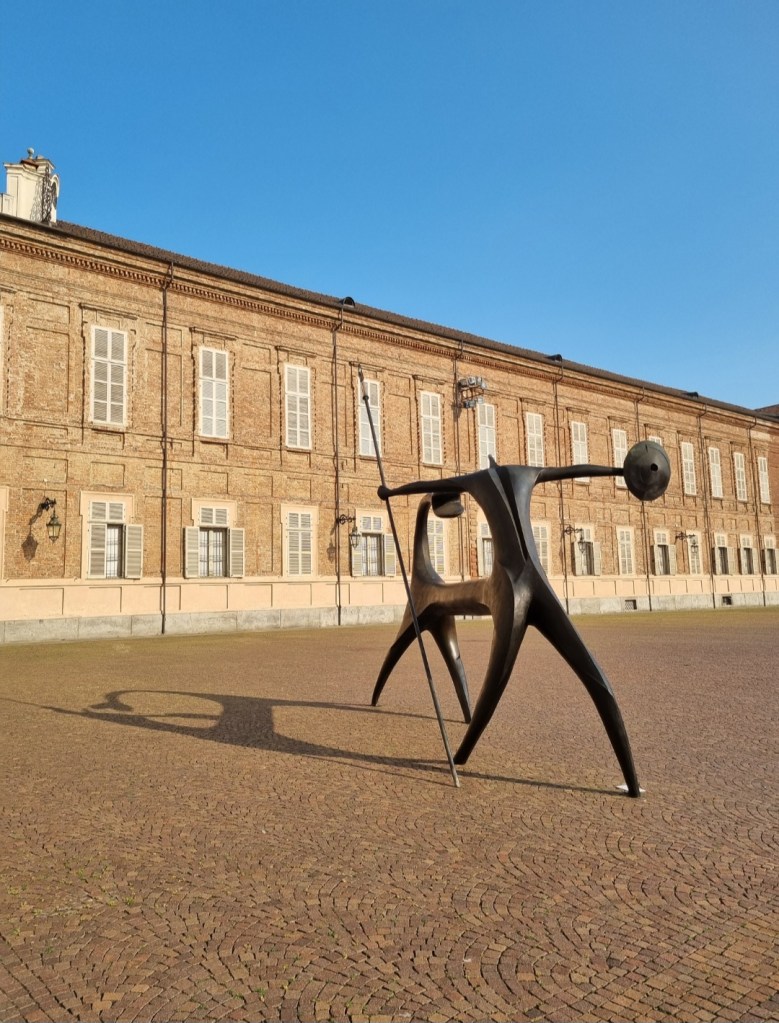
Turin. Photo by Liv Nilsson Stutz
“Instead of a regular session, we proposed a roundtable with guest panelists from diverse backgrounds and career stages. Roundtables allow more time for discussion and sharing experiences. They’re a great way to openly address complex topics, and we believe we fostered a critical yet constructive dialogue on how the field can evolve by confronting ethical dilemmas at key stages of research.”
When ethics in biomolecular archaeology are discussed, the usual concerns often include destructive sampling – especially of human remains – and the role and rights of present-day communities. While these issues are essential and must remain part of ongoing conversations, professional ethics in our field extend far beyond them. This broader scope was the focus of our roundtable.
This year’s panel was structured around two inward-looking themes that examine our discipline and daily professional practices:
Unbalanced Relationships in Knowledge Production
Sustainability and Equity
We had over an hour for panel discussion, followed by audience questions and comments. The conversation could have easily continued much longer – audience engagement was high, and it was clear that many are eager to improve professional ethics in our field.
We’re deeply grateful to the six panelists who accepted our invitation – and our challenge – to share their insights and experiences:
André Colonese (Universitat Autònoma de Barcelona)
Audrey T. Lin (American Museum of Natural History)
Selina Carlhoff (Max Planck Institute for Evolutionary Anthropology)
Katerina Douka (University of Vienna)
Matthew Collins (University of Cambridge, University of Copenhagen)
Beatrice Demarchi (University of Turin), head organizer of ISBA11
We hope this session was as inspiring for participants as it was for us. Ethics is not a checklist – it’s a continuous, evolving process that demands attention, reflection, and engagement. As professionals, it’s our responsibility to keep this dialogue alive and confront the dilemmas that shape our field.
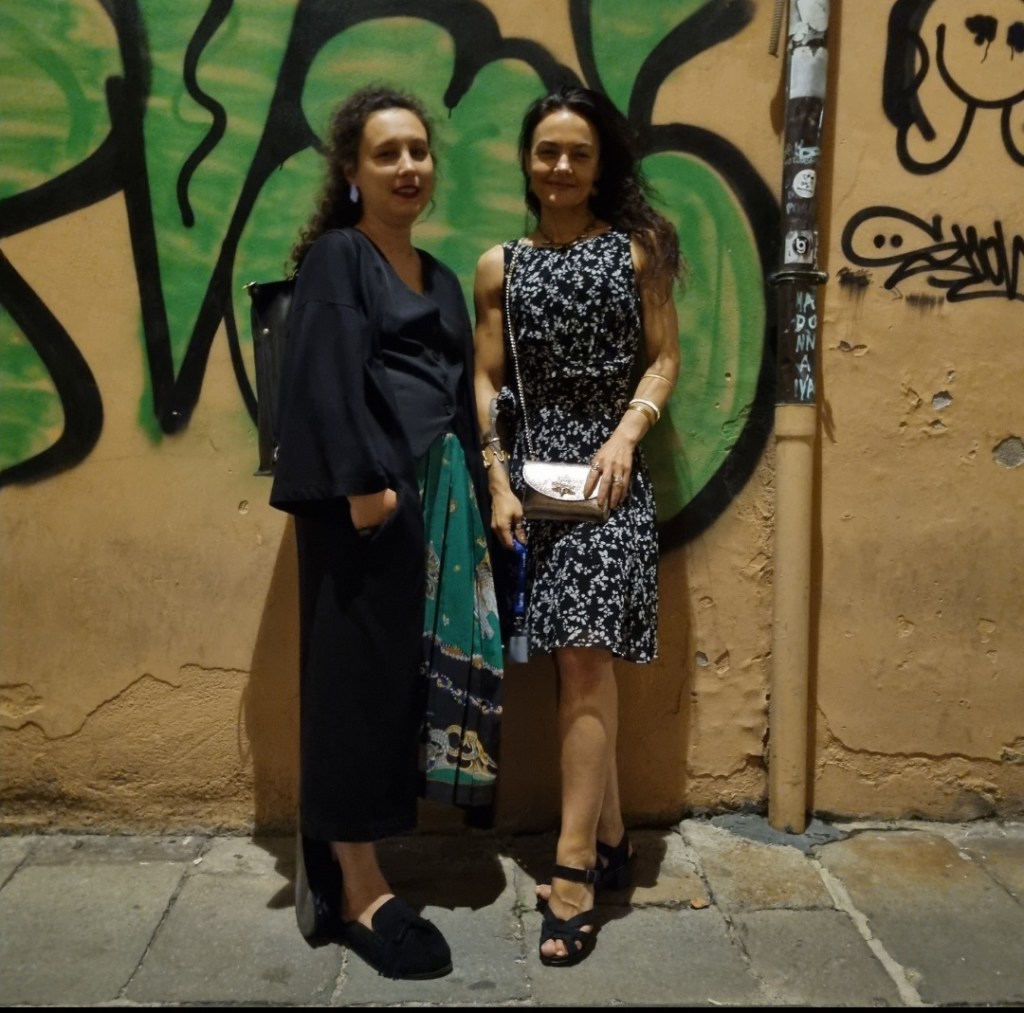
Mari Torv and Rita Peyroteo Stjerna. Photo by Liv Nilsson Stutz
We also hope this roundtable is just one of many, sparking ideas for how the community can carry this conversation forward – within departments, research groups, and future conferences. Whether through workshops, roundtables, or case discussions, it’s vital to learn from each other’s experiences – both the successes and the challenges.” – Rita & Mari
This initiative is part of Rita’s subproject “Researchers’ Perspectives” within the Ethical Entanglements project. She also served on the ISBA11 Scientific Committee, contributing to the Ethics subsection.
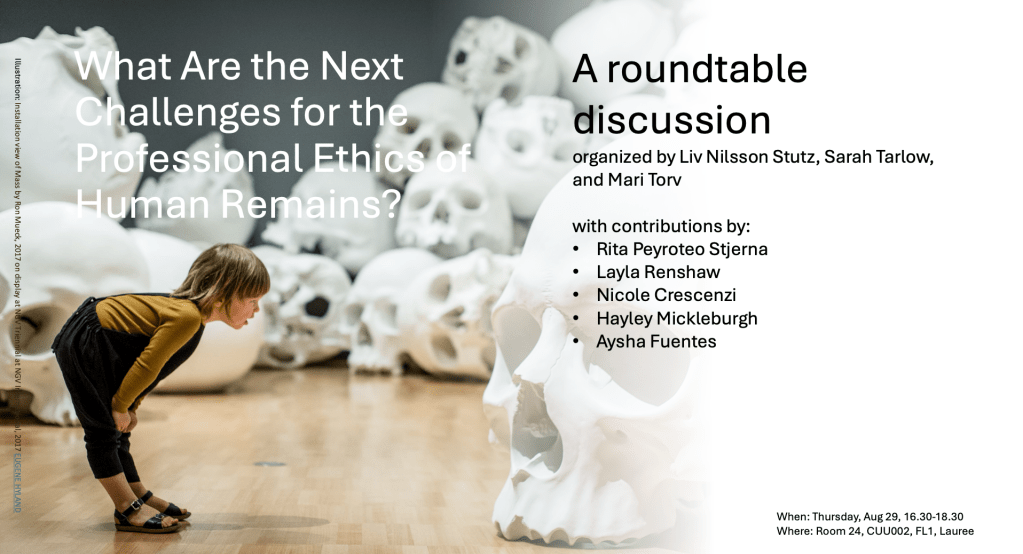
At the annual meeting for the Association for European Archaeologists at Sapienza University in Rome, August 28-31, 2024, Ethical Entanglements organised a roundtable discussion called “What are the Next Challenges for the Professional Ethics of Human Remains.” It might be relevant to note that when we submitted the proposal for the conference we were asked to merge with another session on ethics in biomolecular archaeology. We were happy to do this, but the fact that only two proposals to this year’s conference were focused on professional ethics is somewhat concerning. For perspective: this conference allegedly had 5000 delegates and, from a glance through the abstract book, over 1000 sessions (!). A keyword search of the final program revealed that this was indeed the only session devoted to ethics that ended up in the final program. Are we really, as a field, done with ethics? Are we fed up, or is the problem really considered to be solved?
Poster for the round table discussion.
To stimulate discussion and a freer from of exploration, we opted for a round table format this year instead of a regular session. The panel consisted of current and former members of the Ethical Entanglements team and invited speakers who in different ways have inspired our work in the past years:
Rita Peyroteo Stjerna, is an archaeologist of death and bioarchaeologist, and member of the Ethical Entanglements team where her research is focused on the ethics of the biomolecular dimension of human remains research. Her current affiliation is Linnaeus University and its Center for Colonial and Postcolonial Studies called Concurrences.
Layla Renshaw, Assistant Professor at Kingston University, UK, is specialised in the combination of forensic science and social science in her interdisciplinary research on mass graves, post-conflict contexts and Human Rights investigations. Her background brings unique perspectives on ethics, ranging from the political implications of the past, of memory, and loss in post-conflict contexts, to medical ethics in forensic science.
Hayley Mickleburgh, is an Assistant Professor at the University of Amsterdam. She is an archaeologist and biological anthropologist with a focus on archaeothanatology, forensic science, sensory archaeology, and digital archaeology. Hayley was part of the original Ethical Entanglements team, and her experience in forensic science has been an important inspiration for developing ideas that overlap with medical ethics and ethics of care.
Ayesha Fuentes, is an objects conservator at the Cambridge Museum of Archaeology and Anthropology, with a special interest in Asian material religion including the use of human remains in objects, and the ethics of museum practice. Her profile brought a much needed perspective from the museum side, but also an original understanding of the use of human remains as meaningful components of material culture.
Nicole Crescenzi, is a Ph D student at IMT Lucca, Italy. Her work investigates the care for human remains in museums with a focus on the experience of the public of the exhibition of human remains. Nicole is a member of Ethical Entanglements as she has become integrated into the group as a guest researcher and PhD student.
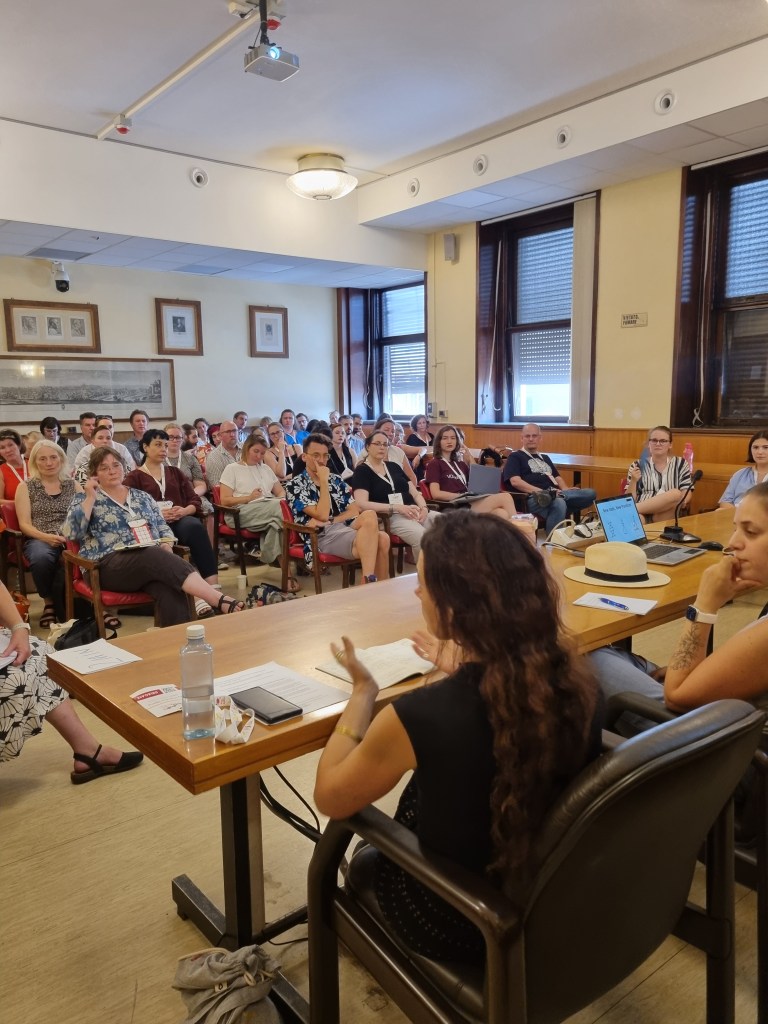
A full room for the panel discussion “What are the next challenges for the professional ethics of human remains?” at the EAAs in Rome, August 2024, Rome. Photo by Liv Nilsson Stutz.
The purpose of the roundtable was to provide a space for open exploration of emerging ethical challenges. The conversation started out with the specialist perspectives represented by the panel, but also engaged the audience. The discussion was future oriented and structured in three themes:
The first segment, New tools, New Practices explored how the very definition of human remains is changing rapidly with new research methods including biomolecules (including DNA, isotopes, etc), 3D-scanning and reproduction, and how new practices such as Open Science require completely new ethical considerations. It was pointed out that while some of these challenges are not entirely new (museums have long curated potentially sensitive photographs of human bodies), the current development calls for a more robust approach to the ethical challenges. We also noted that while we are aware of the problems we do not yet have any solutions to this issue, and the field keeps moving ever faster.
The discussion explored different options of solutions for museums, including community engagement, and repatriation. But it was also asked: is it not our professional duty to make museums a safe space for human remains?
A second segment, New Awarenesses, New Sensibilities started by discussing categories of vulnerablilities that are not often considered in the debate framed mostly by the postcolonial critique. Hayley Mickleburgh shared the example of a collection of crania from an orphanage in Amsterdam. How can we best care for the remains of these often very young and marginalised girls from 19th century? The discussion explored different options of solutions for museums, including community engagement, and repatriation. But it was also asked: is it not our professional duty to make museums a safe space for human remains? A topic that was further explored by Nicole Crescenzi and Liv Nilsson Stutz in a regular paper in a museum oriented session the following day.
Another significant theme broached in this segment was the disciplinary legacy of violence that permeates biological anthropology. Many of the methods and teaching materials we use today, and that have made their way into the disciplinary practice, were developed within a space of violence. How do we as a discipline address this legacy?
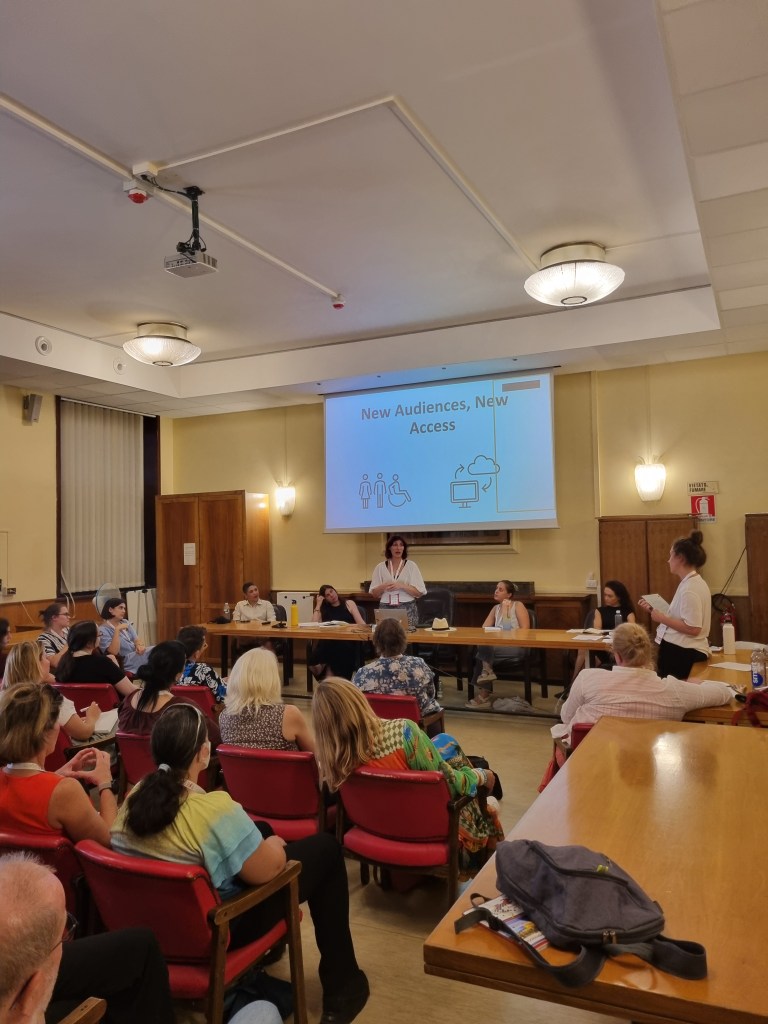
In the segment on “New Audiences, New Access” Hayley Mickleburgh brought up the importance but also the challenges of teaching ethics in a meaningful and engaged way. Photo by Liv Nilsson Stutz.
In a final segment called New Audiences, New Access the discussion focused on teaching and social media. Many raised the concern that despite the fact that the disciplines of archaeology and biological anthropology are clearly both aware of their ethical complexities, we still have a very limited engagement with these issues in universities across Europe. Teachers struggle with the difficult challenge of providing meaningful, engaging, and long term learning opportunities for students with limited time to cover more and more material. All agreed that it is important to include ethics continuously through the process, but all also struggled with how to make this happen in an increasingly austere university context. At this point the audience, who had been impatiently waiting, started to spontaneously participate and we decided to open up the floor for discussion.
Despite the late hour of the day (16.30-18.30), the sweltering heat of Rome in August (35°C), and the limited air conditioning in the room, the audience was active and engaged in brilliant conversation. Among the interesting points made in the audience I noted Sofia Voutsaki’s (Professor of Greek Archaeology at the University of Groningen, the Netherlands) point about how ethics can be weaponised, and that we need to be aware of that dimension in our work as well. On a related topic, Megan Perry (professor of anthropology at East Carolina University, USA) discussed the difficulties of a one size fits all approach to what it means to be ethical. What do you do, she asked, if you work in a region where community engagement is difficult simply because the community is not really that interested? Does that mean that you are not being ethical, or do you need to force something just to qualify as “ethical”? (I paraphrase). And if you do – is this not unethical?
It was also suggested that we may underestimate how much we as archaeologists and biological anthropologists actually engage with professional ethics. One voice in the audience pointed out that we in fact have a robust reflective literature, that at least makes us aware of the issues, in particular regarding the political dimensions of our field. I agree to an extent. It is true that archaeologists and anthropologists for decades have engaged with their disciplinary history, and, to some degree, professional ethics – perhaps more than colleagues in other disciplines with whom we now often collaborate.
I agree that as a field we have a tradition of being reflexive and we have resources and tools to act ethically. But even so, what is lacking, in my opinion, is a deeper and more critical engagement with ethics. One that is not limited to a list of “what not to do,” but consists of a thoughtful reflective attitude that engages professional ethics as dynamic and ongoing practice. One that keeps conversations like the one we were having in that room going, allowing the reflexivity to permeate our professional practice.
A good illustration of this was an audience member working with DNA analysis. He shared that as a biologist he had received no training in the history of his discipline. In comparison, it would seem that archaeology, museology, and anthropology are doing OK. I agree that as a field we have a tradition of being reflexive and we have resources and tools to act ethically. But even so, what is lacking, in my opinion, is a deeper and more critical engagement with ethics. One that is not limited to a list of “what not to do,” but consists of a thoughtful reflective attitude that engages professional ethics as dynamic and ongoing practice. One that keeps conversations like the one we were having in that room going, allowing the reflexivity to permeate our professional practice.
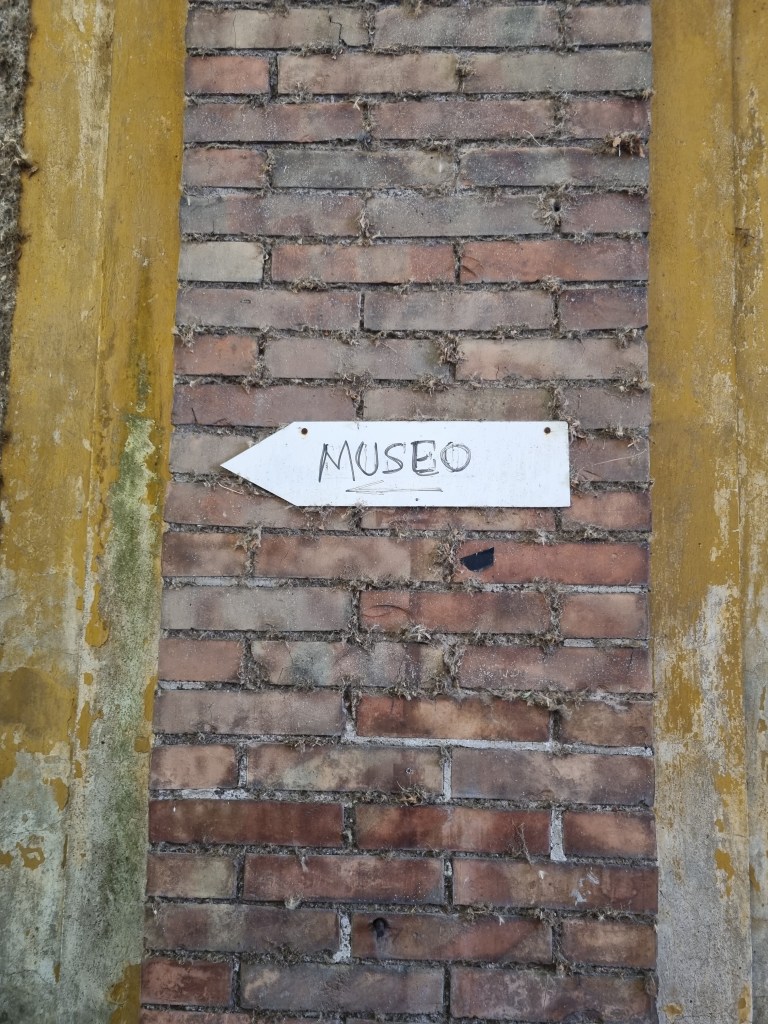
A humble sign directing visitors to one of the many museums in Rome. Among the themes the panel discussed was how we can make museums safe spaces for human remains as new sensibilities emerge in our understanding of them. Photo by Liv Nilsson Stutz.
When the session ended at 18.30 we left the room, not only with more questions (being a cliché it is also often true), but also with the feeling that the field is buzzing with energy and desire to discuss and explore these issues, and the realisation that with colleagues like the ones in this room, from all across Europe and the US, and from a range disciplines, we are making progress toward more reflective professional ethics. The engagement, the willingness to explore and to share that characterised the discussion constituted a stark contrast to the lack of formal opportunities to do so at this conference. But while I initially had wondered if the field is fed up with ethics–if we are “done”–my worries were proven unfounded. Leaving the room that warm evening I could not help but thinking – yes, there is a lot of work to do, but we will be OK.
Viewed from the outside, it often seems as if the Nordic countries are very similar in terms of culture and values. But despite their entangled political and cultural histories, and their cultural similarities, a closer look reveals interesting differences, and this is certainly the case for their professional attitudes to the ethics of collections of human remains.
The Nordic Network for Collections of Human Remains is an informal forum that organises different stakeholders in human remains collections, predominantly collection managers, but also researchers and museum professionals across the Nordic countries . The purpose of the forum is to provide a space for reflection and support in professional discussions and development of ethical practices. The Network organised a conference at Arkivcenter Syd, in Lund on October 26-27, 2023 (for full disclosure, Liv Nilsson Stutz has been a member of the steering group during the period 2020-2023, and was part of the organising committee for this conference). The purpose of the conference was to come together for the first time after the end of the pandemic, update one another on the state of the field in the different Nordic Countries, and strengthen both formal and informal ties and relationships throughout the community.
The conference invited speakers from several large collections across the Nordic countries to share their perspectives and experiences. Unfortunately the participant from Norway (Julia Kotthaus from De Schreinerske samlinger, at the Medical Faculty at the University of Oslo) had to cancel last minute, since she needed to prioritise her presence at a repatriation from the collection she manages. These presentations were inspiring in the sharing of protocols and experiences, but also showed the differences in approaches between countries.
Careful storage of human remains in a Swedish museum. Photo by Liv Nilsson Stutz (intentionally blurred).
The Danish model is interesting since it clearly separates ownership from deposition and curation. The former is held by local museums, while the latter is managed by essentially two centralized collections: ABDOU at the University of Southern Denmark (presented by Dorthe Dangvard Pedersen), and The human skeletal collection at the University of Copenhagen(presented by Niels Lynnerup, Marie Louise Jørkov, and Kurt Kjaer). This arrangement has interesting consequences for the management of processes. The facilities are all highly adapted for the preservation and study of human remains, and the research facilities support, track and assist in access to the collection by researchers, students, and even the public. It can be argued that this system that separates the human remains from their otherwise historical and archaeological context in order to prioritise preservation, control, and documentation, implicitly or explicitly categorises the remains almost exclusively as Objects of Science. It appears to be a very clear, but also unproblematising approach. The division has interesting consequences for the most significant case of repatriation of human remains in Denmark, Utimut – the repatriation of human remains and culturally significant objects to Greenland. The ownership of the human remains is now held by Greenland, but Greenland has elected to follow the same system for the management of collections of their human remains as that practiced for remains found on Danish soil, keeping them in Copenhagen. This case is always interesting to bring up in debates about repatriation since it is clear here that the Greenland side appears to share the same concerns for these remains as their Danish counterpart, and also feels that a practice that protects them as Objects of Science is valuable for them. But that does not mean that nothing has changed. There is a significant shift in the attitudes on behalf of the collection managers who do not claim control or ownership, but take the role as mediators and assistants. In this sense then, the Danish system is arguably more inclusive and progressive than in the rest of the Nordic countries, where ownership tends to be associated with the institution that holds the remains.
The Swedish system with decentralised practices and control was illustrated by presentations from two Swedish collections. The Historical Museum at Lund University was represented by Jenny Bergman and Sara Virkelyst who presented a newly established flow chart to systematically support repatriation processes in order to make them transparent and predictable for all stakeholders. The collections at the National Historical Museums were presented by Elin Ahlin Sundman. The issues of ethics appear to be top of mind for the Swedish institutions, but the decentralised practices result in great diversity in protocols and processes – which stands out as quite a contrast to Denmark.
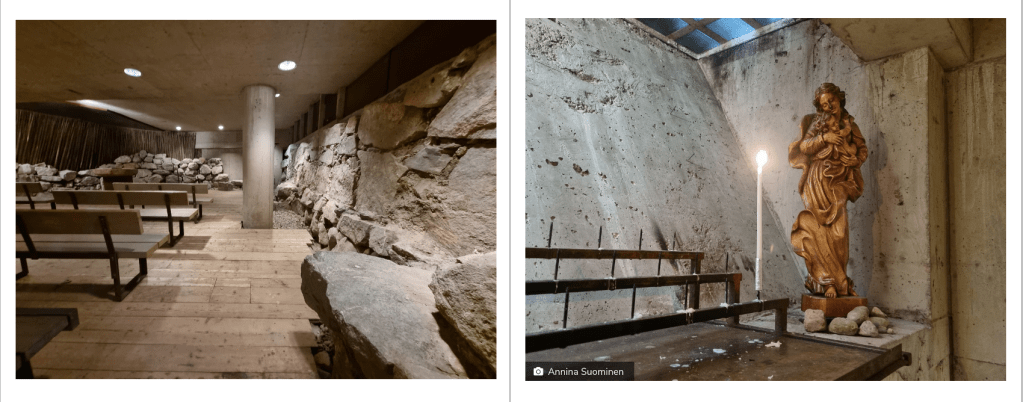
Images from inside the Chapel of the Holy Ghost in the basement of the Casagrande House in Turku, a semi private place of worship that also serves as a resting place for excavated human remains from the later medieval and early modern period. Photos by Annina Souninen, and published by Åbo Underrättelser.
Finland seems to have the least regulation and formalised processes for the care of collections of human remain at the moment. With a law that currently calls for decisions of future reburial to be made before an excavation has even started, human remains, in Finland, appear to be treated more toward the end of “Lived Lives” than in the other countries. They are often reburied immediately – sometimes even before osteological study. It should be added, however, that this position in reality is almost directly dependent on the chronological age of the remains, with prehistoric remains being systematically collected, and historical remains more often reburied. The decision is often made by local parishes who hold a lot of the power in these negotiations. Liisa Seppänen from the University of Turku presented a hybrid solution with the case of the contemporary chapel in the Casagrande House in Turku. The historic building, previously known as Ingmanska huset, was built in the 17th century at the previous location of a Graveyard of the Holy Ghost Church in Turku. After being threatened with demolition in the 1980s, the architect Benito Casagrande purchased and renovated the building under supervision of the Finnish Heritage Agency, and it now includes businesses, shops, and restaurants. The remains of the people buried in the underlying churchyard (from the 14th century and to 1650) were excavated in consecutive projects from the 1960s and through the 1980s, and were collected by a dentist at the university who kept them as a teaching and research collection (predominantly the crania). After extensive lobbying, Benito Casagrande, managed to have the remains transferred from the university to a newly built chapel in the basement of the house, where they can both rest in a sacred space and be accessible for research. The chapel is not open to the public, but can be visited upon request. A small working group, of which Casagrande is a part, oversees the collection and makes decisions with regards to access and curation. The impact of a private citizen is, to say the least, quite extraordinary in this case – but perhaps this is not as difficult to reconcile in a system with a tradition of consultation with the leadership of local parishes. From a more traditional collection manager point of view, Risto Väinölä discussed he human remains collection at the University of Helsinki (LOUMUS) which is a heterogenous collection with a long and diverse history of collection, with potential for research but with limited manifested interest both on behalf of researchers and calls for repatriation.
In addition to the presentations of the state of the field in the respective countries, I also want to highlight two more conceptual papers. Karin Tybjerg from Medicinsk Museion in Copenhagen presented an interesting paper on historical medical collections as a foundation for amemnesis – the clinical medical process of recovering the medical history, usually referring to patient history, to understand medical states in the present, but here expanded to include a broader investigation into the field of medical science, medical history and medical humanities (she has published these ideas in an interesting paper in Centaurus 65(2), in 2023). Equally interesting was Eli Kristine Økland Hausken‘s paper Adressing Bare Bones and Human Remains about her work with exhibitions at the University Museum of Bergen and the underlying ethos of their activities to engage the local community by “lifting the curtain” on the process knowledge production and the history of institutions. I was somewhat surprised at the choice to exhibit a shrunken head, a South American Tsansta (an issue that has also been debated by curator Åshild Sunde Feyling Thorsen from the same intitution), and while I am personally not convinced, I was interested in the arguments in favour of making such an unconventional choice today.
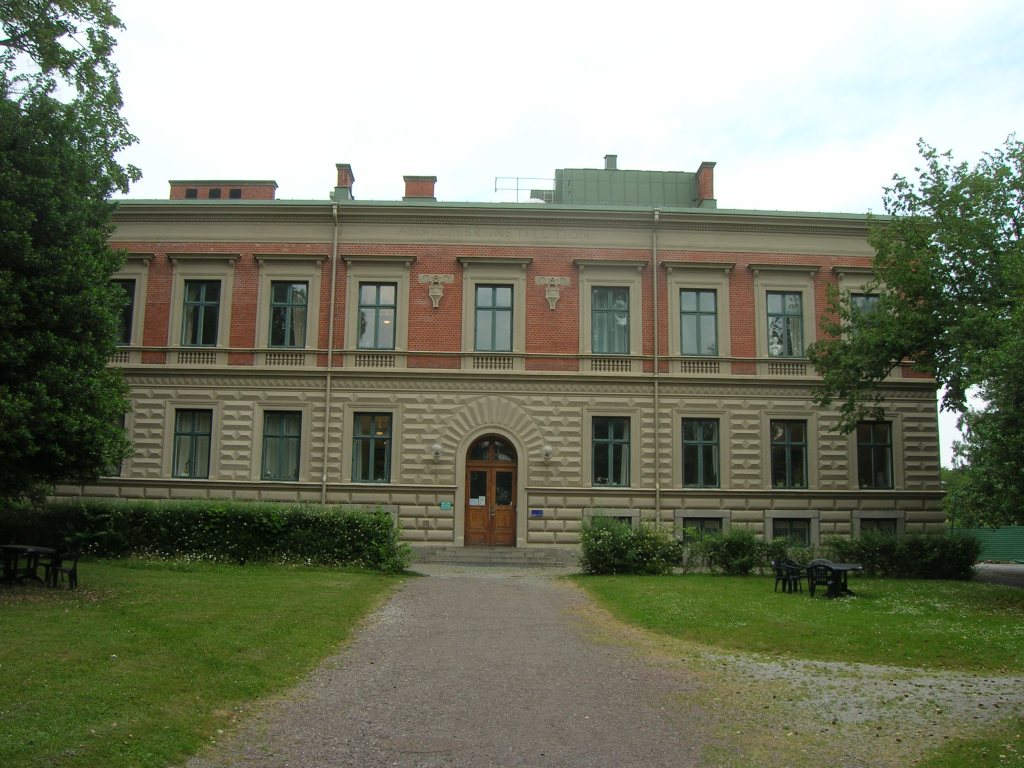
The Old Department of Anatomy at Lund University. Image by Väsk, licensed under CC BY-SA 3.0.
During the course of the conference, three panel talks explored several fundamental issues for the care of collections of human remains. The following topics were explored:
Panel 1: What is the value of collections of human remains? This panel explored the broader topic of the value of these collections for science, pedagogy and history in a time when they are increasingly questioned. Are they valuable? And if so, how?
Panel 2: How to make the collections accessible (including perspectives on digitalization, exhibition, and access for researchers). Should we? And how best to do this?
Panel 3: Accession and deaccession. What are our current challenges? This panel talk will discuss the responsibility (and cost) of accession and deaccession, and discuss the connections to repatriation and (re)burial.
Throughout these conversations it became clear just how entangled these issues really are. The final discussion, on accession and deaccession, also linked up the the local history of anatomy in Lund where a large part of the old and seemingly “worthless” or “problematic” collections from the Department of Anatomy were unceremoniously discarded in 1995 when the department was closed down permanently. Some remains were transferred to the Historical museum (the institution that received most of the skeletal remains) and to other institutions that had previous ownership of remains in the collection, but a shocking amount of wet specimen, ended up in containers to be destroyed or haphazardly collected from the street by private people, potentially to take on another life, now even more in the shadows and even further removed from ethical care. The date, 1995, serves as a reminder that it is not that long ago that these issues were hardly problematised at all.
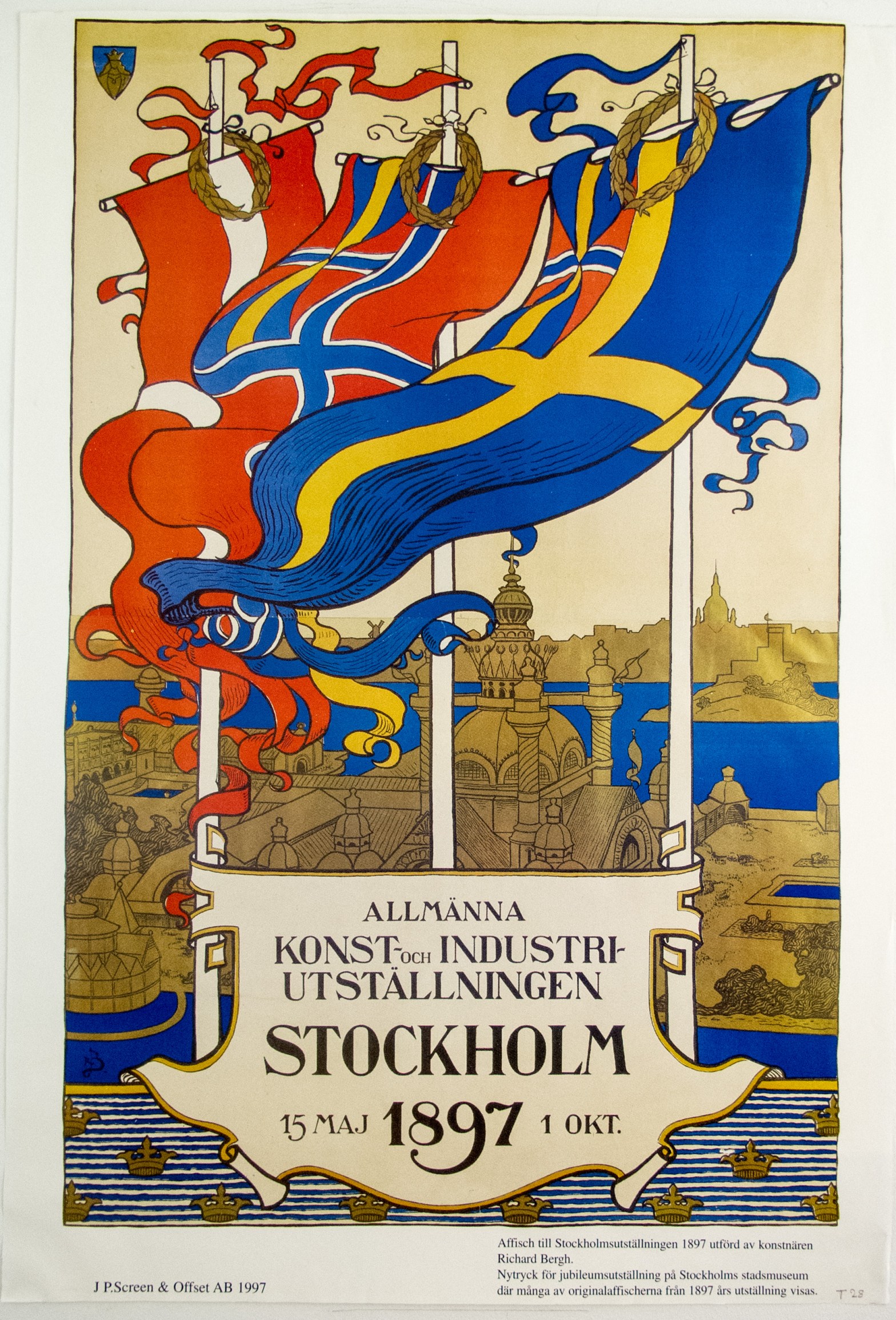
Featured image: Poster for the General Art and Industry Exhibition in Stockholm 1897 (licensed CC BY-SA 4.0). While this poster from the 19th century shows a different political reality, it can be veiwed as a good illustration of the continued entanglement of the Nordic nation states.
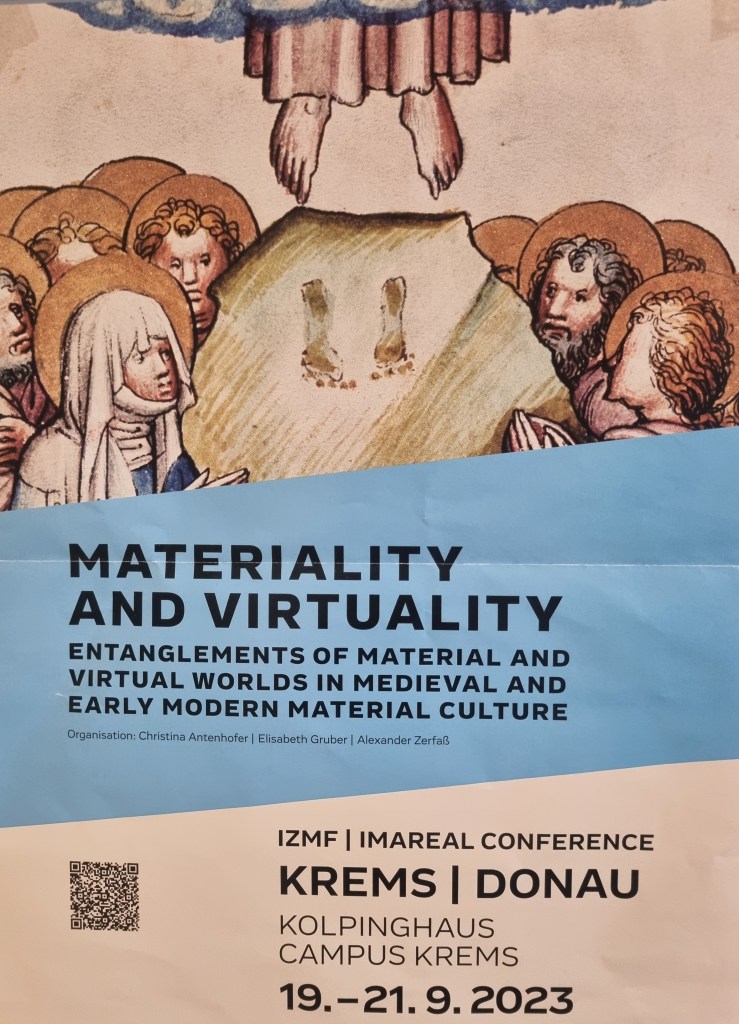
One basic principle of this approach is the Aristotelian meaning of virtuality as “capacity” or ‘”dynamis” that does not come to action, but nevertheless has an effect on reality.
“The virtual is not physically present, but it is ‘seemingly real’ (being a simulation that has real effects). It is not material, but nevertheless existent – the latter distinguishes it from fiction. The virtual has real effects, because it refers as potentiality to its actualization and is effective in this reference.”
IMAREAL
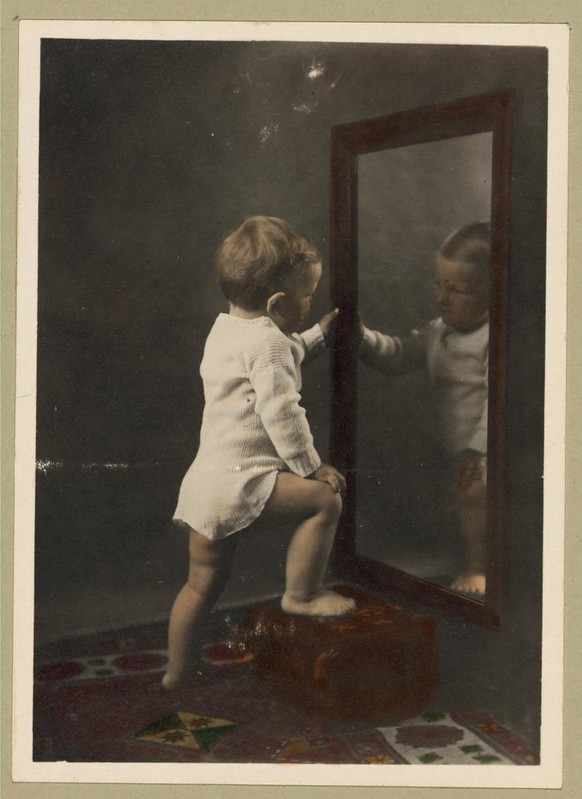
To clarify their position, IMAREAL uses the mirror as paradigm: here the virtual unfolds on the surface of the material – the reflection is the result of causal interactions at the material level. And while the virtual only unfolds on the surface of the material, it has real effects “because we actualize it on the reflecting body.”
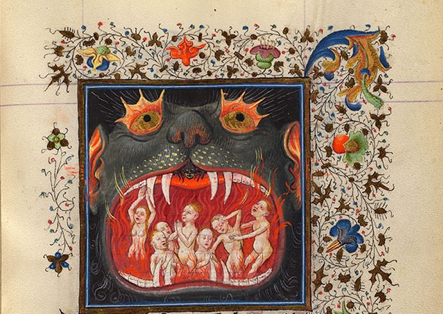
IMAREAL argues that this property – dynamis – capacity and ability to move, did not enter the world with postmodernism and contemporary virtual reality technology, but has probably always been a part of human culture, and one that can definitively be traced in medieval artwork, architecture, and material culture. In a medieval world, and in particular when considering the afterlife, the concept of the body/soul, creates an interesting paradox. The afterlife journey, potentially including heaven, hell, and purgatory, are transcendentary – not conceived of as material, but with long lasting effect on reality, and it is undertaken by the double corporeality of the dead – the physical remains, buried in the ground and left on earth, and the avatar soul that wanders on into the afterlife. Central to this world view however, is the soul’s maintenance of a certain corporeality – one that can be tortured in purgatory and burn in hell. The soul is thus not completely shedding its metaphorical skin – the avatar is a virtual, and while it no longer is understood as material, it still has “the capacity of the corporeal” (e.g. in the sensation of pain).
The immaterial soul/body that can still feel pain. Illustrated by Medieval Hellmouth 1. Cropped image of MS M.917/945, p. 180–f. 97r in The Hours of Catherine of Cleves.
When relating this to research ethics and human remains, it strikes me that the complex nature of the cultural understanding of the human body that we encounter in the debates about research ethics and reburial, resonates with this framework of entanglement between the virtual and the material. The dead body is simultaneoulsy striking in its materiality and the embodiment of a lived life. The virtual emerges from the surface of the bones (or other materiality). This is where the ethical dilemma presents itself as we seek to understand how to best care for them. We wonder if the human remains on the shelves in the museum storage still feel something – if they experience limbo and displacement. If they would consent to being there.
“Questions relating to subject and object, to their distinction and their union, should be put in terms of time, rather than of space”
henri bergson, matter and memory
Bergson’s idea of the relationship between the material and the virtual departs from the neural capacity of the human body, with the nervous system as a “material symbol” of the inner energy we call memory. The capacity for memory allows for humans to depart from their here and now, and in a way extricate themselves for a period of time. Although Bergson does not elaborate on rituals specifically, it appears that this model of the virtual can be connected to Catherine Bell’s concept of ritualisation as a strategic way to act to, in a sense, fire up a connectedness to the overall structure – a continuous whole, which in a Bergsonian sense is a continuity of material extensity in which each individual moves as connected parts of a whole. Yet, we as individuals also function in a time space continuum and through material bodies, and hence the material and the virtual is situated in time and connected to memory.
Building on Bergson, Deleuze elaborated on the term of virtuality, bringing it into closer contact with the real, arguing that it is an aspect of reality that is ideal, but nonetheless real. The virtual is thus not opposed to the real, but opposed to the “actual.” The “real,” he argued, is opposed to the “possible,” thus introducing a movement toward possible realisations, through the concept of duration.
While the conjoined twins previously on display at the Museum of Natural History in Gothenburg (and subsequently cremated) may not actually have felt anything, our encounter with their materiality moves us, and triggers associations in us that enters into a virtuality in which they do. Photo published by Swedish radio and intentionally blurred for this blog.
I am not a philosopher, and I no doubt simplify these complex thoughts in absurdum, but what I take form this is that the idea of elaborating with the connections between the virtual and the material may be fertile ground for further critical examination of the category “old human remains,” as situated in the space between the material and the virtual, between the object and the subject, between the past and the present. In this liminal space lies a multitude of dimensions to explore. To bring the issue back to a series of immediate and concrete challenges, this framework could be valuable as we explore the complexities of 3D-reproductions for display and researech. The relationship between the materiality of the original and the materiality of the copy passes through a digital and virtual space – like the metaphoric mirror, yet enters back into a the world in a materiality that potentially prompts all the ethical issues embedded in the original and authentic specimen – with added dimensions of ownership and control, no longer only of the original, but of the copy as well. But the concepts of virtuality and materiality also brings us back to the foundational questions of the project:
does the age of old human remains affect the relationship between the subject and the object?
can the materiality of the human remains ever be separated froheorym the virtuality that unfolds from our encounter with them, and to what extent is can this virtuality be separated from the cultural context of the encounter? Is there such a thing as an invariably essential virtuality, or can it only emerge in each encounter, making it potentially endlessly variable?
To what extent do we all feel compelled to enter into contact with the virtual as we encounter the materiality of human remains? Are they inhabited by some sort of universal quality that in this respect, transcends cultural difference?
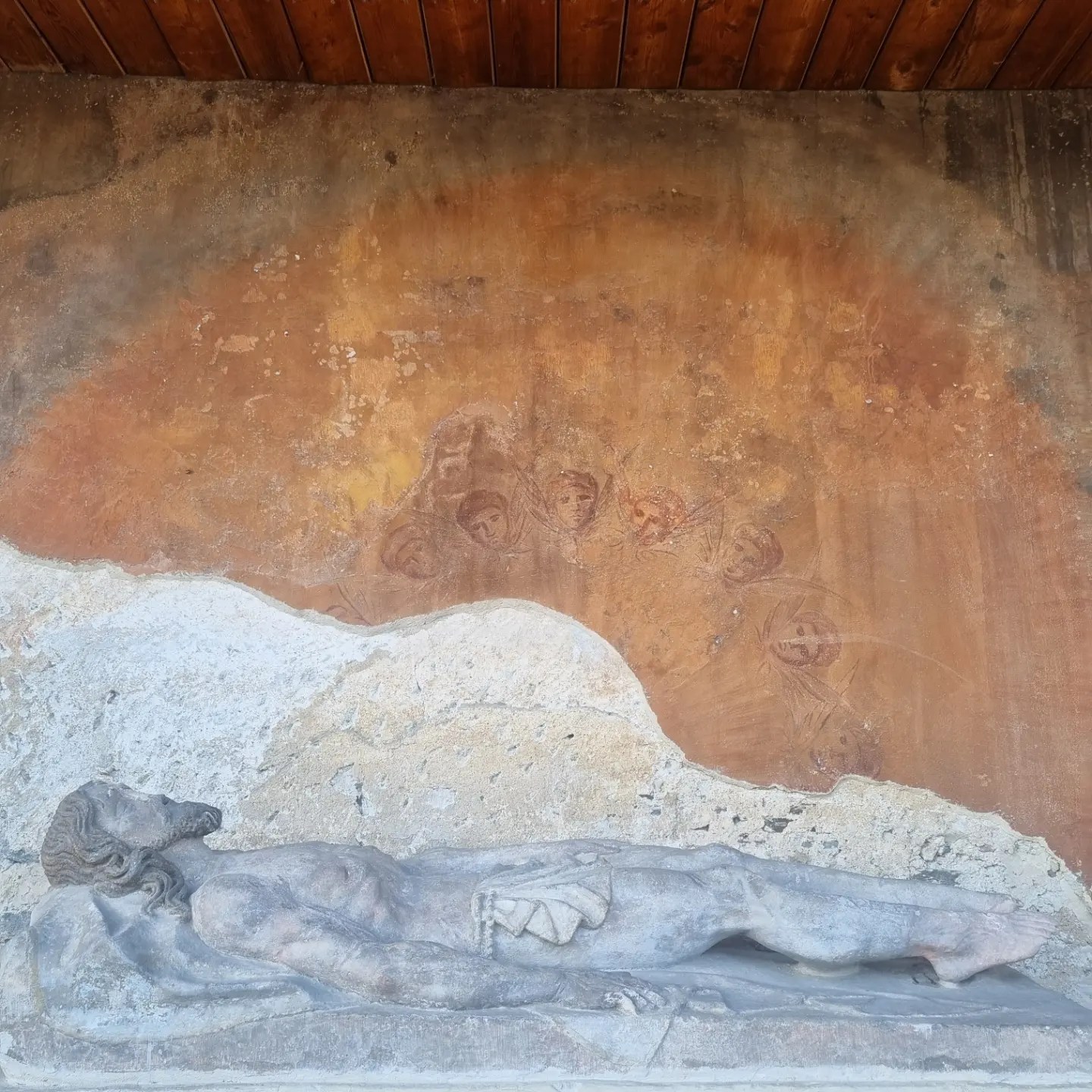
Featured image: the body of Christ. Piarist Church of Our Lady, Krems. Photo by Liv Nilsson Stutz
The European Association of Archaeologists convened at Queens University in Belfast for their annual meeting, August 30th to September 2nd, 2023.
Conference mood. Photo: Liv Nilsson Stutz
Two events immediately touched on the ethical dimensions of human remains, and Ethical Entanglements was present at both of them. The first was a session entitled “From What Things Are to What They Ought to Be: Ethical Concerns on Archaeological and Forensic human remains, organized by Clara Viega-Rila, Angela Silva-Bessa, and Marta Colmenares-Prado. The session included 11 papers with contents ranging from the ethical considerations at the the molecular level of human remains, to the ethics of repatriation, museum practices and contract archaeology.
Aoife Sutton- Butler discussed her survey of visitors to museums with anatomical and pathological collections with regards to “potted specimen.” The survey demonstrated that an overwhelming majority of people tend to both accept and value the opportunity of viewing these human remains on display. The general representation of the study can be discussed since it only included people who had elected to visit these museums, but among the interesting insights was that many said that the experience allowed them to identify with the the person in the past – thus challenging assumptions often made that potted specimen automatically are a form of objectification. An interesting detail in the study was that the use of potted specimen in teaching helped students in osteology to think more carefully and intentionally about the personhood of the individual, and about pain and suffering.
Example of “potted specimen” [File:Fig-1-Photograph-of-the-teratological-collection-in-the-Museum-for-Anatomy-and-Pathology-of-the-Radboud-University-Medic.gif, by Lucas L. Boer, A. N. Schepens-Franke, J. J. A. Asten, D. G. H. Bosboom, K. Kamphuis-van Ulzen, T. L. Kozicz, D. J. Ruiter, R-J. Oostra, W. M. Klein is licensed under CC BY 4.0.]
Constanze Schattke and colleagues form the Natural History Museum in Vienna presented another study that looked at public opinion, in this case with regards to repatriation of human remains from non-European contexts. Their approach to the topic was to analyse newspaper articlas and their online comments section, and code pro and con attitudes. They concluded that while there is are still different views on the topic, over all, the public is more positive to the repatriation of human remains than to the return of objects, which indicates – once again, that human remains are not perceived as neutral objects.
In her thoughtful and problematising paper “Sentenced to Display,” Ethical Entanglements member Sarah Tarlow prompted the room to question the ethics of the display of the human remains of known historic criminals. While the encounter with these infamous bodies in surrounded by a certain level of glamour and thrill, we must also ask to what extent the display of these bodies in museums today simply prolongs the abandoned practice of punishment by display.
Ethical Entanglements member Rita Peyroteo Stjerna presented a thought provoking paper entitled “The Multiple Ethics of Biomolecular Research on Human Remains: Researcher’s Perspective” on the emerging ethical challenges relating to the new methods for analysis often associated with the Third Science Revolution in Archaeology – including issues relating to the privacy of the dead, the unbalanced relationship in knowledge production, and curation and preservation. Her paper presented insights gleaned from interviews with laboratory based scientists, and advocated for the a more proactive engagement with the development of professional ethics that also includes these researchers in the conversation.
Ina Thegen and Clara Viega-Rilo both addressed the challenges of contract archaeology in Denmark and Spain respectively, with lessons learned and thoughts about and how to best engage with multiple and embedded stakeholders including the public, the media, descending communities, and communities of faith.
Three papers engaged in different ways with the legal regulation and process of professional ethics. Sean Denham presented the Norwegian model where research on old human remains, and while recognising the multi-disciplinary character of the research, is included under the broader umbrella of the National Research Ethics Committee, and a special advisory committee. Angela Silva-Bessa problematised the double standards for body donations and the handling of the dead before and after death, with a special focus on the cultural context of Portugal where the cultural practice allows for exhumation of burials as soon as 3 years after death – with teh assumption that the family cremates the remains or moves the remains to an ossuary. But the family is not always able to care for the remains, and they can also be donated to osteological collections. Silva-Bassa asked several important questions: Can this practice be better regulated? Should cemeteries have access to donation registers to be able to see if the person buried would object to being used in this way. Should there be another registry? Nichola Passalacqua and colleagues shared current American standards for forensic science.
Nicole Crescenzi getting ready to present at the Roundtable on illicit trade. Photo: Liv Nilsson Stutz
Ethcial Entanglements affilliate Nicole Crescenzi presented her work in a Round Table Session on illicit trade, where she focused on unforeseen ethical challenges of the new EAA recommendations to increase the use of 3D-copies of bones and other human remains. While this at first glance appears to be a convenient short cut around the growing critique against exhibiting authentic human remains, she argued, the technology itself opens up a whole new Pandora’s box of ethical issues, including ownership, control and reproducibility.
By historical collections the round table referred to the medical museums and anatomical and pathological cabinets that from the mid 18th century that all played a central role in medical research and pedagogy. At the time, and in the century and a half that followed, they functioned not only as reference points for medical knowledge production and reproduction, but also as shrines to medicine, the science, its men and their achievements. In the 20th and 21st centuries however, they are being perceived in new ways. Now the darker sides of their origin is coming into focus: unregulated trade, theft, and ethically dubious collection practices permeated the practice before institutional, professional and state governance and the development of professional ethics centered on bioethics and informed consent reshaped medical and anthropological practice. Nobody can contest the important contributions these collections made to our medical knowledge, our understanding of the human body, its biology, and the pathways to healing it. However, the dark past that looms over the legacy of these collections ties them to structures of classicm, racism, sexism, colonialism, and authoritarianism, that all facilitated their coming into being.
It is – without a doubt – a troubling legacy.
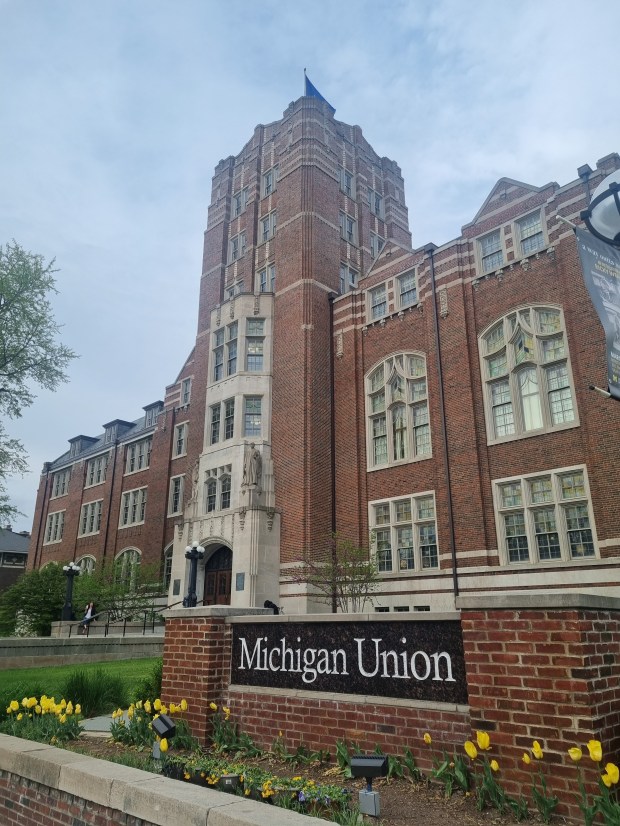
The Michigan Union at University of Michigan campus in Ann Arbor was the venue for the annual conference for the American Association for the history of Medicine, May 2023. Photo by Liv Nilsson Stutz.
Today, new methods and technical advances have made these collections less relevant for teaching medical students and for carrying out research on human biology, anatomy, and pathology. As their “value” for medicine has decreased, they have come under increased scrutiny and criticism with their troubling legacy casting longer and darker shadows, to the point of calling into question their continued existence. We are starting to hear more and more voices calling for their destruction, deaccessioning, and limitations in terms of both public access and research.
While recognizing the importance of the criticism and the dark legacy, this panel problematized this development and asked: Are there multiple and competing ethical claims to consider when exploring the theoretical, political and practical challenges facing these collections and the institutions that care for them? What are the possible futures for these collections? What role should they play for medical professionals, for scholars, in education, and for the public? As these collections no longer hold the status of shrines, can their role be redefined in productive and ethical ways, for example as public facing centers of historical research and exhibition – and if they are, can these centers be imagined in a way that also considers their dark history to operate as democratic, inclusive institutions in a way that adhers to the contemporary role of museums (as defined by ICOM)? What are the best ethical policies and practices when we approach these complex issues?
While recognizing the ongoing debate, which for the sake of simplification can be characterized as postcolonial debate, and that tends to be centered on specific categories of remains, and without trying to ignore or suppress it, the round table sought to explore additional questions around value, use and multiple ethics that tend to be marginalised in the current conversations. We came to this conversation from different experiences – from the fields of medicine, history and archaeology – all with various experiences of debating these issues on a theoretical level, carrying out research on human remains, and managing museum collections with human remains.
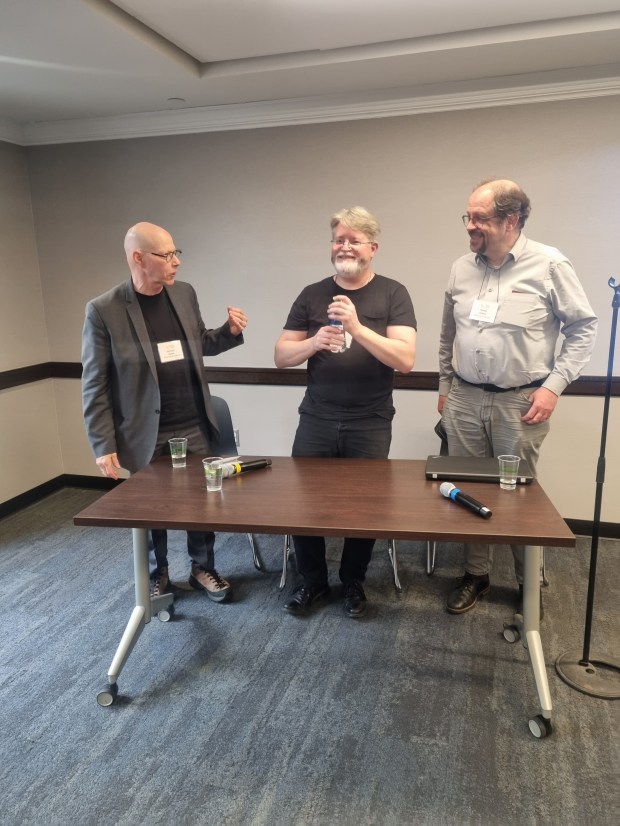
Speakers at the Roundtable on Historical Medical Collections, from the left, Mike Sappol, Olof Ljungström, and Rainer Brömer. Photo by Liv Nilsson Stutz.
The speakers at the roundtable were:
Mike Sappol – a medical historian based at Uppsala university with a significant experience as an exhibition curator and at the National Library of Medicine, and the author of several important books. His work focuses on the history of anatomy, death and the visual culture of medicine and science, the body, the history of museums and queer studies. His paper entitled “Endangered specimens. Historical Human remains and derivatives: competing claims, meanings, critiques, and practices” interrogated and explored the debates surrounding these historical collections and their different and complex values through the case of the Museo Morgagni di Anatomia in Padua: as materiality, artifacts, and perhaps even as a form of “relics of an extinct medical civilization.”
Olof Ljungström – a historian at Karolinska Institutet in Stockholm, where he oversees the anatomical collection. His work focuses on the history of medicine, including 19th century anatomy, race science and the history of research at KI. His paper The Body Politics in the Anatomy Collection: Where the politics of the past meets the politics of the present, contextualized the history of the Finnish crania at the KI collection and the contemporary claims surrounding them.
Rainer Brömer from the Institute for the history of Pharmacy and Medicine at the Phillips University in Marburg, where his research focuses on Anatomy and Pharmacy in the Ottoman Empire, Medical and research ethics, and the body, and where he has also been involved with the Marburg university anatomical collection, its Museum Anatomicum and the conception of a future museum in Marburg. His paper, Gazing at human bodies – epistemology, ethics, and aesthetics discussed the ethical challenges of this project.
After the presentation the room engaged in discussion that included voices form colleagues currently working with historical medical collections in museums across the United States who shared their perspectives and experiences.
“It is always more than one thing”
Lisa Harris in the opeing roundtable “Being a Public Scholar Now” on the subject of abortion
Personally I felt inspired as I made connections between what I was hearing in the room and what I had heard at the opening round table session for the entire conference earlier that day entitled “Being a Public Scholar Now: Obligations, Opportunities, and Dangers” chaired by Susan Reverby with Angela Dillard, Alice Dreger, and Lisa Harris. In her address Lisa Harris, who is an OBGYN, holds a PhD in American Culture, and is an activist for women’s reproductive rights, spoke about her role as a public intellectual and why it matters. Her thoughtful remarks were inspiring and, I believe, tie in with the conversation we were having hours later when discussing historical medical collections. She emphasised two dimensions that drive her work as a researcher and activist. First the presentism of history. “You learn from the past – about what was “bad” then, but you never distance yourself too much from the past, because the problems are still present.” She said, “you can biopsy any moment in American History and you can see similarities today.” The second dimension was her love of history and the ways in which its complexities reveal themselves through research. It is always more complicated than you think, she argued, and you need to embrace the complexity and hold the ambiguities. It is possible that something can be both good and bad, all at once – for example abortion: it is both a death and at the same time the opportunity for life and freedom for another person. “It is always more than one thing.” Given the subject of her research, it was also obvious that taking a stance that complicates the matters at first can be difficult, as many people who are engaged with a topic like reproductive rights may seek and want a more straight forward answer. But ultimately, the only way to really move forward and find the productive and real solutions requires a recognition of ambiguity and complexity. And here, in that recognition, the presentism of history comes back to enrich our sensitivities and our understanding of how phenomena like historic medical collections hold ambiguities and complexities that we need to embrace, not avoid, if we want to understand their potentials and their charge.
On May 11 and 12, 2023, the 23rd Cambridge Heritage Symposium took place at the McDonald Institute for Archaeological Research. The topic of these two-days symposium was “Encountering Human Remains: Heritage Issues and Ethical Considerations”.
Despite what one may think looking at the hosting place, archaeology was not the only point of view in discussing the human remains, nor was it the main one. On the contrary, many different approaches, methodologies, fields were presented and discussed in these two stimulating, interesting, and emotional days – as it is very well proved by the six sessions in which the days were divided: 1. European Conflictscapes and the War Dead, 2. Necropolitics and Commemorating the Dead, 3. Shifting the Narrative and Management of Human Remains, 4. Encountering Death in Museums: Ethics of Display and Public Perception of Human Remains, 5. Studying the Dead: Curation and Archival Research of Human Remains, and 6. Reflecting on Epistemology, Spirituality, and the Social Dead.
Alongside the sessions, two keynote speakers presented their unique perspectives on two interesting themes: the first day Dr. Layla Renshaw explored the different dimensions of personhood sought by the living when a mass grave is exhumed, bringing case studies of contemporary exhumations of Republican mass graves from the Spanish Civil War; on the second morning, George Gumisiriza used the lens of migrant corpses to explore potential individual and collective ways of encountering human remains in society. The registration of these interesting and moving intervention are available on the site of the research center.
After Dr. Renshaw keynote, Dr. Gilly Carr kicked-off the first session with a question that everyone working with human remains – and ethics in general – asked themselves at least once in their life: “What is an inappropriate behavior?”. The question pairs perfectly with the general recommendation of treating human remains “with respect”, when one encounters them. After Dr. Carr her colleagues in the session, Dr. Margaret Comer, Leonora Weller, and Dr. Magdalena Matczak beautifully interrogated regarding war and holocaust dead and on what the human rights of human skeletal remains are as heritage – and if human remains resulting from atrocities should be heritage at all.
The following session, with the talk of Dr. Daniel Gaudio, Oliver Moxham and Hyunjae Kim, explored the commemoration of dead and the connection with politics, from different perspectives, starting with the challenges of analyzing frozen remains in Northern Italy, going through the possible linguistic barriers in Japan and finishing with the interpretation of colonial deathscapes and local’s narrative in South Korea.
The last session of the first day explored new possible narratives around human remains, specifically shifting from the dominant Western approaches and discourses. Dr. Yunci Cai presented the case of the Monospiad Cultural Village in Sabah, East Malaysia, while Dr. Heba Abd el Gawad underlined the invisibility to which the contemporary Egyptian people are subject, when it comes to their discomfort towards the display of mummified Egyptian human remains in Western museums. Paloma Robles Lacayo proudly described the efforts undertaken in trying to identify the Mummies of Guanajuato, to eradicate their objectification, without hiding the difficulties encountered (and still encountering) and Dr. Guido Lombardi showed the possibility of carrying on the Ancestors’ legacy, respecting their body-preserving traditions and bridging them with modern education and local specialists.
Following the beautiful keynote lecture, the second day opened with the encounter of death in museums. To open the session, Dr. Katie Stringer Clary draw the history of the exploitation of the Indigenous or “abnormal”, sometimes living,bodies. She begun by discussing the very first freakshows up until today, pointing out that: “Museums no longer exhibit living people. Still, how far have they come?”. Olga Nikonenko focused instead on the complicated issues of the provenance, public display and repatriation of the multi-cultural Graeco-Roman mummified remains discovered in Egypt. More personal perspectives were those offered by Dr. Jody Joy, who told his experience in curating the Lindow Man, and by Cat Irving, who closed this session telling the stories “of those that you don’t find in history books”.
Since the beginning of the Symposium questions arose at the back on my mind, and they haven’t left yet: where do we draw a line, if we can draw a line at all?
The speakers of the second session of the day, Dr. Miriam Saqqa-Carazo, Dr Rachel Sparks, Jelena Bkvalac and Dr. Ayesha Fuentes, focused more on the curatorial aspects of handling human remains in museums, as well as on the archival research.
To conclude this full, thought-provoking two-days Symposium, the last session tackled a more epistemological, spiritual and social perspective. The speakers, Prof. Shawn Graham, Ellie Chambers, and Dr. Svetlana Seibel, went from unveiling some (disturbing) sides of the trade of human remains on e-commerce and social media platforms, through their exploitation on online news platform as clickbait, to showing literary encounters with ancestral remains. Closing the session, Prof. Charles Clary (see also his IG) moving talk guided us towards his personal exploration of death, mourning and healing through his art, which also provided the beautiful cover of the Symposium’s programme.
Since the beginning of the Symposium questions arose at the back on my mind, and they haven’t left yet: where do we draw a line, if we can draw a line at all? Should politics be allowed to objectify the remains, using them for its own purposes? What’s the distance in time that determines whose ancestors are worthy of asking for repatriation? And is this distance really sufficient, to ignore this type of concern? And should professionals working with human remains be completely detached and unemotional, as usually required to scientists, to be considered professionals?
As for all the best encounters, these two days left me with more new open questions than answers. Unfortunately, it is not possible to see all the amazing talks that have been delivered in those two days, but the online poster session is still available and showcases very interesting researches.
While the main focus of the seminar was on Rapa Nui, the heritage of Nordic colonialism was present as an important backdrop to the discussion, a reminder to Swedish scholars working with repatriation that there is no “Nordic exceptionalism” when it comes to colonial history, and the Nordic countries were a part of these global processses in all their various forms. Ulrika Persson-Fischier (Uppsala University) used her study of the crania collected by Nordenskiöld’s Vega Expedition to discuss the challenges of working with old colonial records when trying to establish “provenience.” She pointed out the paradox that despite good intentions, we risk reproducing colonial ideologies through the practice of repatriation if we use old records and categorisations. Mikael Jacobsson from the Lycksele Museum of Forestry shared his experiences of the repatriation and reburial of crania collected in from an old cemetery in Sápmi in the 1950s and returned for reburial in 2019. He showed moving images of the ceremony and discussed the difficulty in getting museums to really understand that human remains are not just archaeological and historical artefacts. Finally, the agreement to repatriate thousands of objects and human remains from the Kon Tiki Museum in Oslo, collected by Thor Heyerdahl and his team during his travels in the Pacific in the 1950s and 1980s, provided an immediate connection to the main focus of the webinar – the experiences of the repatriation of human remains to Rapa Nui.
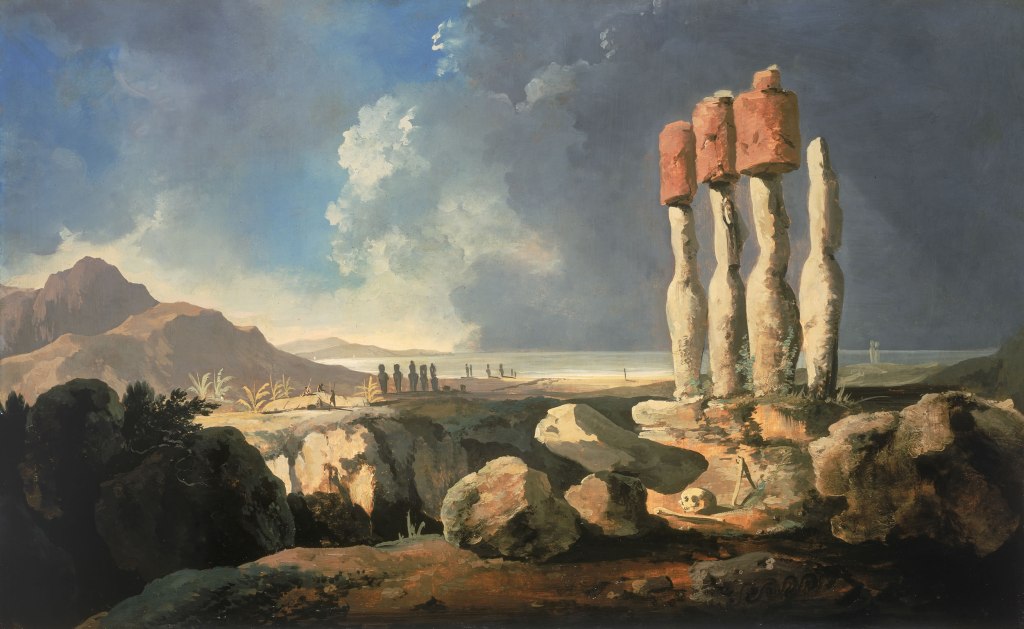
A View of the Monuments of Easter Island, Rapanui, c. 1775-1776 by William Hodges. Public Domain
Rapa Nui constitutes an interesting example to discuss repatriation. It is caught in complex layers of colonialism and relationships to the state of Chile. Known more widely by the name “Easter Island,” a name given by the Dutch explorer Jacob Roggeween who accidentally “discovered” the island on Easter Sunday in 1722, the island is wrapped up in colonial history. In the decades that followed Roggeween’s short visit, several other expeditions landed on its shores, marking the beginning of a deep and painful colonial history including disease, structural violence, black birding, slave trade, and exploitation. The island was annexed to Chile in 1888. It holds the status of special territory since 2007, but the relationship to the Chilean state has not been without conflict.
From a cultural heritage point of view Rapa Nui is renowned for its monumental Moai, the sculptural heads that line its shores as “the living faces of deified ancestors.” But beyond these striking sculptures, the island is the home of an impressive cultural and archaeological heritage of monumental architecture, petroglyphs, and wood carvings that all can be traced back to the indigenous Rapa Nui. Given its painful history with colonialism, it is not surprising that calls for repatriation of both cultural objects and human remains play an important role in current debates, with the most highlighted example being the call to repatriate the Moai called Hoa Hakananai (lost or stolen friend) from the British Museum. In the process Chile has become a powerful player. Under Chilean law, the Moai are not regarded simply as art or artefacts, but deemed an “integral part of the land”, and in 2017 the control over them, along with other archaeological sites, was symbolically handed over, from the Chilean National Forest Corporation to the Rapa Nui by President Michelle Bachelet.
At the webinar, we would hear several voices engaged in the movement for the recognition of the right of Rapa Nui to gain control of their heritage including the human remains of their ancestors deposited in museums all over the world. Biological Anthropologist Associate Professor Felipe Martinez (Pontifica Universidad de Católica de Chile) discussed the importance of viewing human remains, not only as biological specimens but also as a part of cultural heritage, and stressed the need for a developed legal framework that recognises the rights of indigenous people in this context. Dr Jacinta Arthur (Pontificia Universidad de Católica de Chile), who has worked as the coordinator for the repatriation program in Rapa Nui, introduced the concept of patrimonialization of indigenous culture to the discussion, and discussed how legal instruments can protect cultural heritage for the nation without considering the needs of the indigenous communities to which it belongs.
This becomes especially interesting when unpacking the complexities of international repatriations of indigenous human remains and heritage. Who does this belong to? To where should it be repatriated? Who decides on the future of these remains? Here the relationship between the descending community, be it a majority population, a minority population, or an indigenous population, becomes central. As nation states come to agreements, the opportunities for descending communities may look very different depending on their relationship to the nation state that may or may not recognise their right to control their cultural heritage. Here the issues raised by both Dr Jacinta Arthur and Ulrika Persson-Fishcier (albeit in a different context) come back into focus.
“We are the heart, you are the brain”
These issues are without a doubt complex and difficult. What is the way forward? Curator Sr. Mario Tuki (Museo Antropologico Padre Sebastian Englert MAPSE Rapa Nui Repatriation Program Ka Haka Hoki Mai te Mana Tupuna and Hare Tapu Tu’u Ivi) offered a pathway. In his presentation and in the discussion, he stressed not only the importance of collaboration between scientists and indigenous communities, but also the importance of academic actors to recognise the emotional dimension of the process. Indigenous communities, with a lived experience of trauma from a violent colonial history, will bring a consideration for this emotional dimension. This should not be seen as a complication, but as an asset in the work toward mutual learning and understanding. Academics, on the other hand, will bring a problematizing and intellectual approach to the situation. We need both. “We are the heart, you are the brain,” he declared, proposing a wonderful metaphor for all of us who are seeking a productive way forward. Recognising that both the heart and the brain are vital organs, and that they sustain each other, Mario Tuki’s words leave me inspired and humbled.
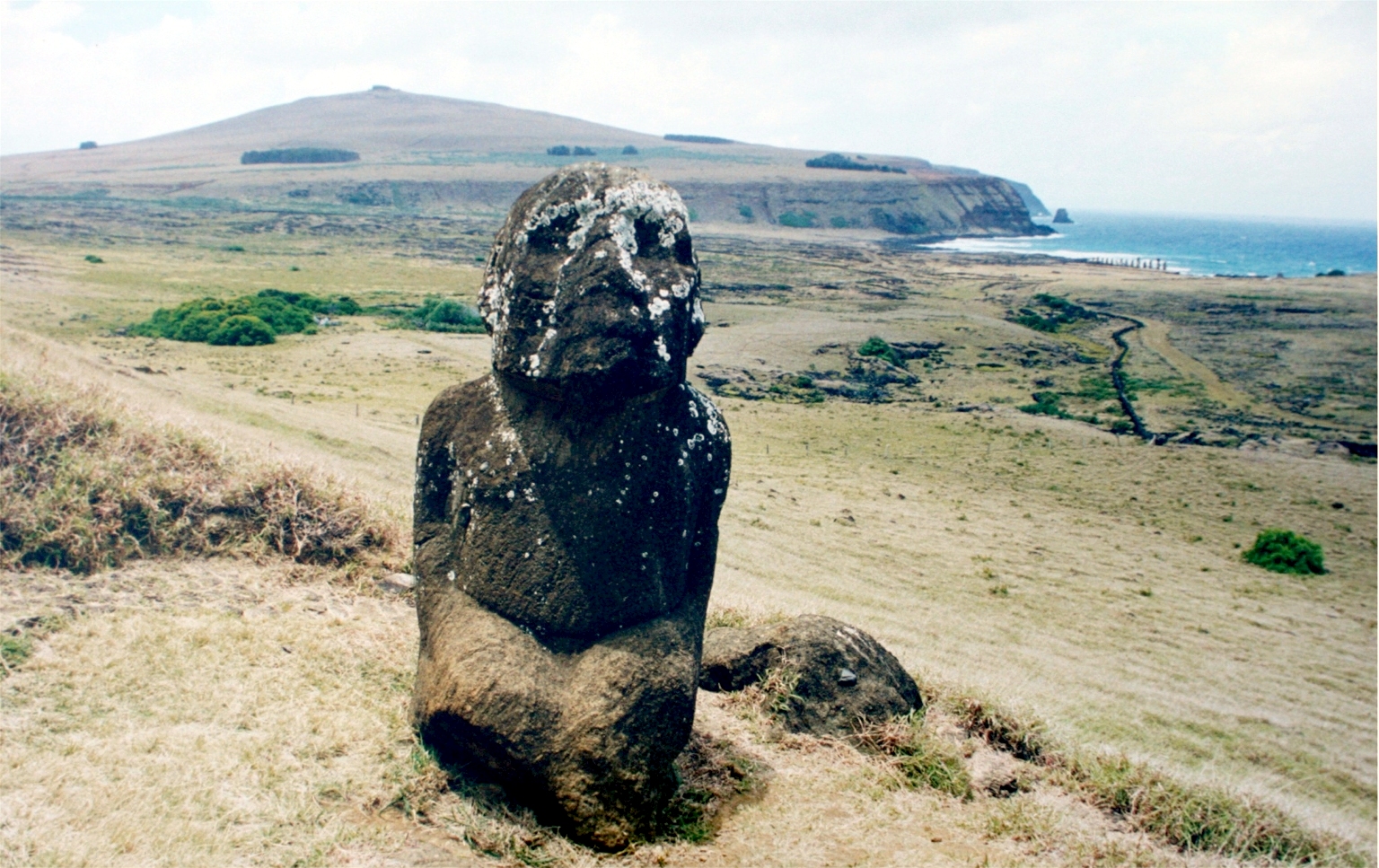
image credit banner: Tukuturi, Brocken Inaglory, CC BY-SA3.0
This year’s edition of the University of Chester Archaeology Student Conference on the Archaeology of Death, DigiDeath 2021, on January 27-28 (for a complete program as well as links to several of the presentations, please see entry on professor Howard Williams blog Archaeodeath), was dedicated to the public archaeology of digital mortality. The event was clearly framed by the global pandemic. The ever looming themes of death and mortality are not new to the yearly conference devoted specifically to these topics, but the changes in howwe die and how we mourn in the time of Covid-19 probably brought the themes of mortality, mourning and commemoration even closer to home this year. In addition, the closure of museums and universities, and the cancellation of conferences, workshops, and other meeting spaces for academic exchange and learning, brought digital tools and social media into focus, and of course, the event took place online.
The papers were presented by students as well as researchers in a range of formats, from live papers presented digitally, to twitter papers and video recordings, all engaging new forms for communication and archiving of academic production.
When summing up the many presentations, several themes around public archaeology and digital tools come into focus, all relating in explicit and implicit ways to broader considerations of ethics – professional and personal.
“Sharing is not always caring”
Several papers on different aspects of public archaeology raised interesting questions about accessibility, education and multi-vocality. While images of archaeological remains and virtual tours of exhibitions serve the important goal of opening up museums, collections, and even the archaeological research process to all, they also pose new questions. Where do we draw the line regarding what to share and how? “Sharing is not always caring” – as stated by Erin Munro in her paper on virtual exhibition tours and mortuary heritage. But how can we tell when we cross the line? Does the showing of human remains become less respectful when it leaves the museum context and moves out on the web – in a virtual exhibit or an instagram post – and if so, why? By asking ourselves these questions we get the opportunity to examine our culturally shaped understanding of museum spaces, and in that process we must also realise that what may be a respectful place in our eyes may be perceived very differently by others
New technologies bring new possibilities – and ethical challenges. The reproduction of 3D models of human remains (paper by Campanacho and Alves Cardoso) invites us to reflect over post mortem privacy and integrity in new ways. This is a growing and unregulated field that has not yet found its ethical footing.
Other ethical issues that were raised related to the ways in which engagement with the public also entails sharing the power over the narrative. Powerful narratives of the past that are presented in the press, in movies, TV series and video games, often take great liberty with the creative license, focusing on the spectacular or gory, highlighting male elites at the expense of others, and reproducing stereotypes about the past. The digital era and its many and various tools intensifies this engagement through online communities, comment sections, an approach to lived experiences through gaming, and so on. What is more important, we may ask: that the past is represented in a “correct” way, or that people engage with it at all? The consequences of misrepresentation might be even higher in the ways in which the press and social media often present archaeology and anthropology, reproducing colonial and ethically questionable images of treasure hunters and grave openers. While these images appear to still attract a part of the public, they are offensive and disrespectful to others and threaten to undermine the work of making archaeology a more respectful and inclusive practice.
In our contemporary digital era, images play a central role in how we communicate with each other and how we draw attention to our work. Online presences on blogs and social media pose new questions about both personal and professional ethics. It is important at this moment to not be satisfied with easy formulaic answers to our ethical dilemmas, but to view our task ahead as one of constant questioning and examining of the ethics of the discipline – and most importantly, of ourselves in our roles as archaeologists and fellow human beings.



 Ethical Entanglements