All the skeletons in the school closets

Last week it was that time again. Swedish media and the public were made aware of the presence of human remains in schools across Sweden. This time the event that triggered the news coverage was the discovery, on behalf of a parent, that a skeleton suspended from the roof of a theatre stage in their child’s highschool in Danderyd as a Halloween decoration, might in fact be authentic. It is interesting to note that nobody at the school seems to have been aware of its existance (including the biology teachers), and nobody was able to authenticate the skeleton as human.

After the discovery, the display was removed, and the school started an investigation that consulted an outside specialist. After examining the remains, the specialist could confirm: these were the remains of a human. But since the consultation was only osteological, its provenance remained unknown. It would require a lot more work to trace who the person whose bones were examined had been in life. This is not unusual. Typically, human remains in schools have a long and complex history that is poorly documented and often forgotten. They were acquired many decades ago, and may have circulated between collections, and changed schools. The Danderyd Highschool now faced the same problem that many Swedish schools have faced before: what should they do with these remains?
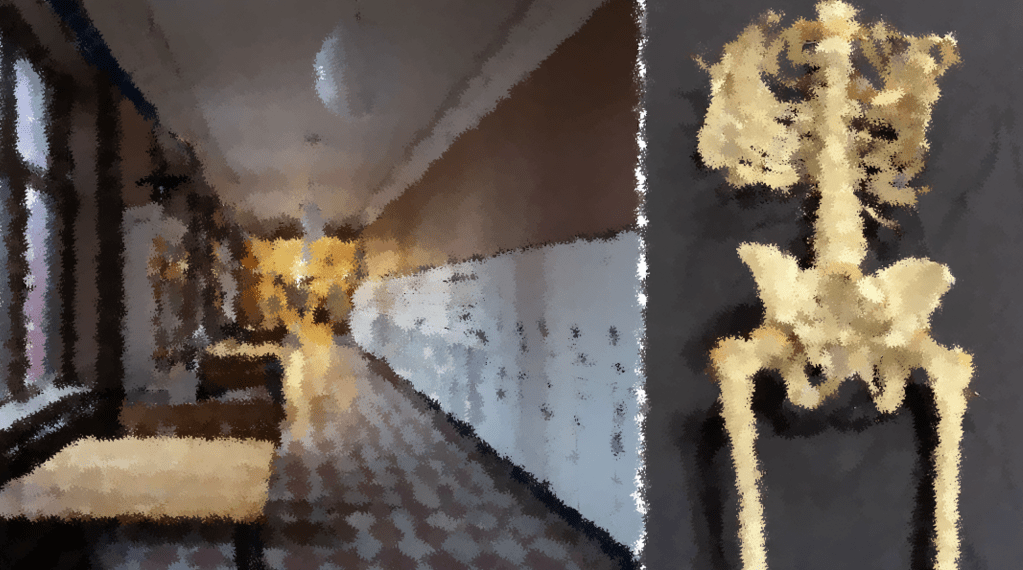
Press photos from inside the Danderyd High School and of the skeleton that was used as a Halloween prop. The photos have been intentionally blurred for this blog.

As I have argued in the article Between Objects of Science and Lived Lives. The legal liminality of old human remains, human remains from historic contexts are situated in a legal gray area, and there are no clear laws on how to handle them. For any school that suddenly discovers that they have human remains in their closets, it is difficult to know what the right thing to do might be. They can turn to the police, to museums, to the National Heritage Board, and even to the Swedish Church – and many do, and find that not only do these institutions not feel that this is their business, but also that nobody can really advise them about what to do. This conundrum has been discussed in this blog before, and the case of schools has also been the subject of excellent reporting by Swedish Radio in 2016.

“What is well intentioned may still be ill advised.”

In the case of the Danderyd skeleton, the decision has now been made that it will be cremated and buried in the local cemetery. While this, at first glance seems to be a well intended course of action, it is highly problematic since no provenance research has been carried out on the remains and we therefore have no idea if this would be desired or even acceptable for this individual. What is well intentioned may still be ill advised. To put it bluntly, this act is more about satisfying the needs of the school and the local community than the needs of the person whose remains were used as a prop by that very same community only a few weeks ago. This is not good enough.

The cremation and burial of human remains in a Christian cemetery may not be for everybody. “Cincinnati – Spring Grove Cemetery & Arboretum “Foggy Morning At Old Oak Tree”” by David Paul Ohmer is licensed under CC BY 2.0.

In several interviews with Swedish Radio and TV I have argued that given that there is likely to be a large amount of human remains in Swedish schools, this is not a problem that is likely to go away anytime soon. What we need is a proper inventory of what is out there, so that we can get an overview – not unlike the inventory that was carried out in Swedish museums in 2016. Once we have an overview we can develop support and guidelines. Ideally, provenance research should also be carried out so that we know what any appropriate course of action might look like.

This is a big job that will require specialist competence. It is not fair to expect individual schools to take responsibility for this. The situation in Sweden is complicated by the fact that the administrative responsibility of schools has been decentralised from the state to the county level (kommun) in a reform in 1991. Is is safe to say that the large majority of the human remains in Swedish schools were acquired long before then, and the responsibility of this necessary inventory and research must therefore fall upon the Swedish state and in particular on the National Agency for Education (Skolverket). When confronted with this request from me in a TV interview on Nov 15, the National Agency for Education predictably punted the question to the county levels, who in turn decided not to respond to the journalists requests.

What happens next will be interesting to follow, and while the future is unpredictable, one thing is for sure: if we do not take responsibility for this problem now, we will have another story just like this one break in a couple of years, and we will start the debate over. Again.
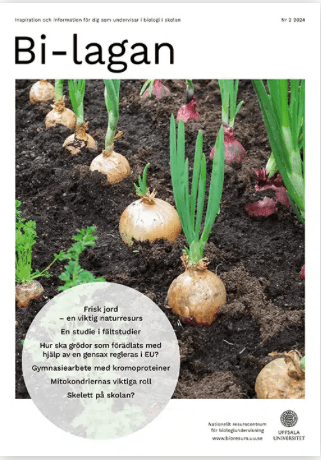
Update: Liv Nilsson Stutz published a short text in Swedish on the topic in Bi-lagan, a resource publication for biology teachers in Swedish schools, published by Uppsala University, in the fall of 2024.

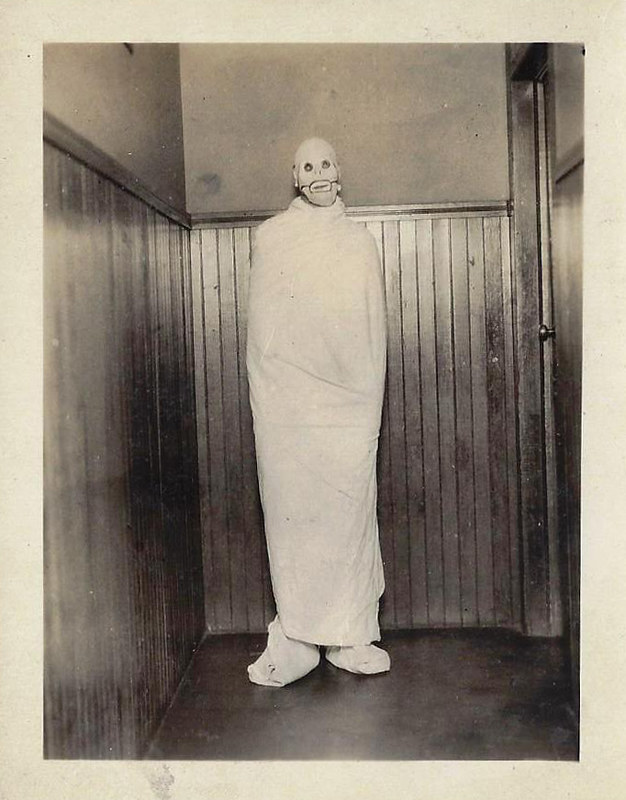
featured image: “Vintage Halloween costume snapshot” by simpleinsomnia is licensed under CC BY 2.0. To view a copy of this license, visit https://creativecommons.org/licenses/by/2.0/?ref=openverse.
Thanks, But No Thanks? The challenge of spontaneous donations of human remains to museums.

In recent conversations with the Swedish museum community, I have been made aware of the challenges they face as people, who for various reasons are in possession of human remains, approach them to make a donation. This may sound odd, but it is quite common, and this probably marks a shift in the culture regarding our attitudes to human remains and the ethics that surround them. And it presents museums, as institutions trusted to “take care of things,” with a difficult conundrum.

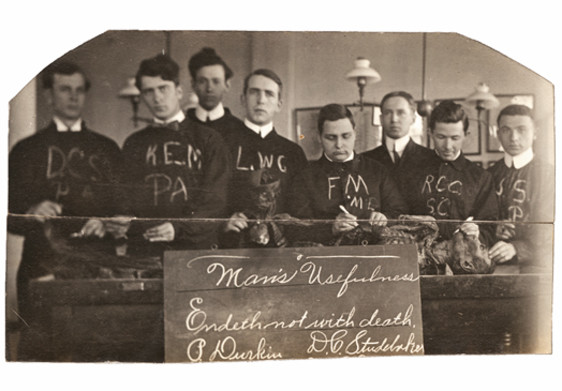
Most of these spontaneous donations are offered by family members of deceased physicians and dentists. In the past, it was quite common for medical students to acquire anatomical specimen as part of their professional training. Having a cranium at home probably initially helped you to learn some anatomy, but it is likely that the possession soon transitioned from pedagogical tool to professional symbolic marker. Studies have shown that the engagement with the human corpse, especially in the form of the practice of dissection, functioned as a rite of passage in medical schools in the past – and still to some degree can be argued to play that role. Through the completion of dissection the medical student becomes marked off as different, as part of a groups of specialists for whom engagement with cadavers is normal. This would have played a central role in professional identity production, and memorial photographs from medical schools indicate that this was also a performance which underscored the distinction from “civilians.” Here, the shock factor, played a part in marking the identity. The keeping of human remains, most commonly skulls, but also other specimen, in the office or even at home, can probably be viewed as part of the same professional identity performance. 

American Medical Student dissection group photograph. The students are posing with the cadaver on a table signed with the name of the school and the year of their class – a common practice to commemorate the event. Photo from Discover Magazine (link above).

But times change – both outside of and in the medical profession. Dissection has become a place where medical ethics are taught, and it is no longer considered unproblematic to keep human remains around the house. Consequently, as older members of the profession die, the skulls kept on shelves start to become an issue to be solved by the survivors. 

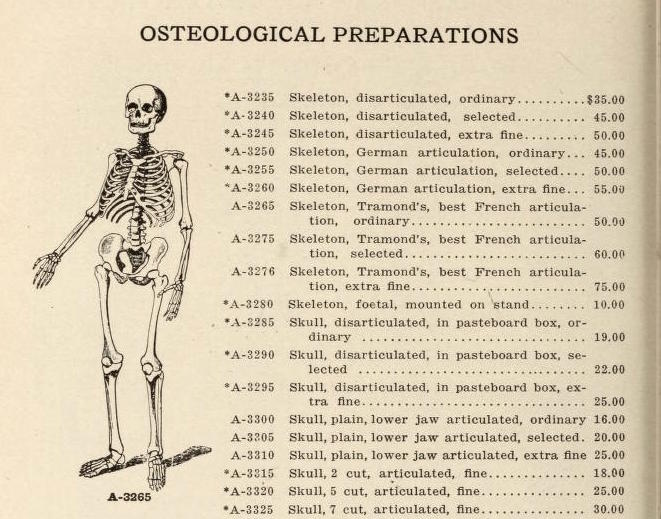
Another source for these remains is teaching institutions, like public schools, that historically would have a teaching skeleton in their pedagogical arsenal, and perhaps also as a symbol of science more generally (since advanced anatomy never was a core component of the curriculum for most students, although exceptions exist). A debate has emerged in the last few years also in the pedagogical community. Although an underresearched area, anecdotal evidence shows that cases of unethical practice can aslo be linked to these collections (like the case of a school skeleton in Strömsnäsbruk sourced from a marginalised local man who committed suicide in 1847). As the school system is being reformed, and schools reorganize and move to new or refurbished buildings, the old skeletons emerge as left overs from the past that need to be handled. With the change in the social and cultural debate they are no longer viewed as unproblematic, and perhaps their usefulness is also being questioned. Schools too are looking for ways to ethically dispose of or rid themselves of these bones. In some cases, like one in Strömsnäsbruk (and others), burial of the remains remind us of similar burials in cases of repatriation to indigenous peoples.

Some of the remains were obtained through not only legal, but culturally sanctioned and celebrated practices at the time, while others were obtained through theft and other dubious or criminal practices. It is important to remember that while widows of dentists and physicians are trying to do right by the remains in their homes, human remains are still being traded today and how illegal that is depends on their provenience. The field is still shifting. 

In a seminar held with museum representatives on Nov 12, 2022 and organised by the Nordic Network for Human Remains in Museums, different experiences were discussed. From the discussion it became clear that museums tend to avoid accessioning problematic human remains. Most of the museums have a policy based on perceived responsibility. For example, if the museum or institution can be connected to a university that provided the medical training of the person holding the remains, or if the remains to be returned has some other connection to the collections already held by the museum, then there is a certain responsibility to receive the remains. The responsibility is not only about personal ethics and postmortem dignity but can also be linked to the professional ethics of documenting the historical practices of collecting and using human remains. It is important to underscore that this is also a consideration that should not be neglected. Other museums only accept archaeological remains.

But when museums do not accept the spontaneous donations of human remains – what happens to them? Who takes responsibility? 

The Swedish Church, The County Boards, the Police, and the Swedish National Heritage Board can also be considered stakeholders with different responsibilities. But so can all the municipalities that are formally responsible for the school system in Sweden today, and even the Swedish National Agency for Education. Bottom line, it is often unclear for an individual or an organisation, like a school, seeking guidance on how to properly dispose of human remains where to turn if the museum turns them down. 

Most commonly people are referred to the Swedish Church that has routines for destruction, but it is still a bit unclear how to proceed since the organization is decentralized when it comes to burial rights and practice. 

What I find fascinating in this discussion is that it so clearly illustrates that a new ethical dilemma has emerged as our social and cultural attitudes to human remains have changed.

What I find fascinating in this discussion is that it so clearly illustrates that a new ethical dilemma has emerged as our social and cultural attitudes to human remains have changed. This is a problem that did not exist in the public mind only a few decades ago. The issue spans many different professional and scientific spheres, from archaeology, to medicine, to forensics and to pedagogy. As it is no longer considered unproblematic to keep human remains in homes, offices, and school classrooms, we are all grappling with how to handle them. Should they be buried, destroyed, or preserved for teaching and research? How do we proceed?

A first step would be to clarify who in the long chain of stakeholders has the responsibility not to curate or dispose of, but to research the history and provenience of these remains. This is a first necessary step to even know what an ethical next step would be. But this is costly. It is not reasonable to lay the burden on individual museums that have no formal, historical connection to the remains, which is probably the reason why they are not willing and able to accept these donations. At the same time, it is not reasonable to lay this burden on the relatives of the collector, especially not if they explicitly want to pass them on for ethical reasons. 

We have work to do.