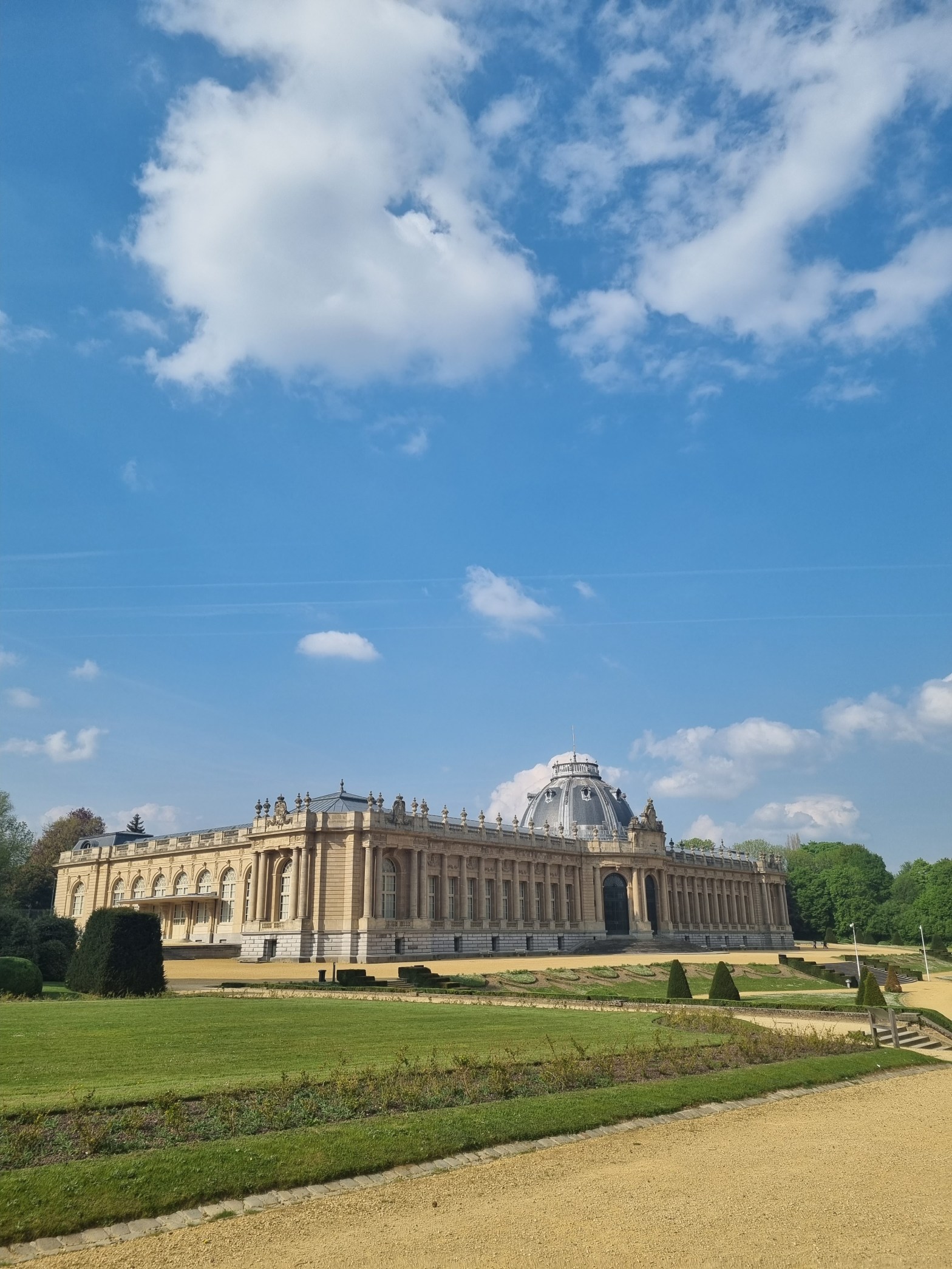
On May 2-4, 2022, I participated in a workshop “Museums, sustainability, collections” at the Africa Museum / the Royal Museum for Central Africa in Tervuren, Belgium. The workshop was organised within the European cooperation project “TAKING CARE – Ethnographic and World Cultures Museums as Spaces of Care” and included curators, conservators and other museum professionals from ethnographic museums from across Europe and Africa. A central focus of the TAKING CARE project is the climate crisis and the Anthropocene with a particular focus on entanglements with colonial histories and their reverberations in our contemporary world.
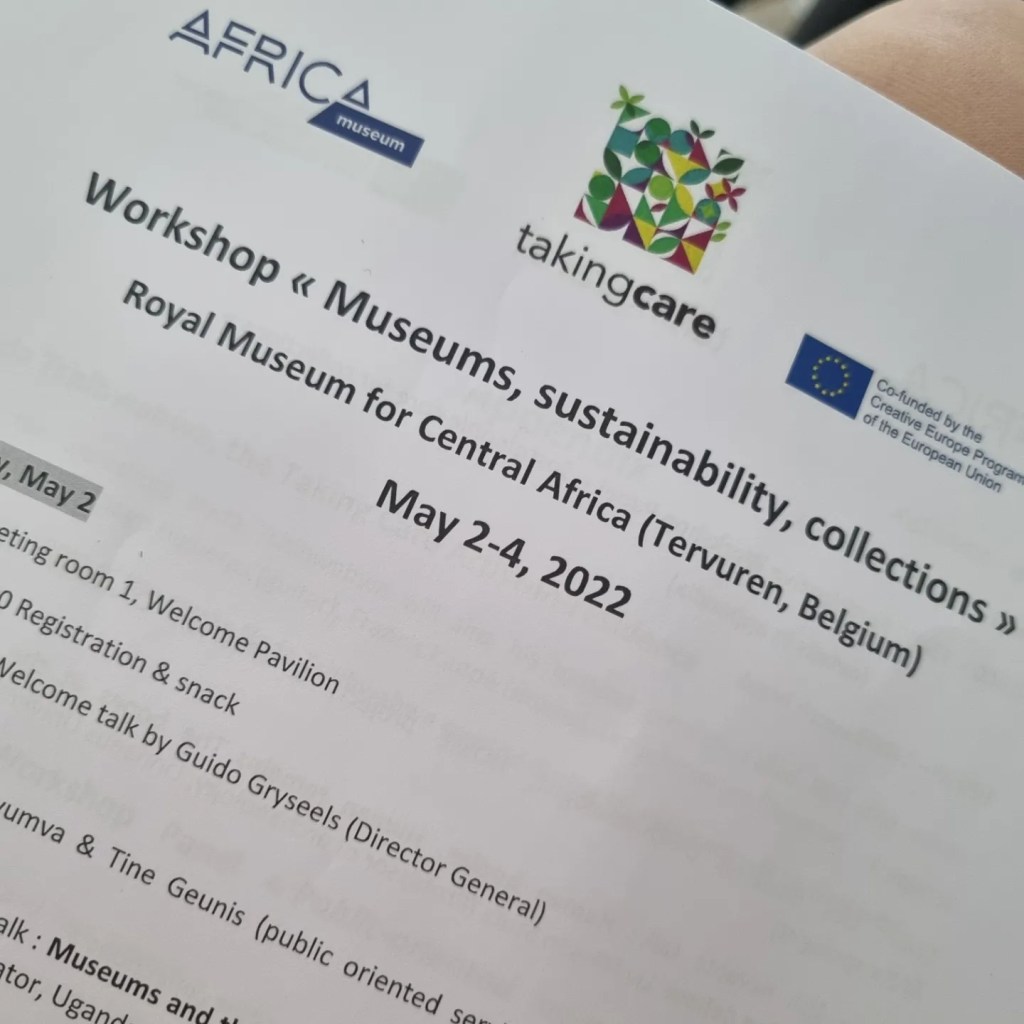
Glimpse of the workshop program. Photo: Liv Nilsson Stutz
The workshop included three keynotes that in different ways addressed sustainable collection practices. Chris Ssebuyungo (Conservator at Uganda National Museum) discussed the relationships between the museums and their publics from his experiences in Uganda. André Ntagwabira (Researcher in Archaeology at the Rwanda Heritage Academy) and Siska Genbrugge (Objects Conservator at the Royal Museum for Central Africa) explored challenges relating to collections care of African collections weighing conflicting interests such as accessibility, cost, environmental impact, and health risks relating to, for example, exposure to pesticides used in conservation practices. My talk on the care for human remains discussed the ethical entanglements of different collections with a range of power structures, including those of colonial histories, and explored alternatives for ethical care practices for these sensitive collections. The talks were all followed by extensive collaborative workshop discussions where participants shared their experiences and perspectives with these issues. It was clear that we are in a moment when museums across Europe are all grappling with the challenges of how to best deal with their history, their role as contemporary inclusive and safe spaces, and their role as agents for sustainable futures.
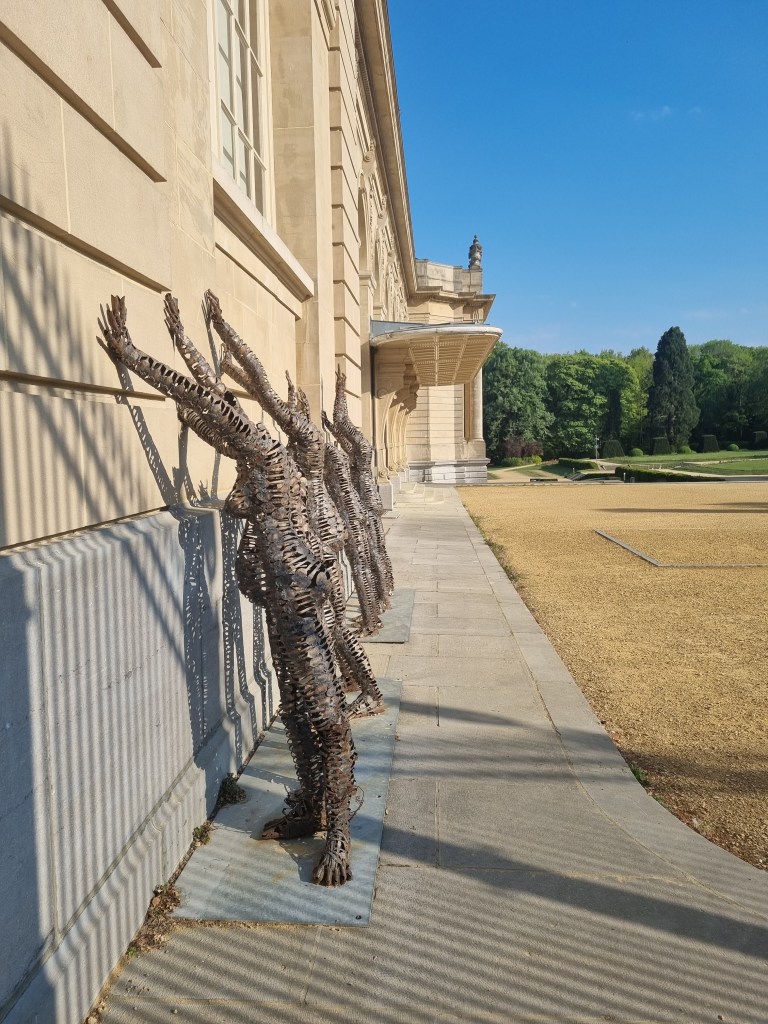
Freddy Tsimba “Centres fermés, rêves ouverts” Tervuren, 2016. Tsimba’s sculpture is made from materials recovered from the building site during the new constructions of the museum in 2016. The sculpture gives form to his experiences in a closed center in Belgium and is a tribute to refugees being interrogated across the world. Photo: Liv Nilsson Stutz
In the segment of the program devoted to discussing sensitive collections we discussed different strategies used by museums to tread the difficult balance between accessibility and respect – for example the ways in which searchable databases can include specific protection for sensitive materials, or only be accessible from within the museum by researchers, descending communities, and curators. Participants also discussed what ethical engagement might look like in the work with human remains – and one participant shared how many bioarchaeologists and biological anthropologists systematically talk to the human remains as they study them to maintain the connection to and acknowledge their humanity. The discussions also raised new questions emerged in relation to new museology techniques. As auditory elements become increasingly incorporated in museum exhibitions, we could for example ask ourselves whether the documented sound of a voice should be included in the category.
The TAKING CARE project involves museums with ethnographic collections, and this means that the focus of any ethical exploration will be rooted in a critical analysis of colonial research and collection practices. In this discussion human remains is only one of many categories of sensitive collections. But there is nevertheless significant overlap in the challenges we all face, and many of the ethical considerations are very similar. In 2013 The Royal Museum for Central Africa closed to accomplish a complete overhaul of its exhibitions. The ongoing work on provenance and restitution is currently central to the mission of the museum.
Sculpture in openwood work by Aimé Mpane representing the Skull of Chief Lusinga which was taken by the Belgian officer Emile Storms as a trophy (the Chief was killed and beheaded) during a raid on the on the village of Lusinga in 1884. The cranium was part of the collections of the Royal museum for Central Africa until 1964, and was then passed on to the Royal Belgian Institute of Natural Sciences. The cranium has not been repatriated. Photo: Liv Nilsson Stutz
While the theme of human reamins was not central for this workshop, it is relevant when thinking about decolonisation and collections. Currently a large scale project called HOME (Human Remains Origin(s) Multidisciplinary Evaluation), to inventory all human remains collected abroad and currently located in museums, research institutions and private collections in Belgium has been initiated. The interdisciplinary project will identify “the individual people, the conditions under which their remains were collected and in some cases, will try to better understand past lifestyles, both from a cultural and biological point of view.”
“In Belgium, there are currently no guidelines for the conservation and management of human remains, nor a legal framework for the return of human remains to family members, institutions or countries of origin. “
The project will also study Belgian and international legal frameworks for repatriation and restitution. Just like in, for example Sweden, “there are currently no guidelines for the conservation and management of human remains (in Belgium), nor a legal framework for the return of human remains to family members, institutions or countries of origin. A large inventory supplemented with archive material should help to identify more individual people and better understand the circumstances in which they were acquired.” This is in and of itself not unusual. What stands out in the case of Belgium however, is that up to today, Belgium has never repatriated any human remains to another state. This is perhaps especially striking given the well known colonial history of Belgium.
The Ethical Entanglements project mainly focuses on collections of human remains in museums, but a significant process by which they get there today is contract archaeology. In contrast to the scientific practices that resulted in many of the older collections in museums, including ethnographic, anatomical and archaeological collections, these new additions to archaeological collections are dominated by a practice driven primarily by development (such as the constructions of roads, schools and railway stations) – where archaeology is inserted as a measure to record and document cultural heritage before the destruction of these contexts for other purposes, rather than driven purely by scientific aims. To an extent this shifts the discussion. This means that it is not the scientific practice that is the root to the excavation and collection of these remains, but development. It also makes archaeology and collection into a protective practice, rather than an exploitative one. That being said, the ethical challenges remain the same, and the field, just like with the case of museum collections, lacks a clear regulation.
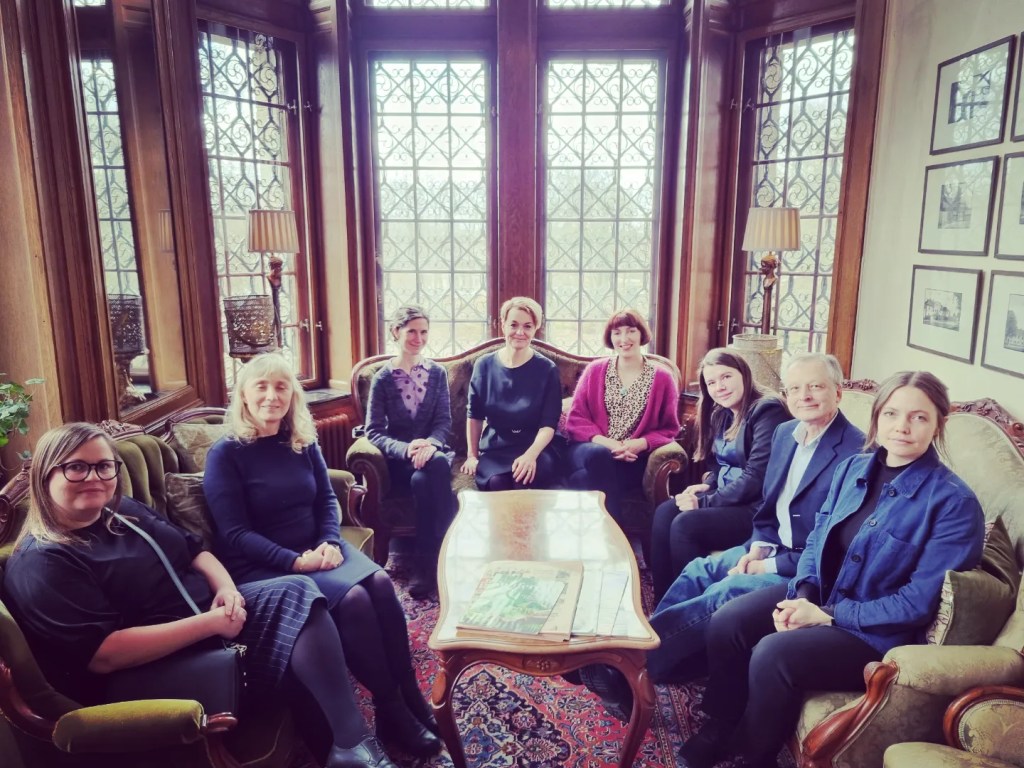
Participants in the workshop (from the left): Anna Tornberg, Caroline Ahlström Arcini, Lisa Hartzell, Liv Nilsson Stutz, Hayley Mickleburgh, Ina Thegen, Niels Lynnerup, and Clara Alfsdotter.
The workshop gathered experts and colleagues working with human remains from contract archaeology contexts in Sweden and Denmark. While presenting a broad view, the different perspectives all highlighted both a concern for ethical issues and an awareness of the importance of professional ethics, and a lack of clear structures, which results in a variation in practices and decision making.
Dr. Clara Alfsdotter, osteologist at Bohuslän County Museum presented the view from a regional museum in Sweden, and highlighted how, despite the existence of guidelines and recommendations, the interpretation of these very guidelines can vary and often depends on the single museum or, even individuals. These issues were discussed around two examples. In one case there were very different views within the museum whether it would be ethical to create an exhibition on the topic of syphilis in historic times using human remains in the mueusm collectons. The other example discussed how priorities in the field could favour the documentation of architecture over human remains. This example was especially problematic as it concerned a medieval monastery, where human remains can be expected.
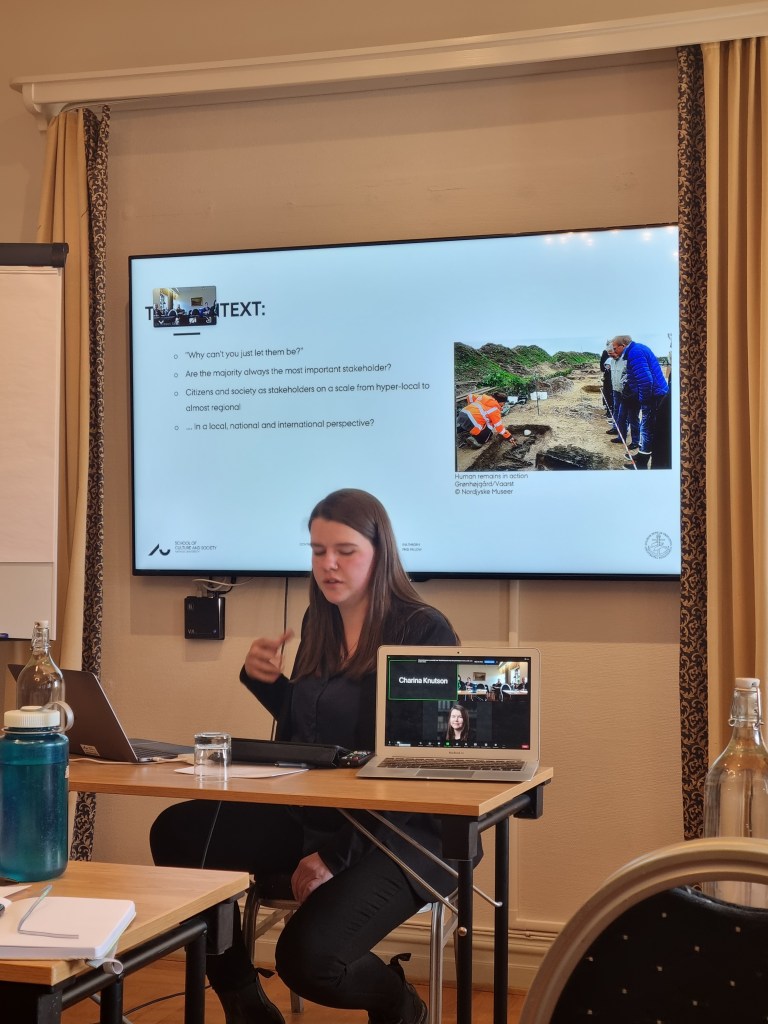
Charina Knutsson, archaeologist at the museum Jamtli, and graduate student at the Linnaeus University Graduate School in Contract Archaeology (GRASCA) discussed the issue from the perspective of contract archaeology in Sápmi. Her previous research, published in her licentiate thesis Conducting Archaeology in Swedish Sápmi: Policies, Implementations and Challenges in a Postcolonial Context has demonstrated the lack of consultation with the Sámi communities in contract archaeology, and this disconnect potentially also affects how human remains are treated in the process. In her presentation she discussed that museums in the region all have policies regarding the handling of human remains, but there are no special recommendations for Sámi remains. The topic is current, but also still, to an extent sensitive.
Dr. Carline Ahlström Arcini, osteologist at the contract archaeology firm Arkeologerna opened her presentation with a moving account of how childhood visits to the paediatric ward at the hospital in Norrköping where her father worked as a physician, initially drew her to the field of osteology. This presentation reminded us of the importance of compassion as a key feature of a discipline that not only allows us to come face to face with an individual of the past, but also allows us to glimpse their lived experience, including pain and illness. Her presentation discussed how different stakeholders have different voices in the Swedish context, and that the Swedish church tends to be among the most critical, while the public ususally are mostly interested in the results. Who, we might ask, are the most important stakeholdes here?
Ina Thegen presents her paper on Danish contract archaeology.
A similar concern was raised by Ina Thegen, graduate student at Aarhus University, who placed these questions in the frame of her thesis that maps and problematises the connections between the legal frameworks, practices, and stakeholders in Danish contract archaeology. She too, points to the Church as a vocal stakeholder along with the media. But she also asked us to problematise if a stakeholder is less valid only because they do not represent the majority. She also discussed how human remains are categorised as movable objects and do not have a clear caretaker within Danish archaeology per se, but rather is under the purview of other disciplines (predominantly medicine), which may create a series of ethical challenges as they are not prioritised by the contract archaeology praxis.
Dr. Niels Lynnerup, head of the Forensic Department at the University of Copenhagen which holds the vast majority of human remains collected in Denmark by contract archaeology (the second depository is at the University of Southern Denmark / Odense), spoke on behalf of this other side of the Danish equation. From the perspective of a vast experience with a range of different contexts he underscored the importance of communication with all stakeholders as a fundamental step toward ethical practice – a theme that was echoed in the other presentations as well, thus highlighting a crucial arena for progressive and constructive work.
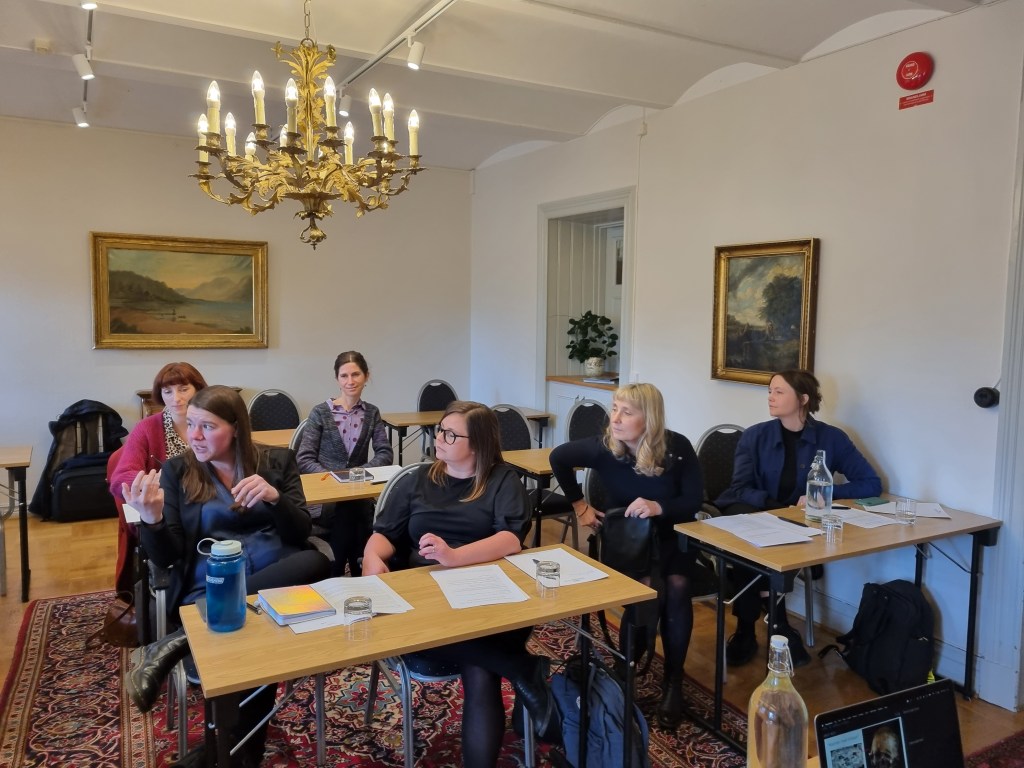
Discussion and exploration of concepts during the workshop. All eyes on Niels Lynnerup – who is out of frame.
Dr. Anna Tornberg, osteologist at the Department of Archaeology and Ancient History at Lund University, discussed the ethical implications of the Third Science Revolution on research. Her presentation highlighted the importance of keeping an eye on how funding agency priorities and publication strategies impact the research process by imposing a top down perspective on human experience in the past. While these new methods offer a lot of possibilities, they also present new ethical challenges that we must consider.
The workshop was very dynamic and inspiring, as the different presentations offered complementary views on a very current and clear professional challenge. We left feeling that we have only started to explore these complexities and are looking forward to more exchanges of ideas and experiences in the near future.
Last week (January 26-27) the researchers with Ethical Entanglements met with the advisory board for the project, including Fredrik Svanberg (Nordiska museet, Stockholm), Linda Andersson Burnett (Uppsala University), Olof Ljungström (Karolinska Instititutet), Malin Masterton (Örebro University), and Kicki Eldh (The Swedish National Heritage Board). The meeting was held at the Ethnographic Museum in Stockholm. The project members presented their respective work packages to the board and received invaluable feedback from the board members who represent a range of experiences and expertise that in different ways will enrich the project with perspectives from the museum world and Museology, Medical Ethics, the History of Ideas and Knowledge, Postcolonial Studies, and more broadly from a critical engagement with Humanities and Social Science research and its history.
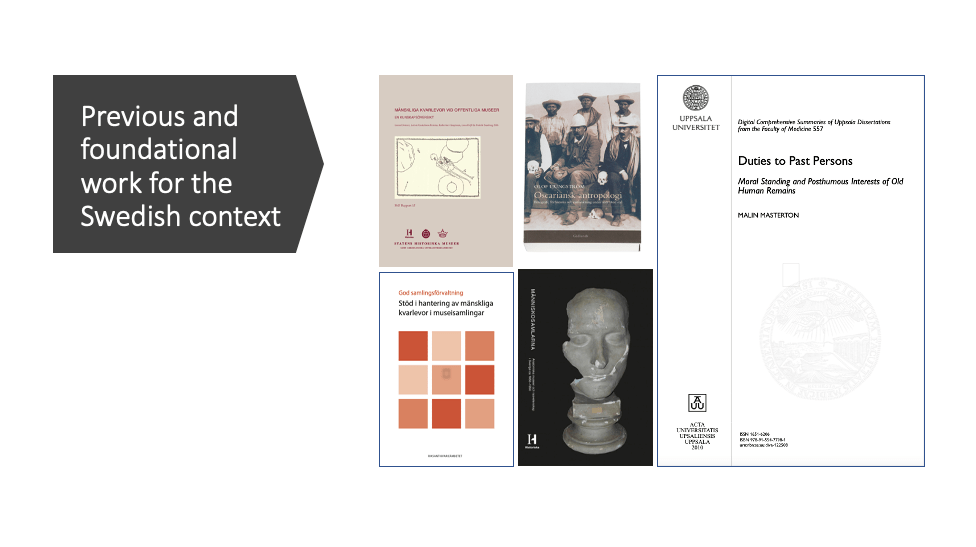
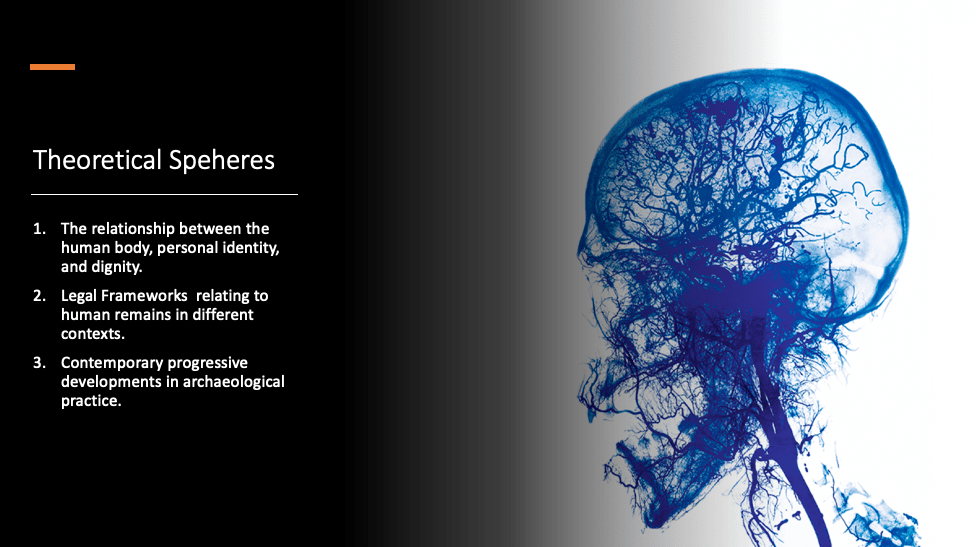
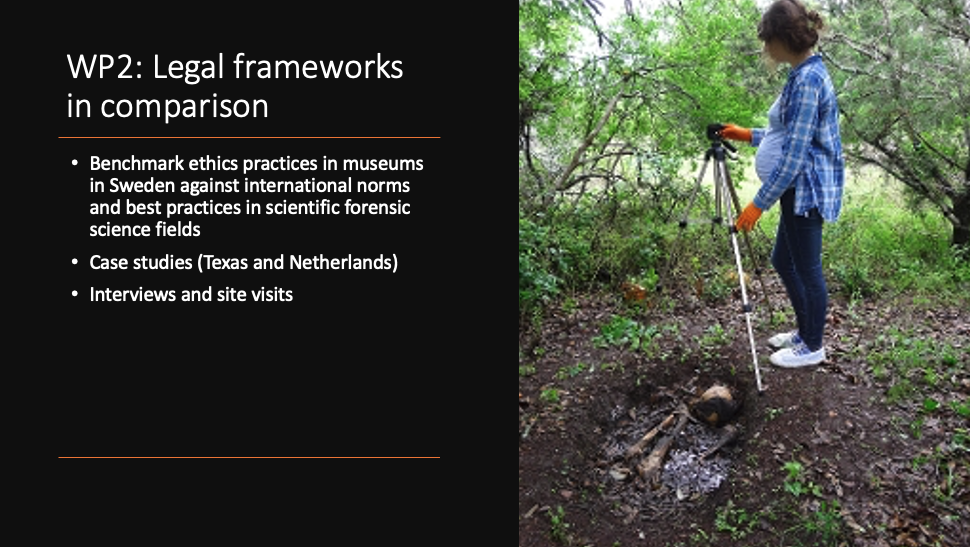
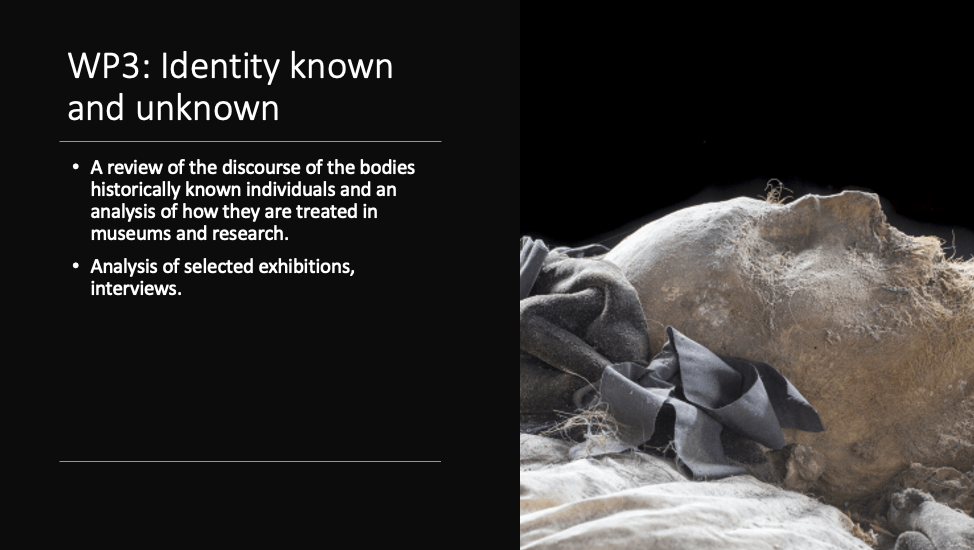
Abbreviated version of the ppt of the overall project
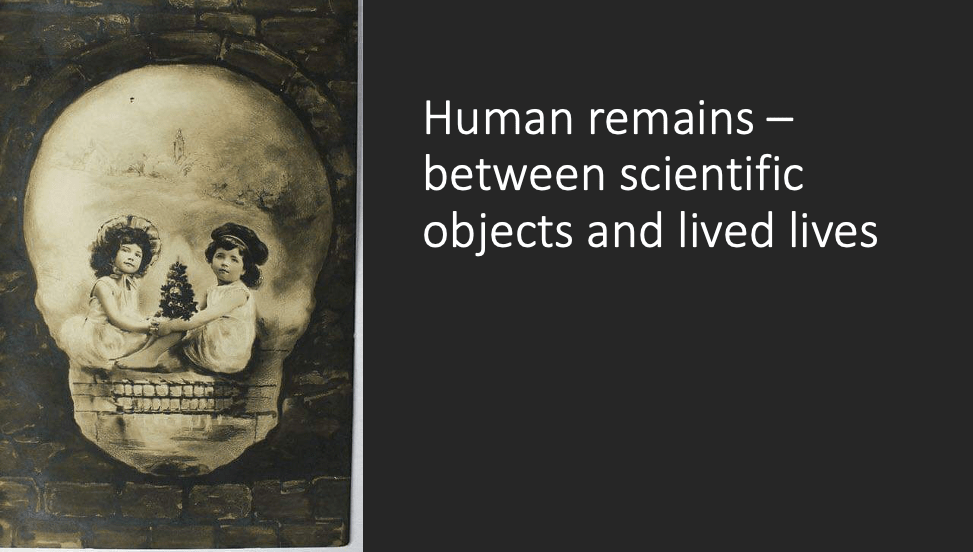
A lot of the discussions came to focus on the ways in which human remains are positioned on a sliding scale, between object and subject, between lived lives and specimens for sciences, and sometimes between evidence and victim – and how their positioning on the scale changes over time, between cultures and academic disciplines.
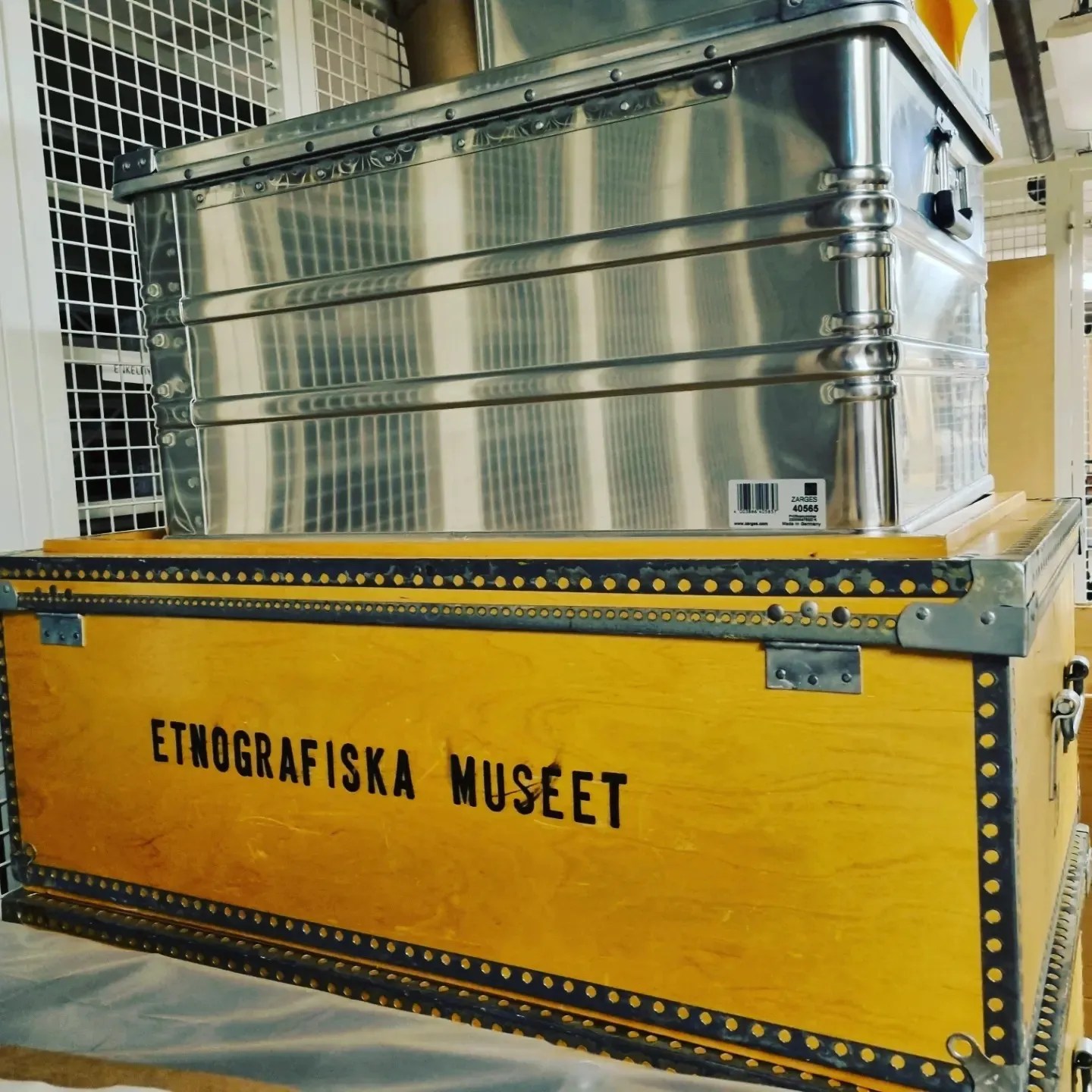
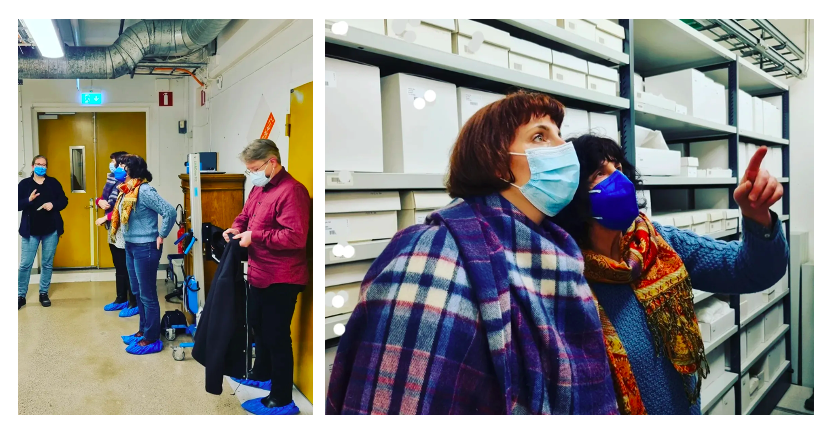
visit to the storage area of the Ethnographic Museum, photo: Liv Nilsson Stutz
After the meeting, Mia Broné, objects coordinator for the four National Museums of World Culture (Etnografiska museet, Medelhavsmuseet, Östasiatiska museet, och Världskulturmuseet), presented the work that these museums in different ways have worked intentionally with their collections of human remains, and the rich and complex history of the collections. We finished with a visit to the storage area where we continued to discuss practice and ethics of care.
A few weeks ago, The European Journal of Archaeology published three book reviews of the same book. That may seem a bit unusual, but the book in question, Repatriation and Erasing the Past by Elisabeth Weiss (a professor of anthropology at San José State University) and James W. Springer (a retired attorney and anthropologist), can without exaggeration be called one of the most controversial academic publications in recent years. It is important to realize is that this book is not a traditional piece of academic writing characterized by curious exploration and scholarly pursuit of a complex topic. Instead, it is an explicitly argumentative text that centers on the position that repatriation is is harmful to research. By building a case against repatriation, the authors seek confrontation with other stakeholders, not dialogue. The law that is scrutinized in the book is the Native American Graves Protection and Repatriation Act (NAGPRA) that since it was signed into US federal law in 1990 has transformed archaeological and museum practices in the United States and their relationships with Native American communities, most would say, for the better.
Given the impact of NAGPRA, and the ways in which it today is perceived as having had a positive transformative effect on research and museum practices, many archaeologists and biological anthropologists have felt the urge to go on the record about this book. I am one of them. The other two reviewers in this issue of EJA are Joe Watkins, archaeologist, member of the Choctaw Nation of Oklahoma, and senior consultant with Archaeological and Cultural Education Consultants, Tucson, Arizona, and Chip Colwell, archaeologist, former senior curator of anthropology at the Denver Museum of Nature and Science and founding Editor-in-chief of SAPIENS. Both their reviews are important and insightful and provide thoughtful and initiated critique.
“Nearly every sentence of Repatriation and Erasing the Past is strewn with mischaracterizations, inaccuracies, misleading assertions, false claims, or hyperbole.”
Colwell, 2021 review of Weiss and Springer, European Journal of Archaeology 24(4), p. 582
Colwell’s piece focuses on fact checking. In a scathing critique he argues that it is simply impossible to account for all the mistakes in the book. To illustrate his point, he selects a single page of the book – page 211, the first page of the volume’s conclusion, a choice he argues is “fair to the authors” since it sets out to summarize the central content and arguments of the book. His devastating scrutiny, that proceeds sentence by sentence of that one page, reveals a steady stream of mischaracterizations of NAGPRA and of academic sources and citations, misleading statements about the support of NAGRPA in the scientific community and its effect on research and collections. After noting that he is running out of words, he concludes: “Nearly every sentence of Repatriation and Erasing the Past is strewn with mischaracterizations, inaccuracies, misleading assertions, false claims, or hyperbole.”
Watkins starts his review with a very important personal anecdote:
“On December 18, 2020, the University of Florida Press sent a memorandum in an email to its publishing partners, including authors (such as I) who have published in the Press. The memo was an apology for ‘the pain this publication has caused. It was not our intent to publish a book that uses arguments and terminology associated with scientific racism’ (Gutierrez, 2020: 1). However, the Press noted that ‘to withdraw the publication at this point, as some have called for on social media and in other forums, is to attempt to hide it and to hope that simply retracting the book will cause the viewpoint to cease to exist.’”
Watkins, 2021 review of Weiss and Springer, European Journal of Archaeology 24(4), p. 571.
This anecdote is significant because it shows both how much debate this book immediately caused, but also – and this is especially important – the enigmatic position of the publisher. How come, I wonder, did an academic publisher not understand that this book was going to be problematic? The book has already been the subject of intense criticism (see for example Halcrow et al 2021; Kakaliouras 2021; Sassaman 2021; ), and calls have been made to cancel the authors, in particular when they have appeared at academic conferences, which in turn has spurred responses from the authors. While it can be argued that everybody has the right to their opinion, it does not automatically follow that they also are entitled to a book contract. So what did University of Florida Press really think would happen?
While I continue to wonder about the decision to publish this book, I still feel that it is more important to take on the issues it presents in open debate to demonstrate the flaws of their argument, rather than to silence its authors. This is especially important as I see this publication as part of a larger context of a reactionary backlash against progressive critical work in academia today, including postcolonial theory, critical race theory, and gender and sexuality studies, all under fire from conservative politicians and debaters across Europe and the US (see for example the development in the US, Denmark, Poland and Hungary). We note how the argument of protecting “academic quality” often is used to squash intellectual critical theory that challenges conservative political ideologies, and the same reasoning can be found in the book by Weiss and Springer where they systematically characterize repatriation as “an ideology.” In this sense, the book about repatriation in the US can be understood as a party in a much broader cultural war within and outside of the academy today.
In my review, which can be read in its entirety in the journal, I advance three critiques against the case mounted by the authors.
My first critique centres on the lack of reflexivity and power analysis, including a lack of recognition of the colonial history and the contemporary relationships between Native Americans and the academy. Today this must be viewed as extremely problematic coming from two anthropologists. The lack of awareness is revealed in a number of ways, including inflammatory statements, a lack of awareness in the use of nicknames given to archaeological finds, and in the unproblematized use of terms like “race,” and even in the uncommented use of photos from colonial contexts.
A second and related problem is the lack of respect for Native American culture. This attitude permeates the book and is communicated through the casual and systematic dismissal of positions about myths, traditional knowledge, Native American cosmology, and so on. The authors argue that science is more objective and rational, and this position can be defended (especially from their own position as radically anti-post- modern). But when they proceed to deduce that a scientific understanding of the world, including of Native American history, is more valuable for humanity, they introduce a judgement that must be tried on its own terms, but they do not explore this issue, probably because they never questioned it.
These two first foundational principles, imperfect as they are, constitute the foundation for the main thesis of the book: that repatriation is an ideology of victimization—born out of elitist postmodernism—and opposed to the ‘good’ represented in the value of the study of human remains. They argue that this ideology is ‘a modern, political construct and not a genuine reflection of historical Native American cultural beliefs.’ To support this argument they refer to the fact that also Native Americans at times handled human remains, in particular those of their enemies. Why this is relevant for the current debate is not explored or contextualized. The argument that repatriation is an ideology is repeated throughout the book, but never actually intellectually explored or supported.
…just because something affects how you do things, or places responsibilities and boundaries on your actions, does not automatically give you the right to delegitimize it by calling it “ideological.”
But can it really be argued that repatriation is “an ideology”? An ideology can be defined as a set of opinions and ideas held by a group of people. But repatriation is not an idea, it is a practice that is regulated by law and the product of years of negotiation between stakeholders. This practice has affected archaeology, anthropology and museum practices. But just because something affects how you do things, or places responsibilities and boundaries on your actions, does not automatically give you the right to delegitimize it by calling it “ideological.” As research ethics have become more central to our professional practice, there are many practies and protocols that have been regulated, abandoned, and even condemned. In his review of the book Joe Watkins refers to the Nazi medical experiments and to the Tuskegee Study as examples of research practices that we, even though they may contain valuable information, no longer can use – for obvious ethical reasons. The study of human remains obtained through theft and structural, political, and physical violence, must be seen in the same way. What is perhaps the most striking conclusion after reading this book is that the authors simply do not understand that as a researcher you do not automatically have an uncontested right to any materials you find interesting to study.
Repatriation can and should be discussed, problematized, and interrogated, but if the goal is to ask interesting questions about knowledge production, research ethics, decision making and long-term consequences, then the way forward must be paved with mutual respect and interest. I am grateful that the conversations and debates about repatriation, and the practice and experience of engagement have built a solid enough foundation for these debates to go on, assuring – I hope – that this book will be just a small bump in the road forward. However, in this political moment, it is important that so many archaeologists and anthropologists have spoken out in critical terms about this book to not allow it to define our disciplines. The battles for democracy and ethics are never won. The frontiers must constantly be guarded and maintained.
In recent conversations with the Swedish museum community, I have been made aware of the challenges they face as people, who for various reasons are in possession of human remains, approach them to make a donation. This may sound odd, but it is quite common, and this probably marks a shift in the culture regarding our attitudes to human remains and the ethics that surround them. And it presents museums, as institutions trusted to “take care of things,” with a difficult conundrum.
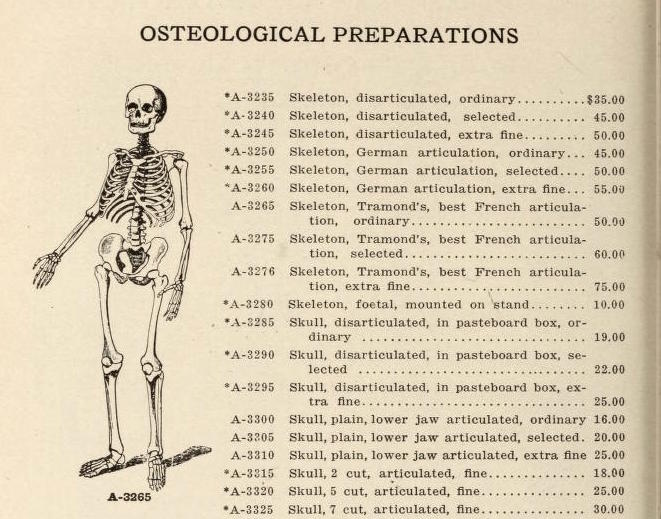
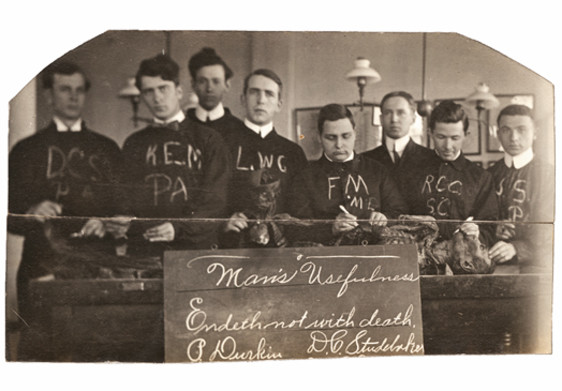
Most of these spontaneous donations are offered by family members of deceased physicians and dentists. In the past, it was quite common for medical students to acquire anatomical specimen as part of their professional training. Having a cranium at home probably initially helped you to learn some anatomy, but it is likely that the possession soon transitioned from pedagogical tool to professional symbolic marker. Studies have shown that the engagement with the human corpse, especially in the form of the practice of dissection, functioned as a rite of passage in medical schools in the past – and still to some degree can be argued to play that role. Through the completion of dissection the medical student becomes marked off as different, as part of a groups of specialists for whom engagement with cadavers is normal. This would have played a central role in professional identity production, and memorial photographs from medical schools indicate that this was also a performance which underscored the distinction from “civilians.” Here, the shock factor, played a part in marking the identity. The keeping of human remains, most commonly skulls, but also other specimen, in the office or even at home, can probably be viewed as part of the same professional identity performance.
American Medical Student dissection group photograph. The students are posing with the cadaver on a table signed with the name of the school and the year of their class – a common practice to commemorate the event. Photo from Discover Magazine (link above).
But times change – both outside of and in the medical profession. Dissection has become a place where medical ethics are taught, and it is no longer considered unproblematic to keep human remains around the house. Consequently, as older members of the profession die, the skulls kept on shelves start to become an issue to be solved by the survivors.
Another source for these remains is teaching institutions, like public schools, that historically would have a teaching skeleton in their pedagogical arsenal, and perhaps also as a symbol of science more generally (since advanced anatomy never was a core component of the curriculum for most students, although exceptions exist). A debate has emerged in the last few years also in the pedagogical community. Although an underresearched area, anecdotal evidence shows that cases of unethical practice can aslo be linked to these collections (like the case of a school skeleton in Strömsnäsbruk sourced from a marginalised local man who committed suicide in 1847). As the school system is being reformed, and schools reorganize and move to new or refurbished buildings, the old skeletons emerge as left overs from the past that need to be handled. With the change in the social and cultural debate they are no longer viewed as unproblematic, and perhaps their usefulness is also being questioned. Schools too are looking for ways to ethically dispose of or rid themselves of these bones. In some cases, like one in Strömsnäsbruk (and others), burial of the remains remind us of similar burials in cases of repatriation to indigenous peoples.
In a seminar held with museum representatives on Nov 12, 2022 and organised by the Nordic Network for Human Remains in Museums, different experiences were discussed. From the discussion it became clear that museums tend to avoid accessioning problematic human remains. Most of the museums have a policy based on perceived responsibility. For example, if the museum or institution can be connected to a university that provided the medical training of the person holding the remains, or if the remains to be returned has some other connection to the collections already held by the museum, then there is a certain responsibility to receive the remains. The responsibility is not only about personal ethics and postmortem dignity but can also be linked to the professional ethics of documenting the historical practices of collecting and using human remains. It is important to underscore that this is also a consideration that should not be neglected. Other museums only accept archaeological remains.
But when museums do not accept the spontaneous donations of human remains – what happens to them? Who takes responsibility?
The Swedish Church, The County Boards, the Police, and the Swedish National Heritage Board can also be considered stakeholders with different responsibilities. But so can all the municipalities that are formally responsible for the school system in Sweden today, and even the Swedish National Agency for Education. Bottom line, it is often unclear for an individual or an organisation, like a school, seeking guidance on how to properly dispose of human remains where to turn if the museum turns them down.
Most commonly people are referred to the Swedish Church that has routines for destruction, but it is still a bit unclear how to proceed since the organization is decentralized when it comes to burial rights and practice.
What I find fascinating in this discussion is that it so clearly illustrates that a new ethical dilemma has emerged as our social and cultural attitudes to human remains have changed.
What I find fascinating in this discussion is that it so clearly illustrates that a new ethical dilemma has emerged as our social and cultural attitudes to human remains have changed. This is a problem that did not exist in the public mind only a few decades ago. The issue spans many different professional and scientific spheres, from archaeology, to medicine, to forensics and to pedagogy. As it is no longer considered unproblematic to keep human remains in homes, offices, and school classrooms, we are all grappling with how to handle them. Should they be buried, destroyed, or preserved for teaching and research? How do we proceed?
A first step would be to clarify who in the long chain of stakeholders has the responsibility not to curate or dispose of, but to research the history and provenience of these remains. This is a first necessary step to even know what an ethical next step would be. But this is costly. It is not reasonable to lay the burden on individual museums that have no formal, historical connection to the remains, which is probably the reason why they are not willing and able to accept these donations. At the same time, it is not reasonable to lay this burden on the relatives of the collector, especially not if they explicitly want to pass them on for ethical reasons.
Last week I was asked to write a short comment for the public outreach science publication Forskning & Framsteg about the ongoing debate concerning the names given to buildings and streets on the campus of the medical university Karolinska Institutet in Stockholm (you can read the full text in Swedish here). This debate can be understood as a Swedish reaction to the broader international protest movement that aims to change the names figuring on university campuses – especially in the United States – that are associated to slave owners and racists.
After protests by students and staff against the names, a thorough report on the history of the naming practices at Karolinska was written by Petter Hellström. He clarifies that the practice to name buildings, lecture halls, labs and even streets after prominent researchers really only became established in the 1990s as the University started to model itself on an Anglosaxon campus model. The individuals thus honoured were mostly medical scientists. Some of them can be linked to race science, racial hygiene ideology, and even Nazi politics.
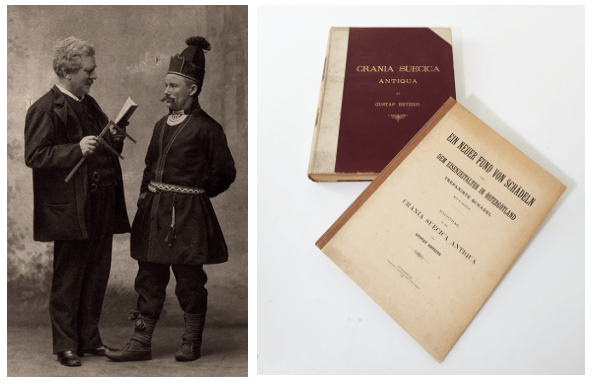
Among those honoured we find Anders Retzius (1796-1860) and Gustav Retzius (1842-1919), a father and son both leading figures at Karolinska, and both heavily implicated in the emerging anthropological race science of their time. Anders Retzius was professor in anatomy at Karolinska and is famous for his cephalic index that allowed him to separate out dolichocephalic and bracycephalic forms, and thus define different human “races.” In addition to describing and organising differences he observed in the anatomy, he also added a value system in which the viewed the Nordic races, and in particular the Swedish, as superior, often using a condescending and problematic vocabulary to describe others. His research was in this way both leading and fundamental in establishing a racial typology at the time.
For the purposes of this project it is key to understand that this research craved human crania and was a driving factor in the collection (through excavations of graves, theft, and the taking of anatomical specimen in hospital institutions dominated by poor and otherwise marginalised patients) and trade with colleagues such as Morton in Philadelphia, in human skulls. Gustav Retzius, professor in histology and anatomy followed in his fathers footsteps and while he did not drive the research front forward as significantly in the field of racial anthropology, he was a very active collector and also participated in the trade in specimens.
It is surprising, to say the least, that even in the 1990s and 2000s, these names were not viewed as problematic enough to be considered out of the question. We must assume that the reason for this was not that any of the committees making decisions on the names sympathised with these ideologies. But what this seems to indicate is that, at the time, the people making decisions were not concerned about racism – probably because they had never experienced it themselves, and likely because they thought about it as something of a distant past – of history, with no actual implications today. This is problematic for many reasons, and I want to underscore a few central aspects that are of particular importance.
The lack of engagement with the topic at the time indicates a lack of diversity at the decision making levels of the institution. The fact that these names were not viewed as problematic a mere 20 years ago is a good illustration of the fact that Sweden has not truly tackled racism in society and in the academy, not in the past, and not in the present. As the academy and research become increasingly international and diverse arenas, this attitude is no longer sustainable.
Medical and medical anthropological research has demonstrated that not only is racism real in societies, but it also affects heath, well being and health outcomes for those affected by it. It is therefore not sustainable that a leading medical research and teaching institution like Karolinska does not firmly take a stand against race science, even if it was carried out in the past.
The collections made by researchers like the Retziuses still haunt archaeology and biological anthropolgy, and have undermined our credibility with other stakeholders generations down the road.
From the perspective of the project Ethical Entanglements, it is also crucial to understand that also research and science outside of the immediate purview of Karolinska has suffered from this legacy. The collections made by researchers like the Retziuses still haunt archaeology and biological anthropology, and have undermined our credibility with other stakeholders generations down the road. Their collections, and the specimens they have traded, are still sitting on shelves in our museums, museums that now are given the difficult task of ethically caring for them. The fact that researchers like these are still honoured makes it difficult to argue that the disciplines have truly changed.
The past has consequences and ethical implications also in the present. The debate about the names at Karolinska will continue, but for now they have made a decision to remove the most problematic ones – like references to Anders and Gustaf Retzius. This is a good step toward a more inclusive and diverse academy and it will also likely help in building trust outside of it.
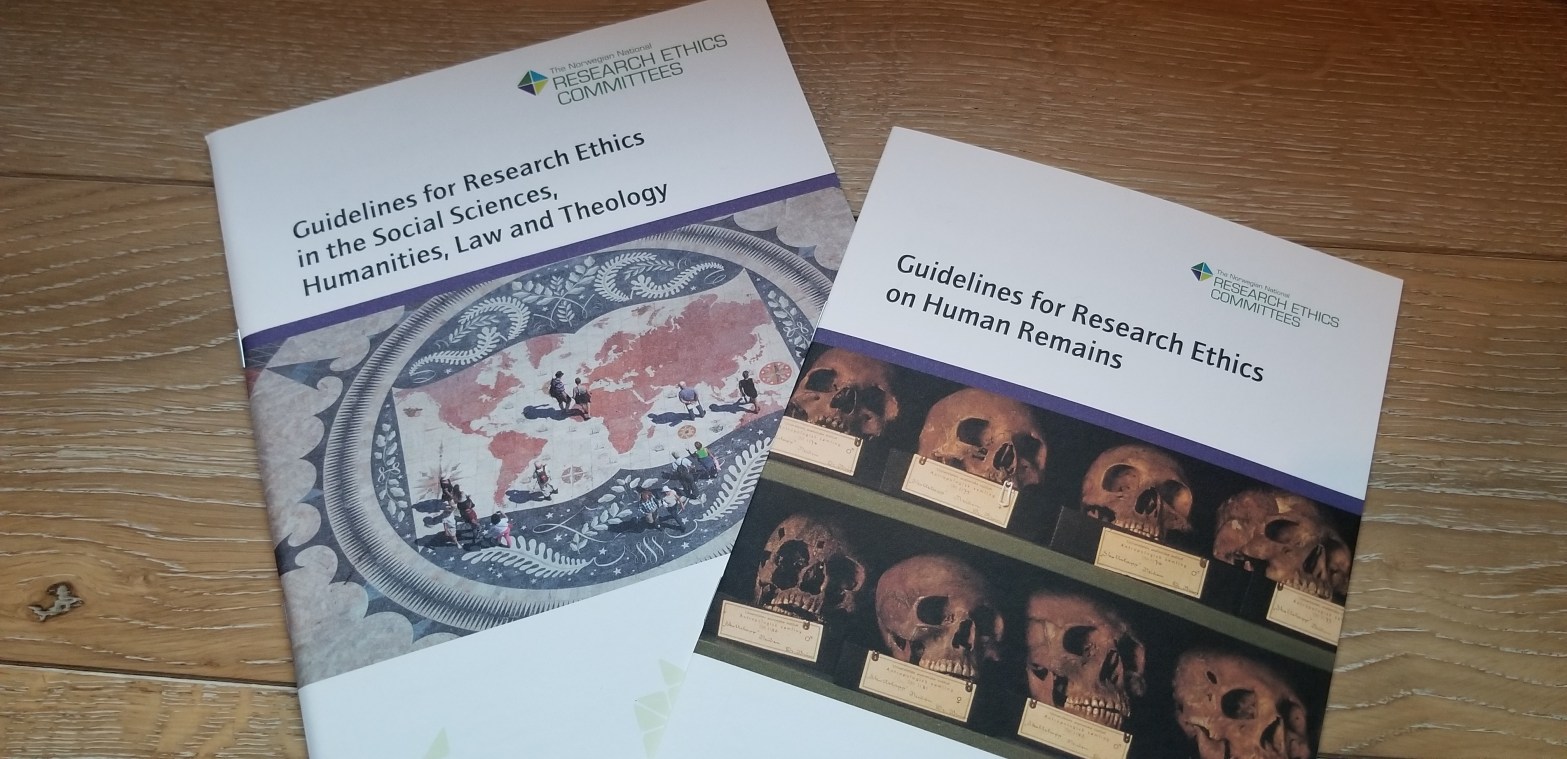
Several interesting papers brought perspectives to the issue and some raised complex and interesting questions. Reports about productive and successful repatriations from the National Museum of Finland to Mesa Verde in 2020 (presented by Director General Elina Antitila), and from the Swedish History Museum to Lycksele (presented by Adriana Aurelius, PhD student at Umeå University) in 2019, provided good examples of how the practice of repatriation – both international and national – is becoming embraced by Scandinavian museums. As practical support for this process, many attendants referred to international and national guidelines and recommendations as having been central in guiding the process. Kicki Eldh and Gabriella Ericson at the Swedish National Heritage Board presented the work of developing such support documents for Swedish Museums.
But there is diversity in how the issues is being broached in different Scandinavian countries. Ina H. Tegen, PhD student at Aarhus University presented her work on the issue of repatriation from a Danish perspective, where the archaeological and museum communities so far have been less willing to embrace the process, and where decision making regarding archaeological remains in general, including human remains, tends to be very decentralized and relies on individual decision making. At the same time, archaeology has a very high profile in Denmark, engaging multiple constituencies – also outside of the academy. She introduced the concept “embedded stakeholders” in her ongoing work to map attitudes and connections across this complex web.
Other papers sought to problematize the practice beyond the straight forward story and push the boundaries. Asgeir Svestad‘s (The Arctic University in Norway, UiT) paper on the fraught repatriation and reburials of Sámi remains at Neiden and Skjellevik, both in Norway, raised questions about the control of the process and the role of the Church in the reburial of people that predate Christianity. Jonny Geber (University of Edinburgh) presented the complicated case of Maria Grann, a woman who died in her late 20s, probably of tuberculosis, at a hospital in Lund in the 1860s. The few notes that remain of her indicate that she was poor and did not have any relatives in the area. She is described as a “Lapp Woman” or “Lapp Girl” from Lycksele. Most of her body was probably buried in the general area for unclaimed patients, but her cranium was collected to become incorporated in the anatomical collection of the university. It is now at the Lund University History Museum. Despite efforts to establish her identity it has not been possible to trace her history back to the Lycksele area or to a Sámi heritage, and even if there has been some pressure from the media, there is no current claim for her remains to be repatriated. The case, showed both how difficult and heartbreaking provenience research can be, but also how much direct engagement between researchers and descendant communities means to build trust and relationships.
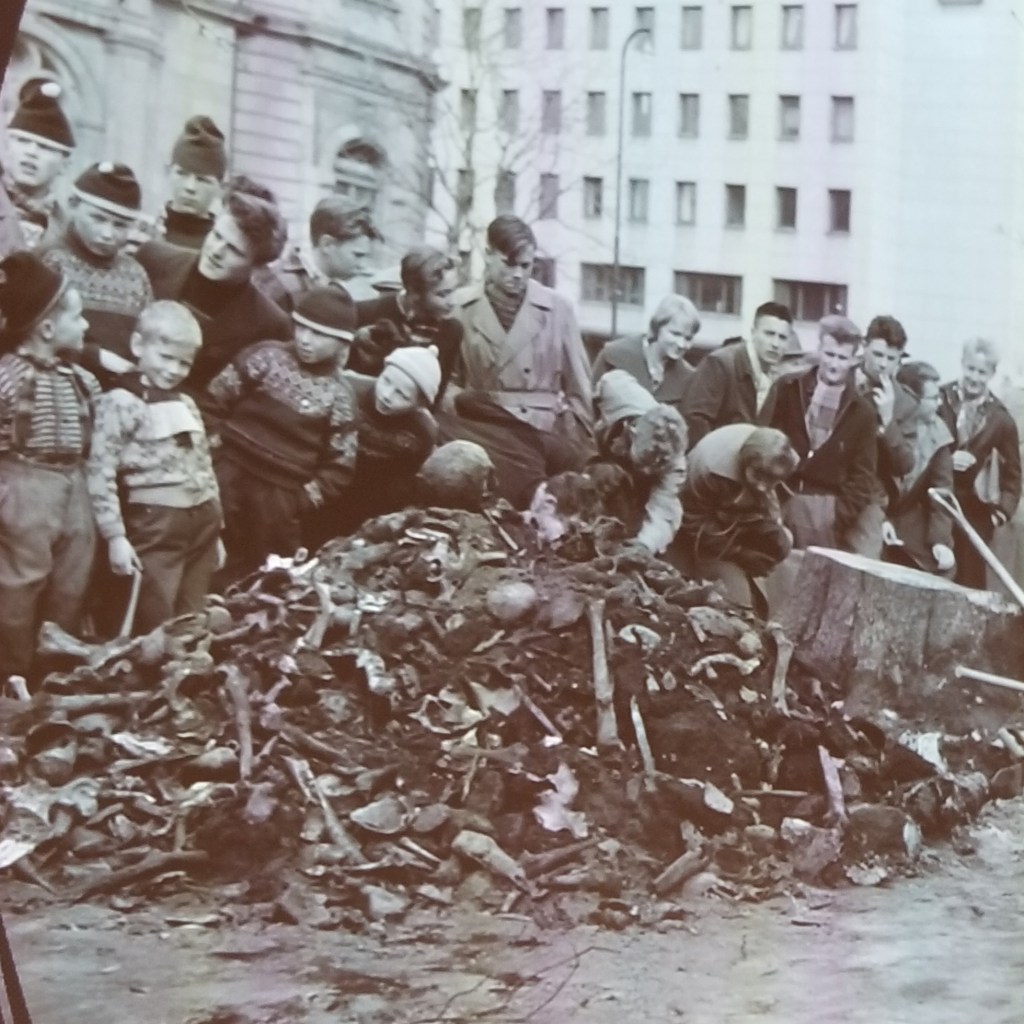
Image from an urban excavation in Norway in the 1950s. When human remains younger than 1537 are not protected by law, can we avoid this kind of unethical handing in urban excavations? Slide from the presentation by Nina Elisabeth Valstrand and Monica Nordanger Enehaug.
Other ethical dimensions of the excavation and curation of human remains were discussed from various angles. Nina Elisabeth Valstrand and Monica Nordanger Enehaug, PhD students from the Norwegian University of Science and Technology discussed how the Norwegian Cultural Heritage Act only protects materials that are older than 1537, often resulting in more careless handling of younger finds, including human remains. This, they argued, is both ethically problematic and a scientific loss since bio-archaeological research on these kinds of remains holds the key to unlock osteo-biographies of the past allowing us to better understand the lived experience of past peoples. Angeli Lefkaditou (researcher at the University of Oslo) discussed the ethics of museum displays of human remains through the case of “Maren i Myra,” an unknown woman who died in the 19th century and whose body, preserved in adipocere, has become a museal curiosity still exhibited at the National Museum of Science and Technology in Oslo.
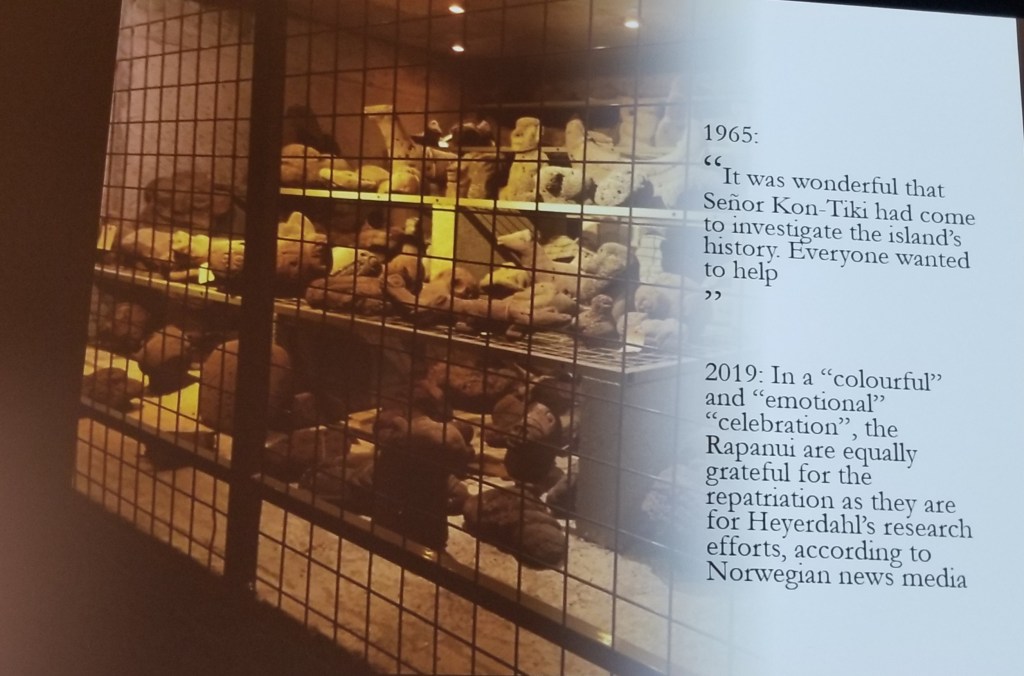
Finally the paper by Josephine Munch Rasmussen (post doc at the University of Agder) and Vibeke M. Viestad (postdoc at the University of Oslo) problematized the process of repatriation from the Kon Tiki Museum in Oslo. Their study highlights the intricate political dimensions of the creation of Heyerdahl as a national Norwegian hero and “creator” of Rapa Nui heritage and history – an image that persists despite the postcolonial critique of the assumption and despite the evidence of ethically questionable collection practices – and the current agenda to “decolonize the museum” though agreements with the Chilean state, not the descending communities in Rapa Nui. The study shows how the legacy of a problematic collector can live on to the point of becoming an absent present curator even beyond his death. This paper took us to the heart of both why repatriation matters, and why it is important that it is done right. The study has been published in the Journal of Critical Arts.
In their presentation, Josephine Much Rasmussen and Vibeke M. Viestad demonstrated the continued creation in the national discourse of Heyerdahl as a Norwegian National hero and as the creator of Rapa Nui history and heritage.
The seminar was very rich and stimulating. It was positive to see such a thoughtful debate, and also to witness the many ways in which Scandinavian museums and the heritage sector more broadly are entering into an era of engagement with descendant communities through repatriation.
The seminar left me with many insights, but also a few questions. Is it possible that the general embracing of repatriation also can hold new challenges? When a social or activist movement gains ground and becomes mainstream, it runs the risk of becoming appropriated. For the future we must make sure that repatriation does not become a performance carried out by by museums to promote themselves as socially conscious. I must underline that I have not yet seen any evidence for this. The progress made thus far is important, and this potential risk should not be used to question repatriation per se, but rather be viewed as a small concern that we need to keep in mind as we support the process going forward.
On August 20, 2021, The Tucker Law Group published its independent report The Odyssey of the MOVE Remains on the handling of the human remains recovered from the MOVE bombing site in 1985 that eventually resurfaced in an online anthropology course at Princeton decades later and caused outrage and protest in the spring of 2021 (for more on the background and recent developments please read this previous post). Five days later the Penn Museum published the key findings on its webpage under the heading Towards a Respectful Resolution. The report can be read to assess blame and responsibility, but I find it even more interesting as a documentation of the complex, unregulated, and muddled grey areas of professional (and sometimes unreflected) practice, law, and ethics that sometimes occur in the handling of human remains in museums and research.
The report establishes that the human remains ended up in the Penn Museum in 1986 after anthropologist Dr Alan Mann was contacted, as a private consultant, by the Medical Examiners Office in Philadelphia to help settle a difference of opinion concerning the estimated age of the fragmented remains of two individuals, one named B-1 and the other Body G. The efforts of identification were inconclusive, especially regarding B-1. Three of the experts who had studied the bones estimated the age to be 14, which was the age of Katricia Africa at the time of the bombing, while others, including Mann, his then graduate student Janet Monge, and the Medical Examiner, concluded that the remains were those of an older individual, and therefore could not be attributed to Katricia Africa. There was also some debate over the age estimation of Body G, but in the end it was attributed to Delisha Africa aged 12 at the time of her death, and the remains were released to her family for burial in September 1986. The remains of B-1, were considered by Mann and Monge to be unidentified and were therefore never returned to the MOVE community. Instead they came to be curated as a semi-private possession in the heart of a museum.
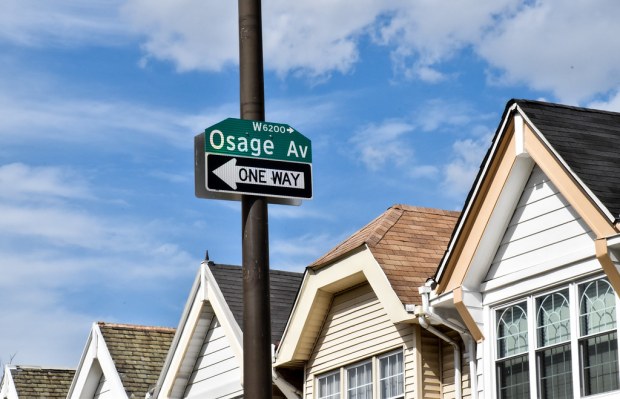
Osage Avenue in Philadephia, the site of the MOVE bombing in 1985. Photo credit banner: “Community dedicates plaque of MOVE bombing” by joepiette2 is licensed with CC BY-NC-SA 2.0. To view a copy of this license, visit https://creativecommons.org/licenses/by-nc-sa/2.0/
After the first examination in 1986, no further tests were carried out by Mann on individual B-1. The remains were left in storage in his office until 2001 when he moved to a new position at Princeton. This is an interesting detail. It is important to note that the remains never were added to the museum collections – but remained in the office space of Dr Mann. To understand this we must remember that the remains came to him in the capacity of private consultant, not museum curator. This is a key piece of information, because it shows that the museum never formally acquired these remains, even if they existed on its premises. This may explain why their exact location was unknown by the Penn Museum Spokesperson in April 2021 who, at the time suggested that they may have been transferred to Princeton. This turned out to be incorrect. In 2001 the remains were transfered from Mann’s office to a file cabinet in Dr. Monge’s office, now the Curator-in-Charge of the Physical Anthropology section at the Penn Museum. In 2014 they were stored in Monge’s lab at the museum.
The relationship between the remains, and the museum, curators, and university, remains remarkably undefined in the following years. The fragments were stored in the offices and lab of the curators, which were located in the museum, but they were never officially accessioned to the museum collections. However, while not formally part of the museum collections, they were, in fact, often treated as if they were. They were occasionally displayed (albeit never as a part of the public museum exhibitions), and used for teaching purposes. In the decades that followed Mann’s departure from Penn, the remains were displayed by Monge “on ten separate occasions,” and notably in 2015 during a meeting of Museum donors. Monge also occasionally showed the remains to colleagues to get their opinion about the age estimation. This indicates that she might have been unsure about her and Mann’s original assessment, or at least wanted additional confirmation. The remains were also used to train students (including in the now infamous Princeton Coursera video, but also in student research projects, and examinations). In 1998, for example, they were included in a diplomate exam for the Society of Forensic Anthropologists where the takers of the exam were asked to estimate the age of the remains. In 2018-19 a student under the supervision of Dr Monge, wrote a senior paper on the MOVE remains, a study that included x-rays of the bones. The paper is focused on B-1, but also includes references and an x-ray of what the student at the time of writing the paper identifies as the occipital bone of Body G (i.e. Delisha Africa), remains that allegedly would have been returned to the family and buried in 1986. It is unclear whether or not this identification is correct, but, of course that kind of lack of clarity is in itself troubling. The report outlines issues in the handling of the human remains including the lack of systematic labelling, and even accounts of a student taking remains home with him. This might explain why there might be some confusion about the identity of some bone fragments in the labs.
On two occasions, in 1995 and in 2014, attempts were made on behalf of Monge to communicate with members of the MOVE group “to enlist their help in identifying the remains and, if they did belong to Katricia, return them to her mother, Consuewella Africa.” These efforts were unsuccessful. According to the report, the family members refused to assist her. It was only after the story about the use of these remains in an online course broke in Billypenn on April 21, 2021 that the remains were relocated and transferred to a West Philadelphia funeral home. According to the report, the Deputy Director of the Museum, Dr. Stephen Tinney, instructed Monge to hand over the remains to Mann, who in turn, at the request of the University, handed them over to a funeral director. The remains were picked up in a hearse from Mann’s home on April 30th, 2021. This performance of transfer of ownership was no doubt arranged by the museum to clearly signal that it never had formal custody of the remains, and that the responsibility of receiving them must be shouldered by Mann. The remains were finally returned to the Africa family on July 2, 2021.
The handling of the remains in this case reveals interesting insights into the grey areas that sometimes still loom over research and museum practices when it comes to human remains.
The handling of the remains in this case revelas interesting insights into the grey areas that sometimes still loom over research and museum practices when it comes to human remains, and the close examination of this case revelas significant contradictions between practice, policy and decision making.
The remains were never accessioned to the museum, which means that they were never the museum’s responsibility to validate, catalogue, store, and make available to research and the public. According to the report this never happened because according to Mann and Monge, the goal ultimately was to return them to the Africa family. This is puzzling to me for two reasons. First it is unclear why the museum would want to accept such a problematic donation in the first place, and second, because the reason they initially were withheld was because the Medical Examiner, Mann, and Monge concluded that the remains could not be attributed to Katricia Africa because of their age estimation. While the museum never formally accepted the bones, they remained within its walls. In the report it is stated that the curators felt OK with this because they were stored in safe conditions. Yet, the report points out, that the curators seem to not have had complete control of what happened to the bones. Mann is quoted saying: “I do not specifically recall, apart from the re-examining the bone fragments, what we did with the fragments after we secured them at the Penn Museum.” Had the bones been subject to a clear process of accession, they may in fact have recieved better protection. In 2017 the museum drafted a policy “addressing the use and display of the accessioned human remains in the Museum’s collection”. However, these guidelines to not concern unaccessioned remains like those of B-1, a category that according to the former Director of the Penn Museum, Julian Siggers, may be quite common in University museums across the US.
What we have here is an interesting unregulated grey area. Both the current and previous directors of the Museum were aware of the presence of the MOVE bones, but did not think that their presence or use violated any museum policies. In fact, because they were never accessioned, they did not fall under the guidelines of the Institute of Museum Ethics on the treatment of human remains or the American Alliance of Museum’s Code of Ethics section on Collections. When reviewing case law and statutes concerning liability for the mishandling of human remains, the report also concludes that the case falls through the legal cracks, “because statutes or holding by their terms the requisite states of mind required for liability were not present, or the statutes of limitations had run on any potential claims.” The case is further complicated by the fact that as long as the bones remain unidentified, it is difficult to identify the proper claimant. In the end, what we are left with are ethical professional guidelines.
In the end the report states that it is not possible to conclude that the actions taken by Mann and Monge were “unethical as such.” It reprimands them for their “cavalier” treatment of the remains and for displaying “extremely poor judgment and gross insensitivity to the moral, social, and political implications of their conduct.” Their actions were, the report states “inconsistent with the implied overarching principle of the respectful treatment of human remains.” But they never broke the law.
While not illegal – and formally not unethical – the whole ordeal is upsetting. It clearly illustrates the vast grey areas that still exist in the field of research ethics when it comes to human remains. As researchers and institutions become increasingly aware of their ethical responsibilities, the field will need better practices and guidelines to prevent this kind of behaviour in the future. In the end, it does not only hurt stakeholders, it damages the reputation of biological anthropology and undermines our credibility as researchers.
Last week Princeton University and the University of Pennsylvania both released apologies for their “insensitive, unprofessional and unacceptable” treatment of the bones belonging to an unidentified African American child who had perished in the flames of the MOVE bombing in Philadelphia in 1985. The apology refers to the use of charred remains of the child’s pelvis and femora in an online anthropology course entitled Real Bones: Adventures in Forensic Anthropology offered by Princeton University. The story was reported in an article in Billypenn, and also discussed in a Philadelphia Inquirer Op-ed, both published on April 21, 2021. The apology came only weeks after the release of a report that outlines a shift in the policy at the Penn Museum to repatriate African American remains from the infamous Morton collection. While the ethical challenges of the Morton collection (which was built and used to support a polygenist racist ideology) was well known, the debate about it reached a tipping point in the summer of 2020, as the world was protesting structural racism and the police violence that had killed George Floyd. The new direction taken by the museum signalled a desire to build better relationships with the local African American community and make amends for its problematic heritage. In the light of these progressive steps, the story about the bones from the MOVE bombings was shocking, and it seems to indicate just how much work the scientific community still has left to do.
In the 1980s, The Philadelphia Police Department was engaged in a lingering conflict with the revolutionary black military separatist group MOVE, who lived in a communal row house on Osage Ave in West Philadelphia. On May 13th, 1985, a final and violent standoff ended with the police dropping a bomb on the house. 11 people died in the ensuing fire. Five of them were children. The Philadelphia Fire Department deliberately held back their response, and as a consequence the fire spread to engulf two city blocks, and over 60 homes were completely destroyed. Pictures from the blast reveal what looks like a war zone, and the attack has left a deep wound in Philadelphia’s African American community. In 2021, 36 years later, bones recovered from the MOVE house, and suspected to be those of 14 year old Katricia “Tree” Africa, resurface in an online anthropology class at Princeton. How is that possible?
When examining the chain of custody of the remains, several things stand out as problematic. The bones arrived to Penn already in 1985 when the Philadelphia Medical Examiner’s Office asked anthropologists there to assist in their identification. The Medical Examiner’s Office wanted to know if the bones, recovered from the burned out MOVE house, could be the remains of Katricia Africa. The analysis was inconclusive. So far so good. It is common to seek out specialists for analysis, and it can be viewed as a service to the community at large. It is also to be expected that some specialist analyses are inconclusive. It is what happens next, or rather what does not happen, that is strange. The remains were never returned to the Medical Examiner’s Office once the analysis was terminated, but remained in the museum. Museums are often custodians of human remains from archaeological and historical contexts, some of them admittedly controversial or problematic. This is a well known and complex issue. Museums have a responsibility to curate and make these collections available for researchers and to the public, and many of them are currently grappling with the ethical considerations this responsibility entails. However, it is very unusual that contemporary specimens are incorporated into such collections, and certainly not without the explicit consent of the donor or their descendants. It is not the museums’ responsibility to accept to curate remains from local law enforcement, and usually, unidentified remains are cremated. Is it possible that the bones from the MOVE house were simply forgotten? Did they get lost in the chain of custody? Is this a case of neglect and poor procedure? Beyond questions of responsibility and professionalism, we must also ask how is it possible that the remains were not viewed as deeply problematic at the time? Even if it may have been difficult to locate surviving relatives, it is especially hard to understand how the anthropologists working in a museum in a city recovering from such a traumatic event did not make the connection between the remains and the needs of the community. That is troubling.
Then, somewhere along the way, things get even more complicated: the location of the bones becomes unclear. In her article in Billypenn, Maya Kassutto writes:
“For decades, the bones were kept at the University of Pennsylvania Museum of Archaeology and Anthropology. A Penn Museum spokesperson said the remains have since been transferred to the care of researchers at Princeton — but an administrator at the New Jersey university was uncertain of their whereabouts. After this story published, a spokesperson said Princeton does not have them.“
Could it be that a researcher simply took the remains from one place of employment to another? Here, it is difficult to shake the feeling that these practices are not very different from those of anthropologists in the 19th century who viewed scientific collections as their private property.
Kassutto continues:
“Princeton Anthropology Department Chair Carolyn Rouse wasn’t sure of the remains’ current location. Reached by phone, she said they might be in a lab run by Alan Mann, the now-retired professor who had been studying them with Janet Monge, curator of Penn Museum’s physical anthropology section.”
A lot has happened in the 36 years that have passed. Ethical standards, recommendations, and experiences with different perspectives have pushed anthropology to examine itself and develop more ethical practices and attitudes. Seen in that light, it is even more surprising that the remains of this unidentified child, violently killed by the police in Philadelphia in 1985, could be used in an online course that, according to its description, explicitly focuses on lost personhood (cases where remains cannot be identified due to their condition). What is so striking about this is the combination of a choice of words such as personhood, which signals an awareness of contemporary anthropological research questions and sensibilities, with such a casual neglect for the lived life of the human being that is represented by those very remains. It is difficult to imagine a case that more clearly, not only objectifies, but even dehumanises the remains of a child.
Ruth Benedict famously stated: “The purpose of anthropology is to make the world safe for human difference.” With those words in mind, it is discouraging to realise that anthropology still so often remains incapable of reforming itself from within and leading the charge against racism and structural violence, but instead only reacts to external pressure when the public lifts up the curtain to expose our dirty laundry. This must prompt us to take action and examine our practices and ethics at every juncture. It is not certain that the discipline will survive many more of these omissions, missteps and scandals.
You see, the thing about real bones is that they once were living people. If we want to continue to have the privilege of studying them, we must learn to respect them and those who care about them.
Photo credit banner: “Community dedicates plaque of MOVE bombing” by joepiette2 is licensed with CC BY-NC-SA 2.0. To view a copy of this license, visit https://creativecommons.org/licenses/by-nc-sa/2.0/
While the main focus of the seminar was on Rapa Nui, the heritage of Nordic colonialism was present as an important backdrop to the discussion, a reminder to Swedish scholars working with repatriation that there is no “Nordic exceptionalism” when it comes to colonial history, and the Nordic countries were a part of these global processses in all their various forms. Ulrika Persson-Fischier (Uppsala University) used her study of the crania collected by Nordenskiöld’s Vega Expedition to discuss the challenges of working with old colonial records when trying to establish “provenience.” She pointed out the paradox that despite good intentions, we risk reproducing colonial ideologies through the practice of repatriation if we use old records and categorisations. Mikael Jacobsson from the Lycksele Museum of Forestry shared his experiences of the repatriation and reburial of crania collected in from an old cemetery in Sápmi in the 1950s and returned for reburial in 2019. He showed moving images of the ceremony and discussed the difficulty in getting museums to really understand that human remains are not just archaeological and historical artefacts. Finally, the agreement to repatriate thousands of objects and human remains from the Kon Tiki Museum in Oslo, collected by Thor Heyerdahl and his team during his travels in the Pacific in the 1950s and 1980s, provided an immediate connection to the main focus of the webinar – the experiences of the repatriation of human remains to Rapa Nui.
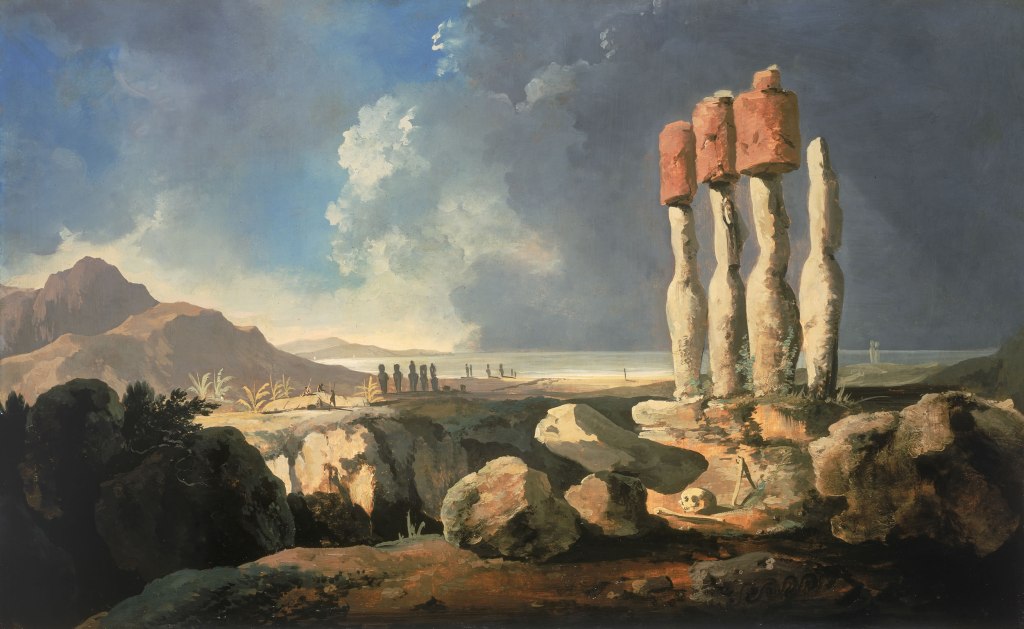
A View of the Monuments of Easter Island, Rapanui, c. 1775-1776 by William Hodges. Public Domain
Rapa Nui constitutes an interesting example to discuss repatriation. It is caught in complex layers of colonialism and relationships to the state of Chile. Known more widely by the name “Easter Island,” a name given by the Dutch explorer Jacob Roggeween who accidentally “discovered” the island on Easter Sunday in 1722, the island is wrapped up in colonial history. In the decades that followed Roggeween’s short visit, several other expeditions landed on its shores, marking the beginning of a deep and painful colonial history including disease, structural violence, black birding, slave trade, and exploitation. The island was annexed to Chile in 1888. It holds the status of special territory since 2007, but the relationship to the Chilean state has not been without conflict.
From a cultural heritage point of view Rapa Nui is renowned for its monumental Moai, the sculptural heads that line its shores as “the living faces of deified ancestors.” But beyond these striking sculptures, the island is the home of an impressive cultural and archaeological heritage of monumental architecture, petroglyphs, and wood carvings that all can be traced back to the indigenous Rapa Nui. Given its painful history with colonialism, it is not surprising that calls for repatriation of both cultural objects and human remains play an important role in current debates, with the most highlighted example being the call to repatriate the Moai called Hoa Hakananai (lost or stolen friend) from the British Museum. In the process Chile has become a powerful player. Under Chilean law, the Moai are not regarded simply as art or artefacts, but deemed an “integral part of the land”, and in 2017 the control over them, along with other archaeological sites, was symbolically handed over, from the Chilean National Forest Corporation to the Rapa Nui by President Michelle Bachelet.
At the webinar, we would hear several voices engaged in the movement for the recognition of the right of Rapa Nui to gain control of their heritage including the human remains of their ancestors deposited in museums all over the world. Biological Anthropologist Associate Professor Felipe Martinez (Pontifica Universidad de Católica de Chile) discussed the importance of viewing human remains, not only as biological specimens but also as a part of cultural heritage, and stressed the need for a developed legal framework that recognises the rights of indigenous people in this context. Dr Jacinta Arthur (Pontificia Universidad de Católica de Chile), who has worked as the coordinator for the repatriation program in Rapa Nui, introduced the concept of patrimonialization of indigenous culture to the discussion, and discussed how legal instruments can protect cultural heritage for the nation without considering the needs of the indigenous communities to which it belongs.
This becomes especially interesting when unpacking the complexities of international repatriations of indigenous human remains and heritage. Who does this belong to? To where should it be repatriated? Who decides on the future of these remains? Here the relationship between the descending community, be it a majority population, a minority population, or an indigenous population, becomes central. As nation states come to agreements, the opportunities for descending communities may look very different depending on their relationship to the nation state that may or may not recognise their right to control their cultural heritage. Here the issues raised by both Dr Jacinta Arthur and Ulrika Persson-Fishcier (albeit in a different context) come back into focus.
“We are the heart, you are the brain”
These issues are without a doubt complex and difficult. What is the way forward? Curator Sr. Mario Tuki (Museo Antropologico Padre Sebastian Englert MAPSE Rapa Nui Repatriation Program Ka Haka Hoki Mai te Mana Tupuna and Hare Tapu Tu’u Ivi) offered a pathway. In his presentation and in the discussion, he stressed not only the importance of collaboration between scientists and indigenous communities, but also the importance of academic actors to recognise the emotional dimension of the process. Indigenous communities, with a lived experience of trauma from a violent colonial history, will bring a consideration for this emotional dimension. This should not be seen as a complication, but as an asset in the work toward mutual learning and understanding. Academics, on the other hand, will bring a problematizing and intellectual approach to the situation. We need both. “We are the heart, you are the brain,” he declared, proposing a wonderful metaphor for all of us who are seeking a productive way forward. Recognising that both the heart and the brain are vital organs, and that they sustain each other, Mario Tuki’s words leave me inspired and humbled.
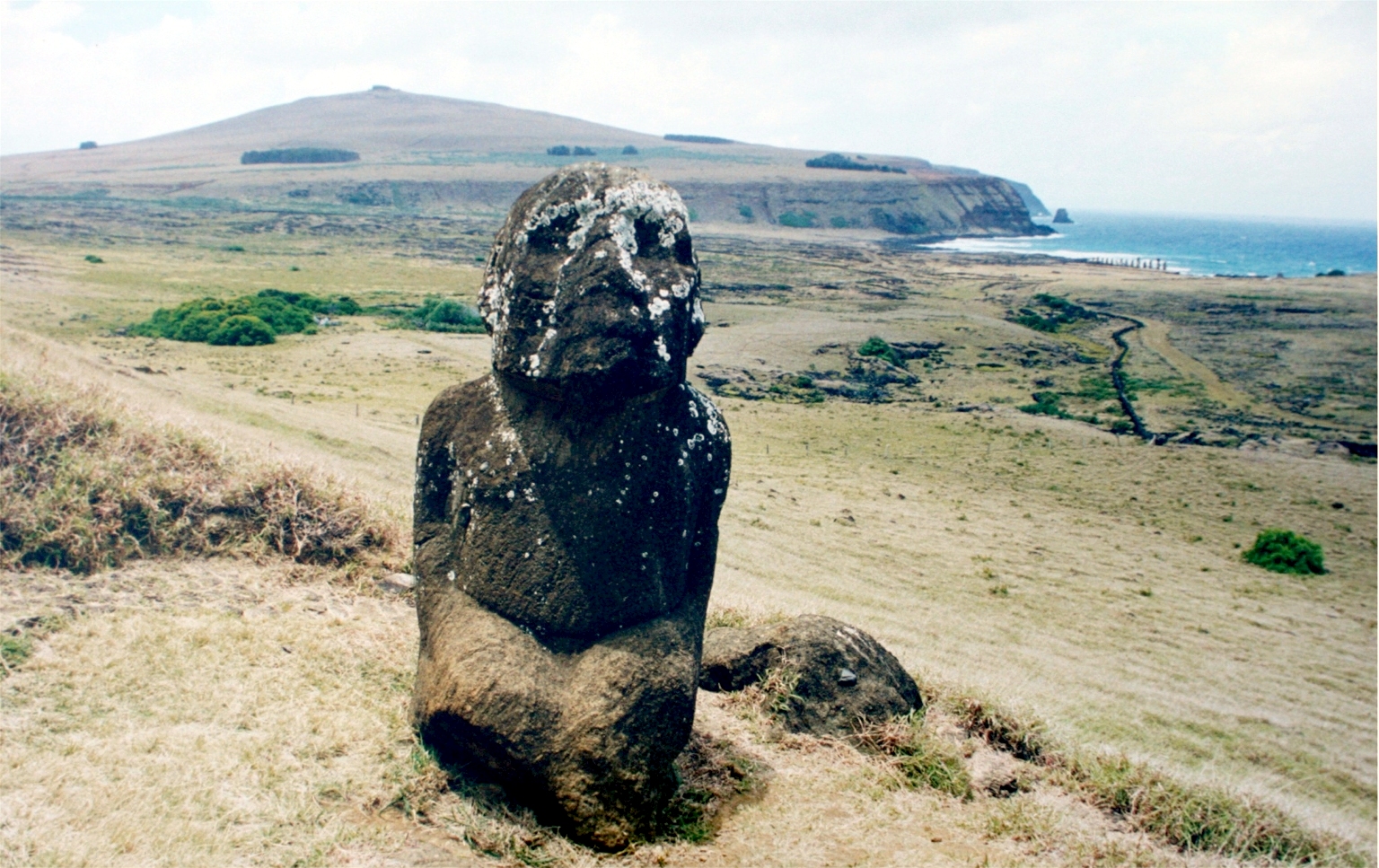
image credit banner: Tukuturi, Brocken Inaglory, CC BY-SA3.0



 Ethical Entanglements