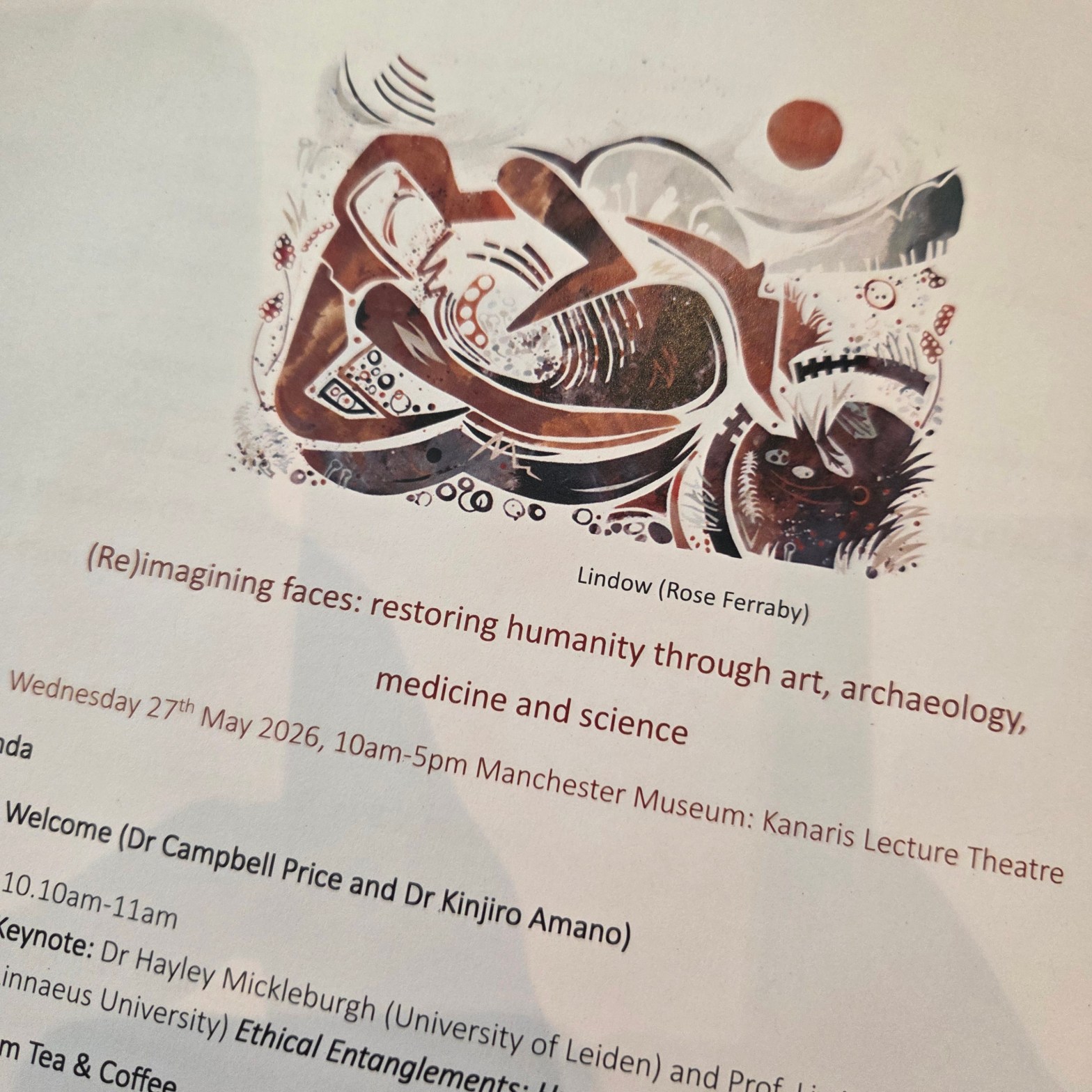
On May 27th, 2026, Hayley Mickleburgh and I attended a workshop at the Manchester Museum called (Re)imagining faces: restoring humanity through art, archaeology, medicine and science. The workshop was hosted by ‘Multifaceted. Interdisciplinary research seminars on the human face’ at the University of Manchester, organised by its Research Institute’s (UMRI) flagship interdisciplinary seminar series, and at the invitation of professor of Archaeology Melanie Giles.
The workshop united researchers from across several disciplines including archaeology, forensic science, egyptology, history, philosophy, and medicine.
Together we were invited to give a keynote lecture on the role of facial reconstructions in moving human remains along the spectrum between ‘objects of science’ and ‘lived lives.’ The model is a fundamental theoretical outcome of the Ethical Entanglements project, and we are now able to use it to both describe the complexity of human remains, and to analyse research and communication strategies, including the making and use of facial reconstructions. In addition to outlining the model we discussed more in detail how facial reconstructions move human remains toward the lived life end of the spectrum to evoke empathy, allowing for now living people to connect to a person in the past. As a case study, Hayley Mickleburgh presented her work with the skeletal remains of girls from the Maagdenhuis orphanage (Amsterdam, 1570-1952) and how facial reconstructions can be used in a pedagogical game to activate ethical reflexivity and increase ethical competence among students and professionals. But, at the same time, we argued, given that the face is so connected to our identity and so central in inter-personal communication and relationships, facial reconstructions can also be transgressive. How we make, use, and circulate them is a new frontier for ethical consideration.
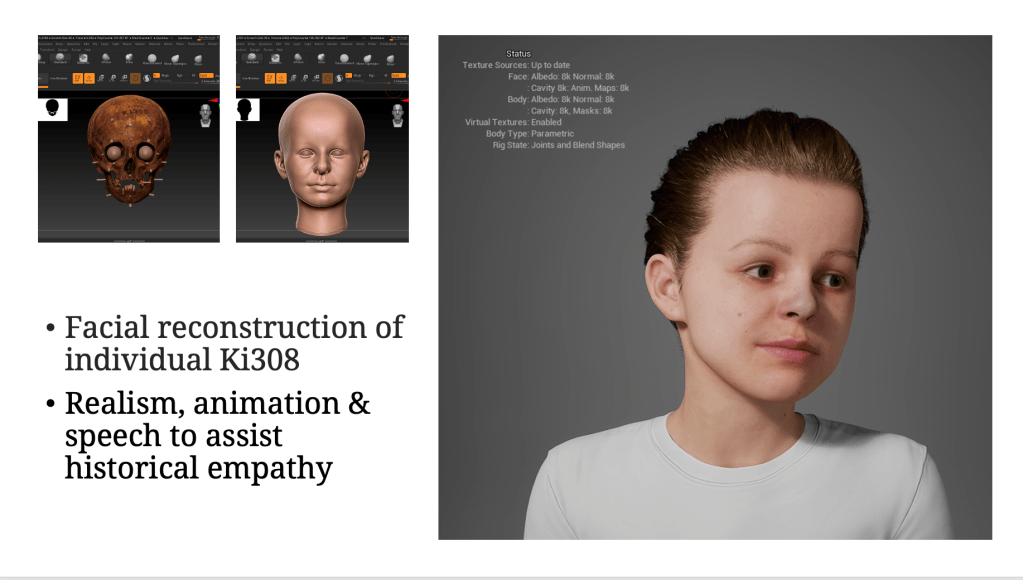
Slide and images: Hayley Mickleburgh.
Similar questions were raised in the paper by Prof. Caroline Wilkinson (Liverpool John Moores University) presented by Mark Roughley (Face Lab, Liverpool John Moores University): Presenting faces from the past: from clay models to speaking digital avatars. The paper showed the development of facial reconstructions to highlight the ethical, practical and heritage affordances of this rapidly changing field. Dr Scott Midson (University of Manchester) pushed the potential boundaries even further in his paper Face/off: Self-Identity and Robot Doppelgängers on social humanoid robots. Departing from Emmanuel Levinas ethics based on the face of the other he focused on the uncanniness of robot doppelgängers, and reflected on the ‘otherness’ of robots and the significance of faces for identity and relationship in a digital context. Where, we must ask, will we be drawing lines as these technologies develop….or will we?
Two papers discussed the centrality of the face in our connection with individuals from pharaonic Egypt. Dr Campbell Price (Manchester Museum) presented a paper on Manchester Museum’s “Two Brothers”: Modern reconstruction, ancient intentions. These two individuals, Khnum-nakht and Nakht-ankh, lived and died in Middle Egypt around 1850 BCE and are now cared for by the Manchester Museum. They were unwrapped in 1908 and were later subject to some the earliest facial reconstructions by Richard Neave using the famous Manchester Method developed in the 1970s. The method combines the muscle-based ‘Russian’ approach with the tissue-depth-marker ‘American’ approach and proceeds by building the face from the skull by modelling clay according to information gleaned from anthropological data. The paper problematised our contemporary interest in the individual face in contrast to the idealised face of the dead in pharaonic Egypt, that was rather a depiction of a god than an individual.
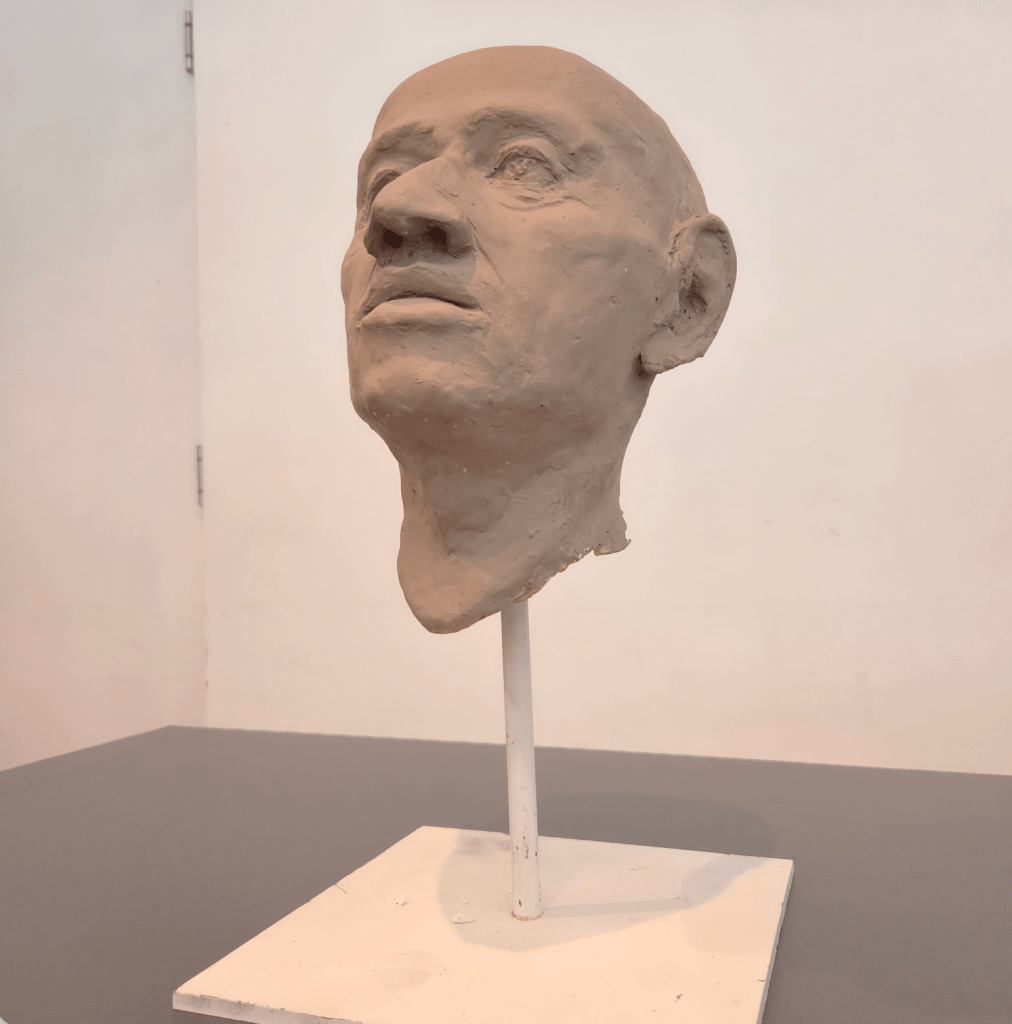
Photo: Liv Nilsson Stutz
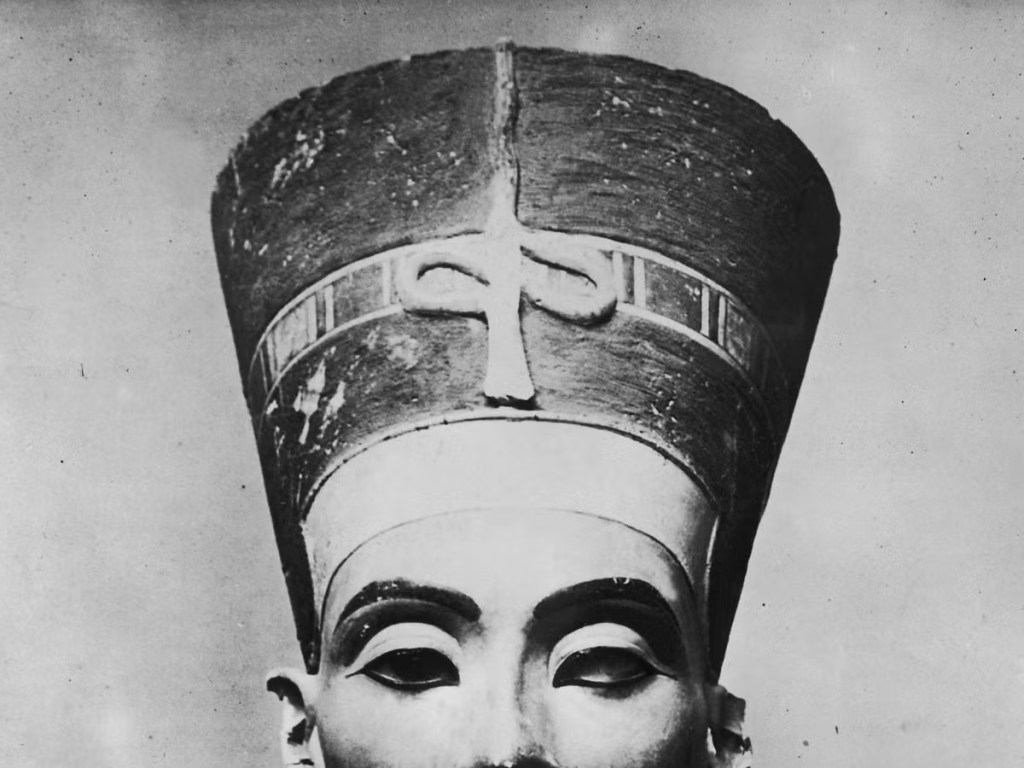
In her paper Nefertiti’s Face: The Creation of an Icon Dr Joyce Tyldesley (University of Manchester) discussed the contemporary fascination with the face of Nefertiti, immortalised by her famous lime stone bust recovered from an abandoned workshop in the royal city of Amarna. Her timeless beauty has long stirred our imagination to the point of obscuring the past, arguably at the expense of other women at the time, and of other representations of Nefertiti herself. The paper invited us to reflect on the fascination with female beauty and the risk of us ascribing status to it that perhaps says more about us and our 20th and 21st century culture, than it does about the past. I would even say that her bust has become a hyperreality sensu Baudrillard – taking the place of the actual Nefertiti, becoming more real than her. In this case we might see a spectrum that moves the lived life not to an object of science as much as to a contemporary imagination, fetishisation, and commodification – another form of objectification.
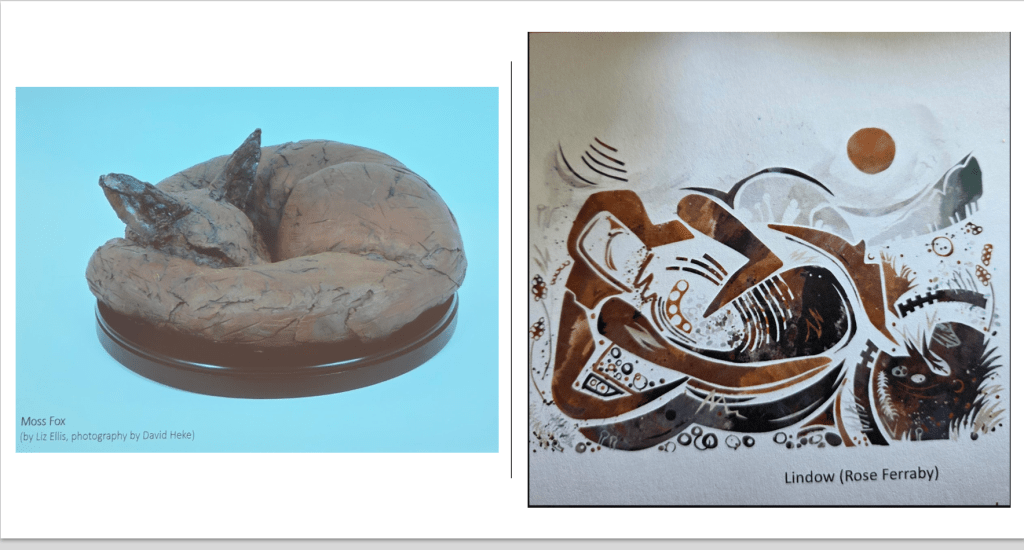
Prof. Melanie Giles (University of Manchester) invited us to look away from the face and consider other ways of connecting to past individuals that from a perspective of historical affect and connection can be as, or perhaps more effective than a facial reconstruction. When discussing Lindow and Worsley man who also have been central to the work by John Prag and Richard Neave, and the ‘Manchester method’ of archaeological facial reconstruction, she offered alternative pathways to connect through art that relates to the past individual as a complement including art highlighting the past person’s own choices. In her work with Lindow Man she collaborated with artist Liz Ellis to create connections through the presence of a fox fur amulet, and to the bog itself, where in the work by artist and archaeologist Rose Ferraby, Lindow Man and the bog seem entangled and connected. Both these projects decenter the human body, yet, in many ways, brings us closer to both the past and the man. The paper reminded us that while the face is a central entry point for us to feel connected to the past person, there are other, multi-dimensional pathways to the past that can connect us in more and perhaps even deeper ways.
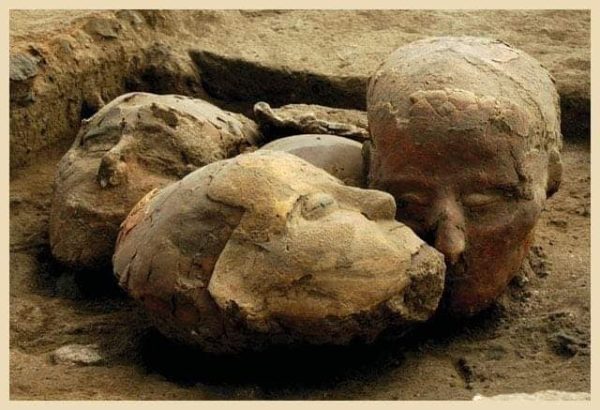
Prof. Karina Croucher (University of Bradford) presented her work on plastered skulls from Neolithic of Southwest Asia and proposed that the curation of the heads of the dead and the transformation of their faces might have been part of ritualised nurturing of ties with the dead, using the concept of ‘Continuing Bonds’. The paper centred the significance of the face for selfhood and invited us, yet again, to think about our positionality as researchers as we make decisions about facial reconstructions and how we use and share them. Because, the face really does seem to matter as demonstrated in the different examples from both the past and present. Dr Emily Cock (University of Cardiff) discussed the use of disfiguring punishments to consider the contested meanings of facial difference in early modern Britain. Prof. Marianne Aznar (Manchester Cancer Research) discussed the impact of cancer treatment in childhood on facial features, and how to manage and predict future developments in the face, and how survivors relate to them. Both these cases, as different as they are, all make us acutely aware of how much we care about the face. Our own and those of others.
All the papers in different ways explored the centrality of the face for how we relate to and communicate with others. The face concentrates so much of our interpersonal relationships. It is more than representation, it is relational and central to how we relate to others and in many ways also ourselves. For these reasons it makes sense that facial reconstructions become a way for us to see the humanity in the past which explains why facial reconstructions are so appreciated as both research tools and in public communication and pedagogy. Coming “face to face” with the past really does mean something. But to create such a face is a huge responsibility as it interacts and arguably “messes” with that significant interface between ourselves and others. The discussions about how to ethically act in that space is a significant professional challenge today and, increasingly in the future.
The workshop concluded with the reading of three poems by Dr Abbi Flint (University of Oxford). She uses a process called poetic transcription to approach the past and express “plural, affective, sensorial, and subjective dimensions of engagement.” Her work closed the workshop by further opening our emotional connectedness to the past and to human experience in the word, the past and the present. We were yet again reminded of the deeply human and more than human core of archaeology.


